Best Motion Graphics Agencies in 2026: 13 Studios Compared by Price, Style, and Fit
Motion graphics agencies design animated text, shapes, icons, and interfaces that explain an idea or move a brand. In a world where attention span is dropping every single day, resorting to these services for dynamic design elements is the only solution.
But even then, it is super important the quality of animation is good enough to bait a visitor.
According to 6sense's 2024 Buyer Experience Report, as cited by Broadcast2World, about 70% of the B2B buying journey is finished before a buyer contacts a seller. That means the first animation a buyer sees often does much of the selling.
That stat just made the importance of good motion design much more pressing. Problem is, how would you know which agency is specialized in offering these services? That is what we are trying to solve today with this listicle.
From our experience in this industry, we have shortlisted the top 13 motion design agencies you can explore to find your right fit. We have further broken them down into categories so you don’t need to put much time on research.
Here is what this guide covers:
- What is motion graphics agency
- How we shortlisted the agencies
- A comparison of 13 motion graphics agencies
- How to choose the right agency for your need
Best motion graphics agencies at a glance
This table lists all 13 agencies with what each is best for, so you can scan first and read the details after. Prices come from agency pages and directories, and the pricing section explains which numbers are estimates.
How we picked these motion graphics agencies
Each agency had to pass four tests, and the reason for each test is listed next to it.
- Named brand or tech work: The public portfolio shows motion for software, technology, or established brands, which proves the studio can handle a brief like yours.
- Range beyond one format: The studio shows brand systems, UI, 3D, or campaign motion, so you are not locked into a single style.
- A clear specialism: You can tell what the studio is best at from its work, which makes matching it to your project easier.
- Findable pricing or engagement model: A published price or a stated model, such as subscription or project, lets you compare options before booking calls.
We built each profile from the studio's public portfolio details as reported in directories and roundups published in 2026, and we reviewed the lists on November 16, 2026.
We have included ourselves because magier offers motion work too, through our design and Webflow subscription and through one-time projects. Each profile says who the agency fits best, including where another agency may suit you better than we do.
The 13 best motion graphics agencies in 2026
Each profile below follows the same order, covering an overview, key services, location, best for, and pricing, so you can compare agencies line by line. The agencies are grouped by the situation they suit.
Flagship brand and campaign studios
These four studios suit brands with a large budget, a long timeline, and a campaign that needs to feel like a film.
Buck
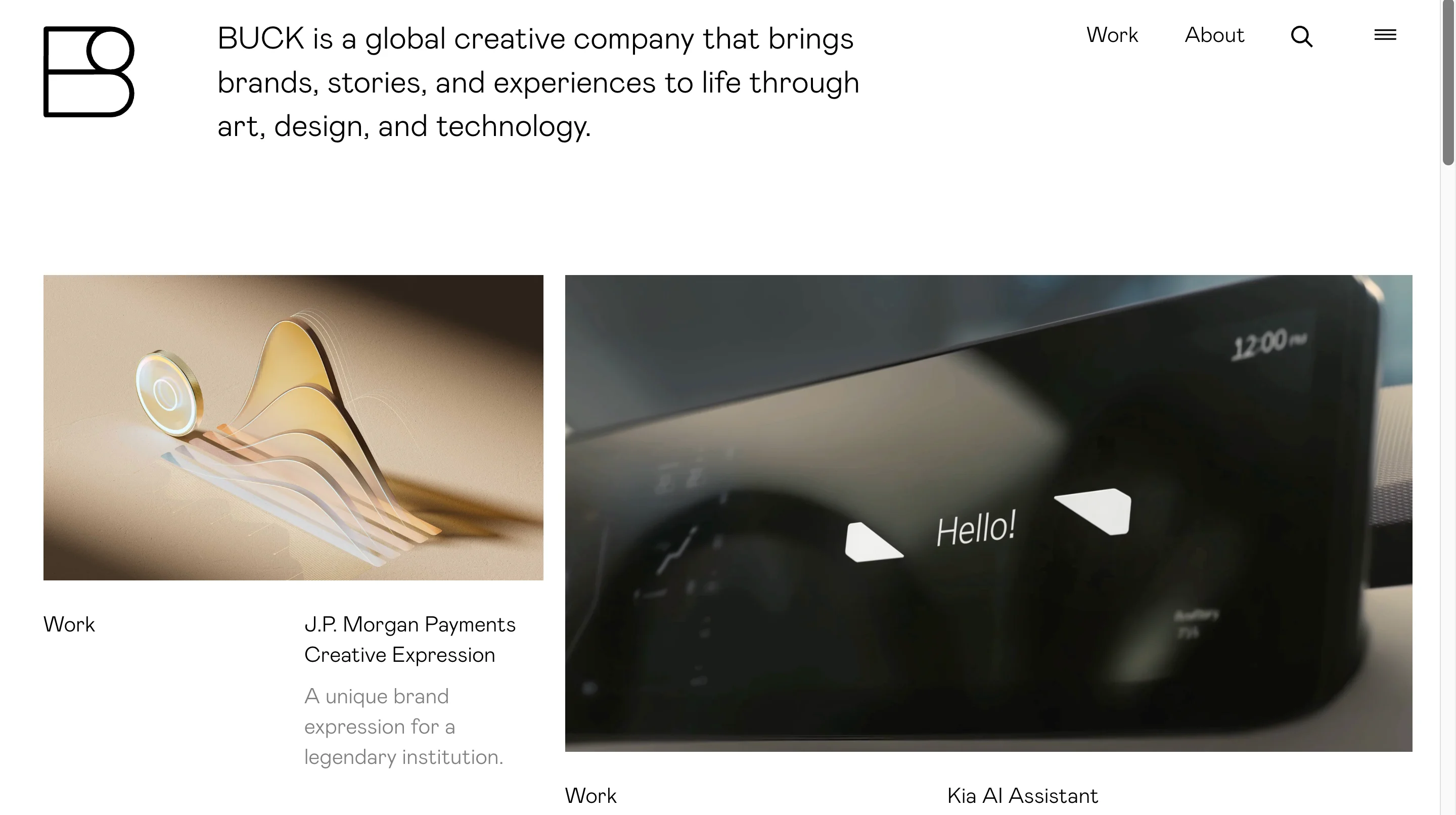
Buck is a global creative company founded in 2004 that makes 2D, 3D, character, and live-action work for large brands. Its tech work includes a character for the Notion AI Assistant, an identity for Kia's AI assistant, and a Year in Review for LinkedIn.
- Key services: 2D and 3D animation, character design, live action, branding, and motion systems.
- Location: Los Angeles, with studios in New York, London, Amsterdam, and Sydney.
- Best for: Tech and consumer brands that want an ambitious brand moment made by a large team.
- Pricing: Not published. Find Design Agency (2026) places Buck at $100,000 and above for multi-format campaigns.
ManvsMachine
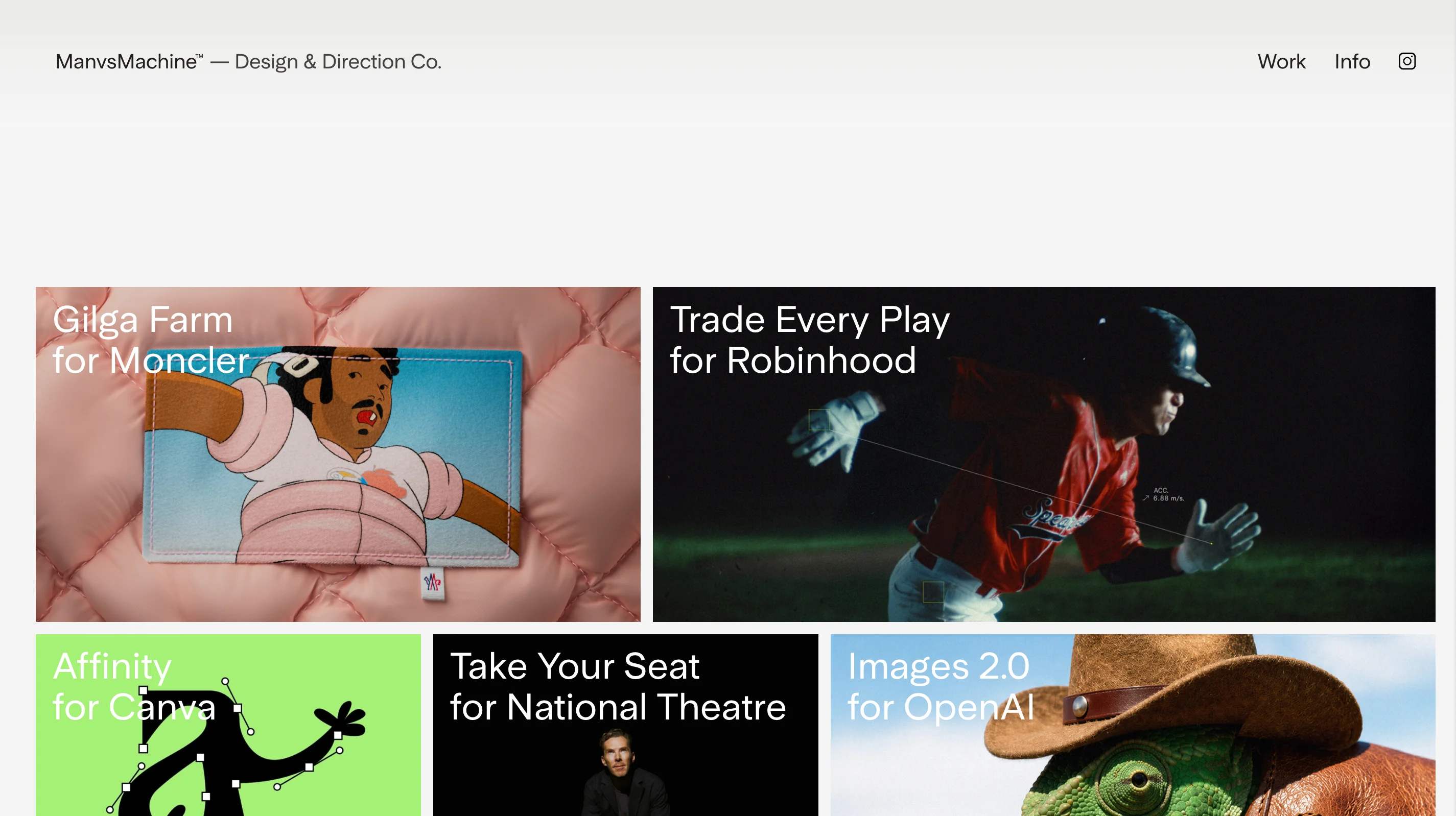
ManvsMachine is a creative company working in design, film, and visual arts. It introduced reMarkable's Paper Pro tablet with a product video that combined 3D renders with live action shot on 16mm and 35mm film, and it made a Meta Quest Pro video entered at Cannes Lions.
- Key services: Product films, 3D, live action, design, and visual arts.
- Location: London, with a studio in Los Angeles.
- Best for: Hardware and premium tech products that need a cinematic product video.
- Pricing: Not published.
Golden Wolf
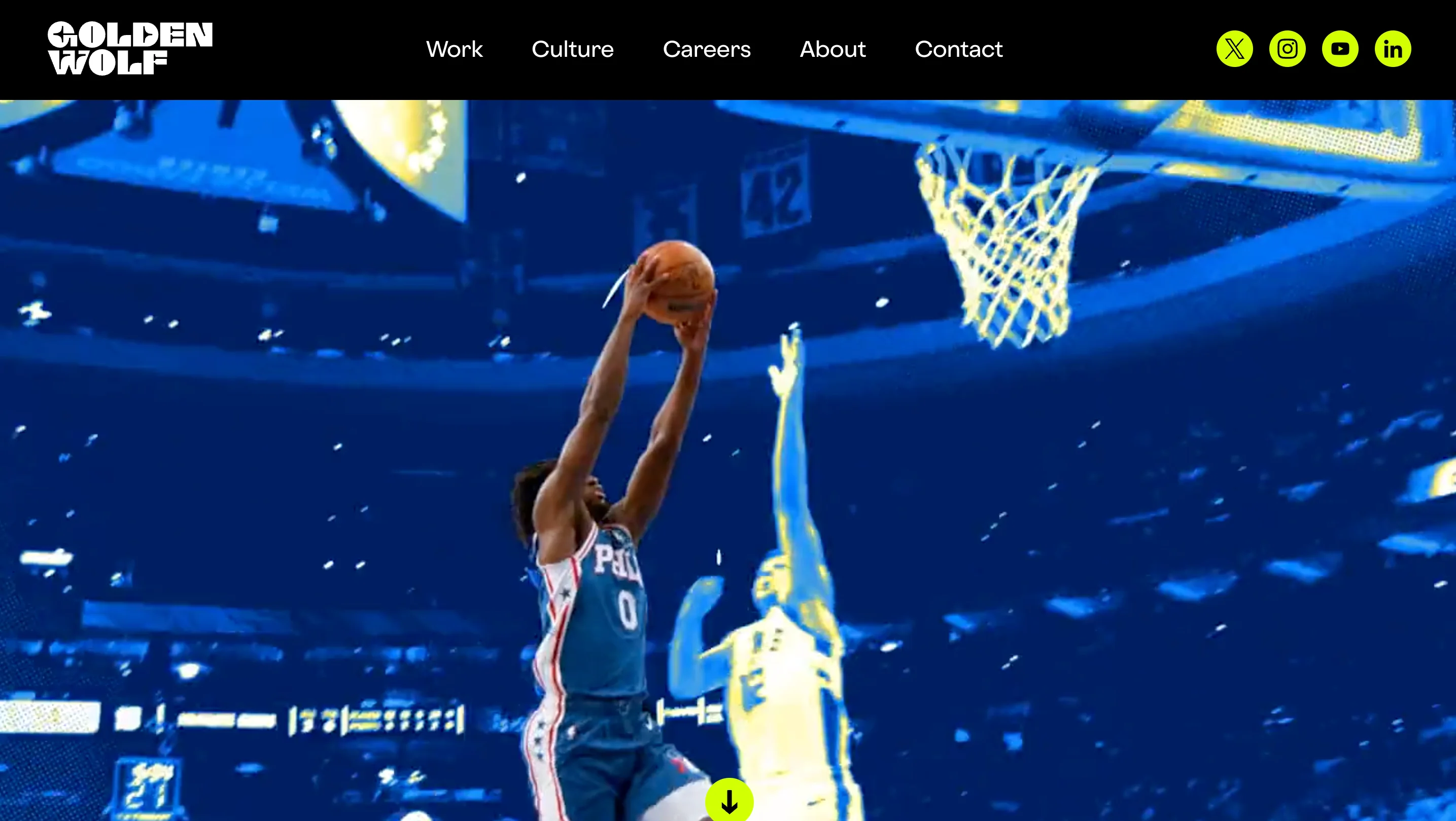
Golden Wolf is an award-winning animation studio and creative agency known for playful, character-led work. Its tech work includes Google Messaging's "Text It Like You Talk It," a piece for Samsung on Spotify, and a Super Bowl spot for Instacart.
- Key services: Character animation, campaign films, and brand entertainment.
- Location: London and New York.
- Best for: Consumer tech brands that want a playful campaign with a recognizable character.
- Pricing: Not published.
Giant Ant
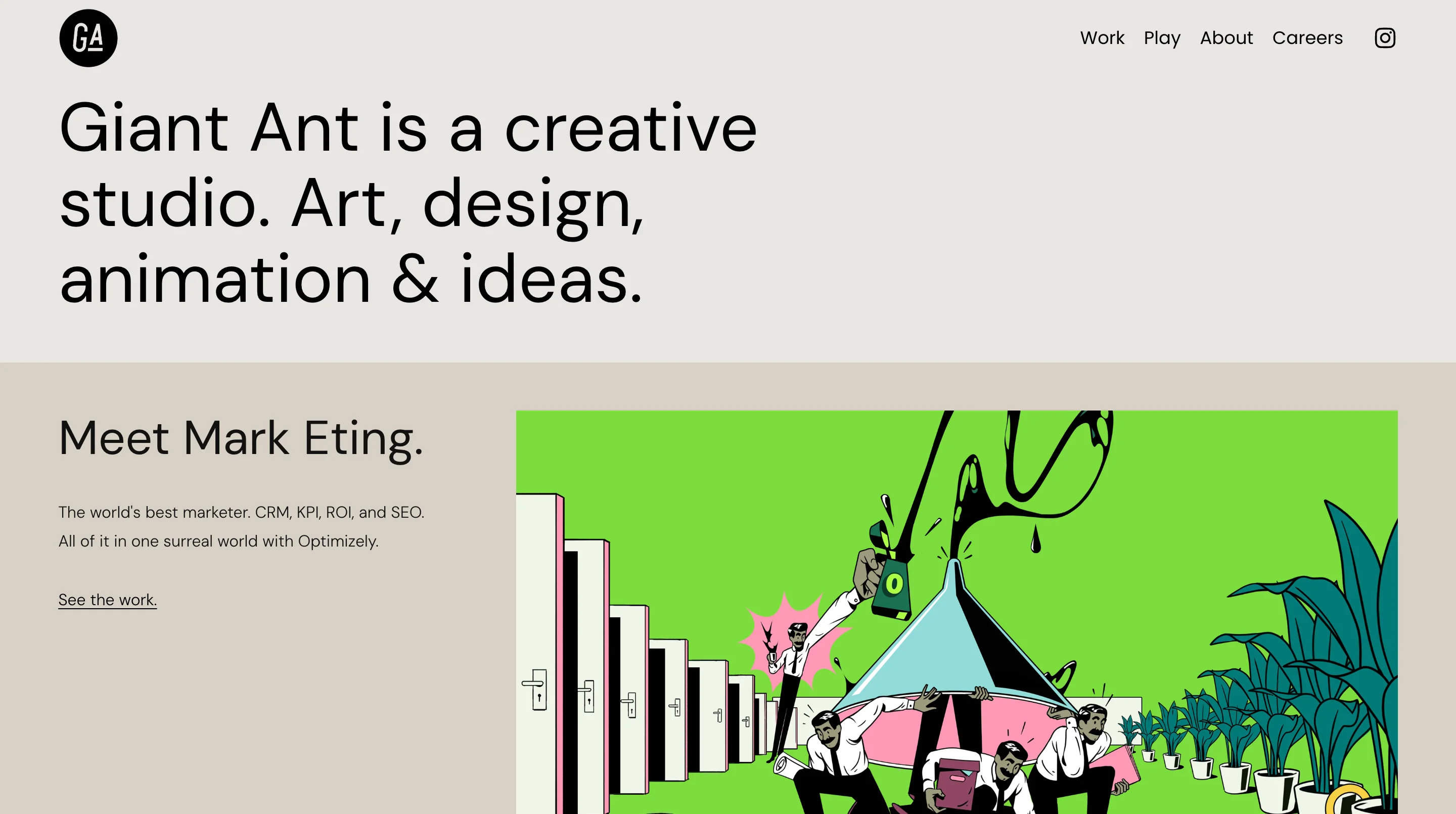
Giant Ant is a Vancouver studio founded in 2009 and known for premium brand films and social impact campaigns. It has worked with Slack, IDEO, TED, and The Obama Foundation, with a focus on concept-led 2D and 3D motion design.
- Key services: Brand films, 2D and 3D motion design, illustration, and character animation.
- Location: Vancouver, Canada.
- Best for: Brands with a substantial story to tell and the time and budget for a long process.
- Pricing: Not published. Broadcast2World (2026) places Giant Ant in its top price tier, above $25,000.
Craft-led boutique studios
These three studios suit brands that want a recognizable visual style and close work with a small team.
Ordinary Folk
Ordinary Folk is a Vancouver studio founded in 2019 by creative director Jorge R. Canedo E. The team has nine people across six countries, by the studio's own count, and it made the opening video for Webflow's 2021 No-Code Conference.
- Key services: 2D, 3D, cel, and character animation, plus illustration.
- Location: Vancouver, Canada, with a team spread across six countries.
- Best for: Tech companies launching a product at an event or during a big campaign.
- Pricing: Not published. Broadcast2World (2026) places Ordinary Folk in its top price tier, above $25,000.
Oddfellows
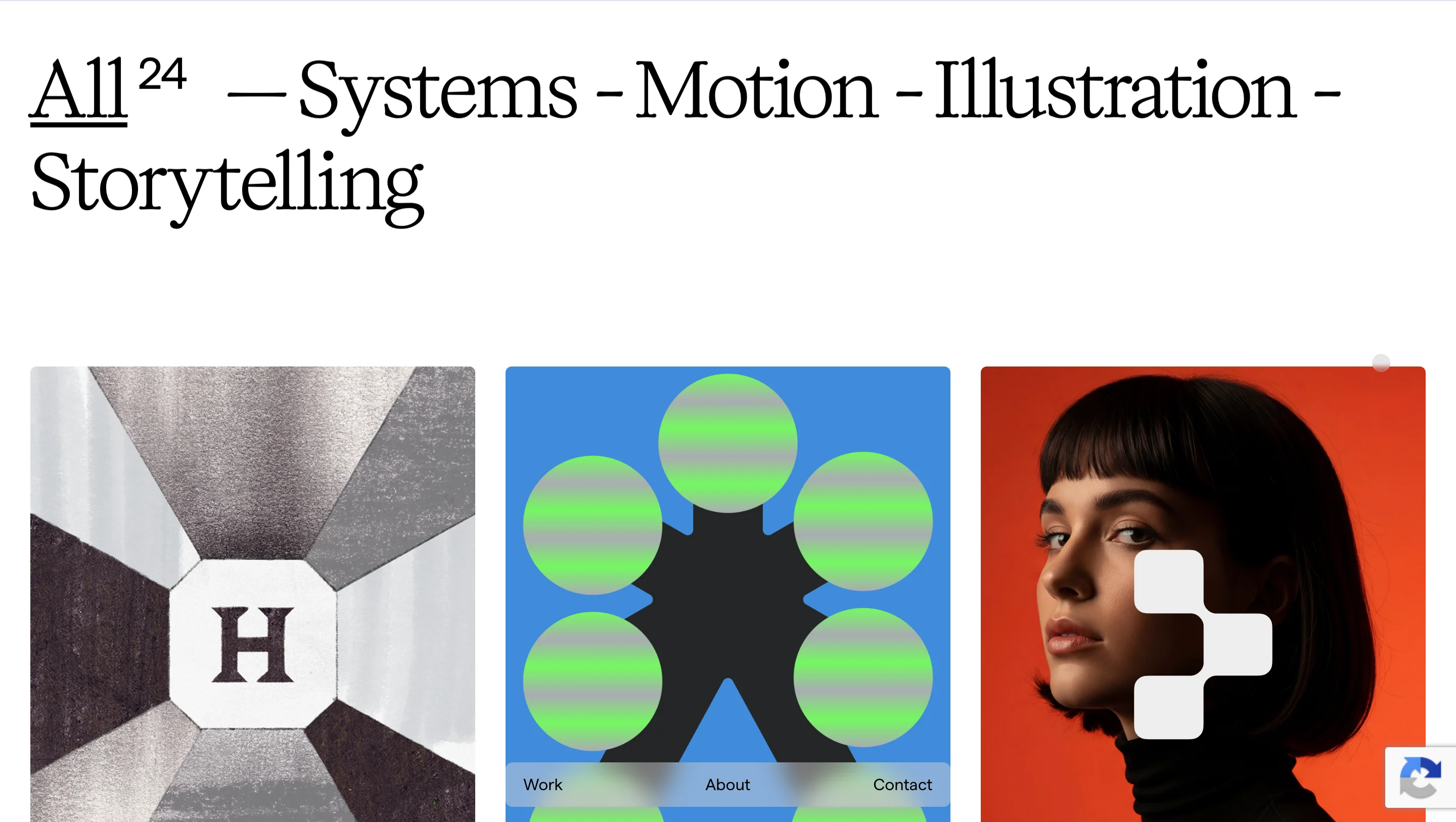
Oddfellows is a visual strategy and storytelling studio with more than a decade of experience. Its tech work includes "This is Figma," a launch video for the legal AI company Harvey, a brand anthem for Replit, and a product icon system for Netflix.
- Key services: Creative direction, design, motion, illustration, and icon and design systems.
- Location: Portland, USA.
- Best for: Software brands that want motion and illustration systems that carry into the product.
- Pricing: Not published.
Buff Motion
Buff Motion builds motion identity systems and reusable animation toolkits instead of only single videos. Its work for UKTV and Starling Bank shows how a brand can keep motion consistent across many assets.
- Key services: Motion identity, animation toolkits, explainers, campaign motion, and ongoing brand content.
- Location: Brighton, UK.
- Best for: Brands that want a reusable motion system for ongoing content.
- Pricing: Quote on request.
Product and SaaS motion studios
These three agencies suit software companies whose motion has to explain a product or sit next to product design.
Heyo
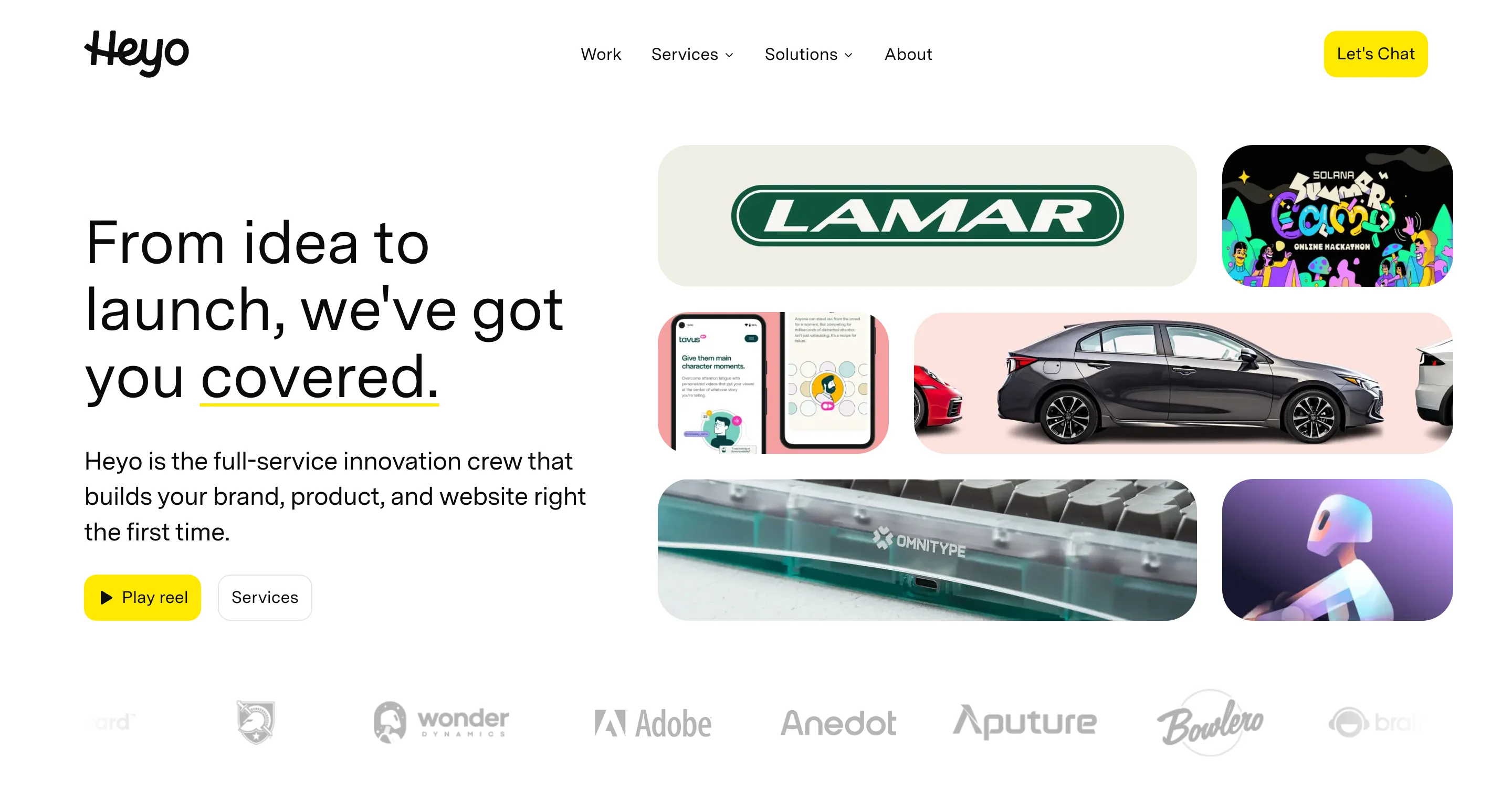
Heyo is a studio that Find Design Agency labels a Global Icon. It combines motion graphics with product design, 3D, 2D animation, and branding, and its clients include Adobe, Figma, Discord, Meta, and Peacock.
- Key services: Motion graphics, product design, 3D, 2D animation, and branding.
- Location: Monument, Colorado, USA.
- Best for: Product and SaaS brands that want motion built together with product design.
- Pricing: $70,000 to $100,000, as estimated by Find Design Agency (2026).
Vidico
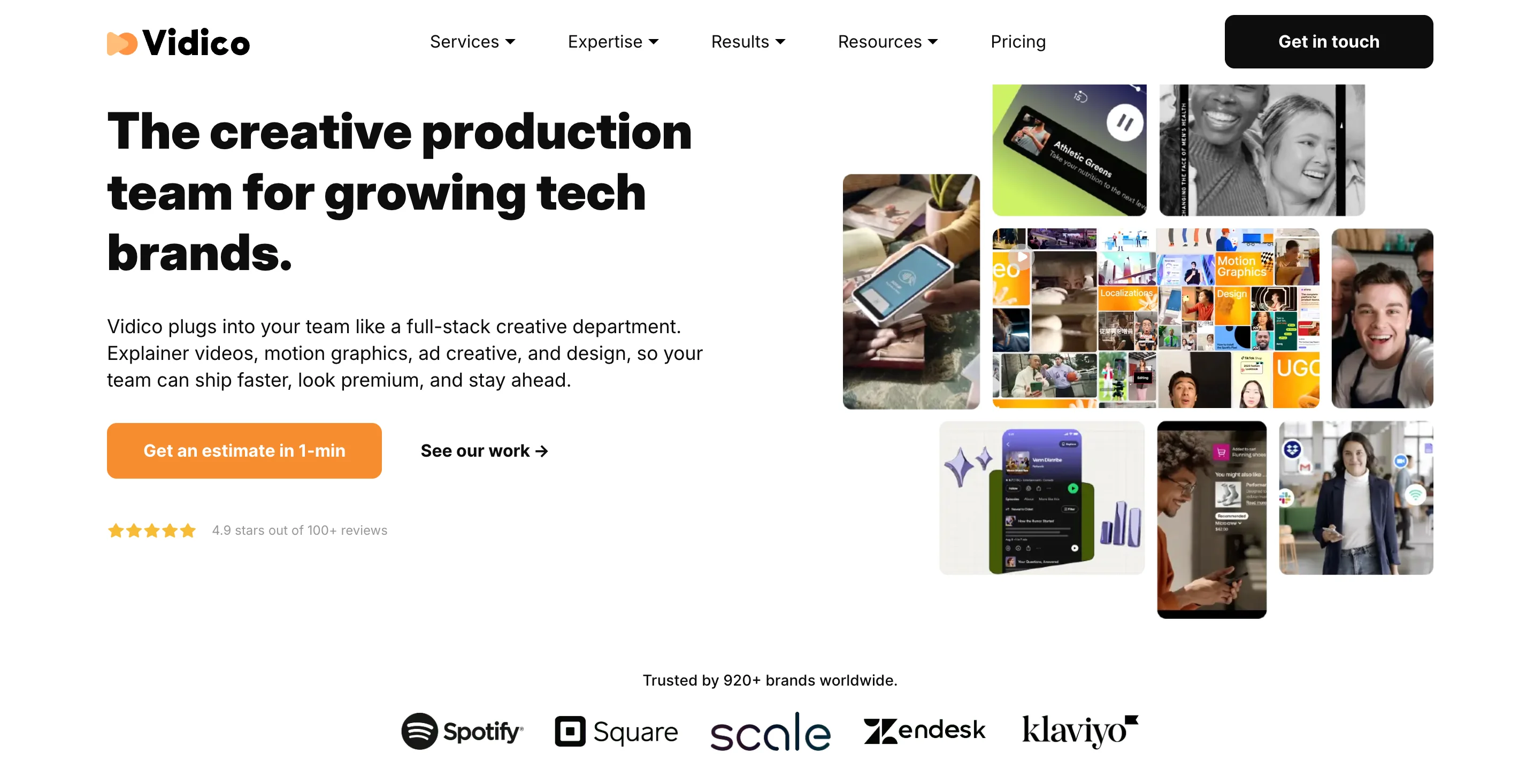
Vidico was founded in Melbourne in 2015 and now has more than 75 people. It makes motion graphics, character animation, 3D product visuals, and UI-led product videos for companies such as Spotify, Zendesk, Airtable, and Scale AI, and it pitches its work on view rates and landing page conversion.
- Key services: 2D motion graphics, character animation, 3D product visualization, UI-led product videos, kinetic typography, and live action.
- Location: Melbourne, Australia, with offices in Sydney, New York, Singapore, and Barcelona.
- Best for: Well-funded SaaS companies that want one partner for animation and live action across a launch.
- Pricing: Quoted on scope.
Fullsend Solutions
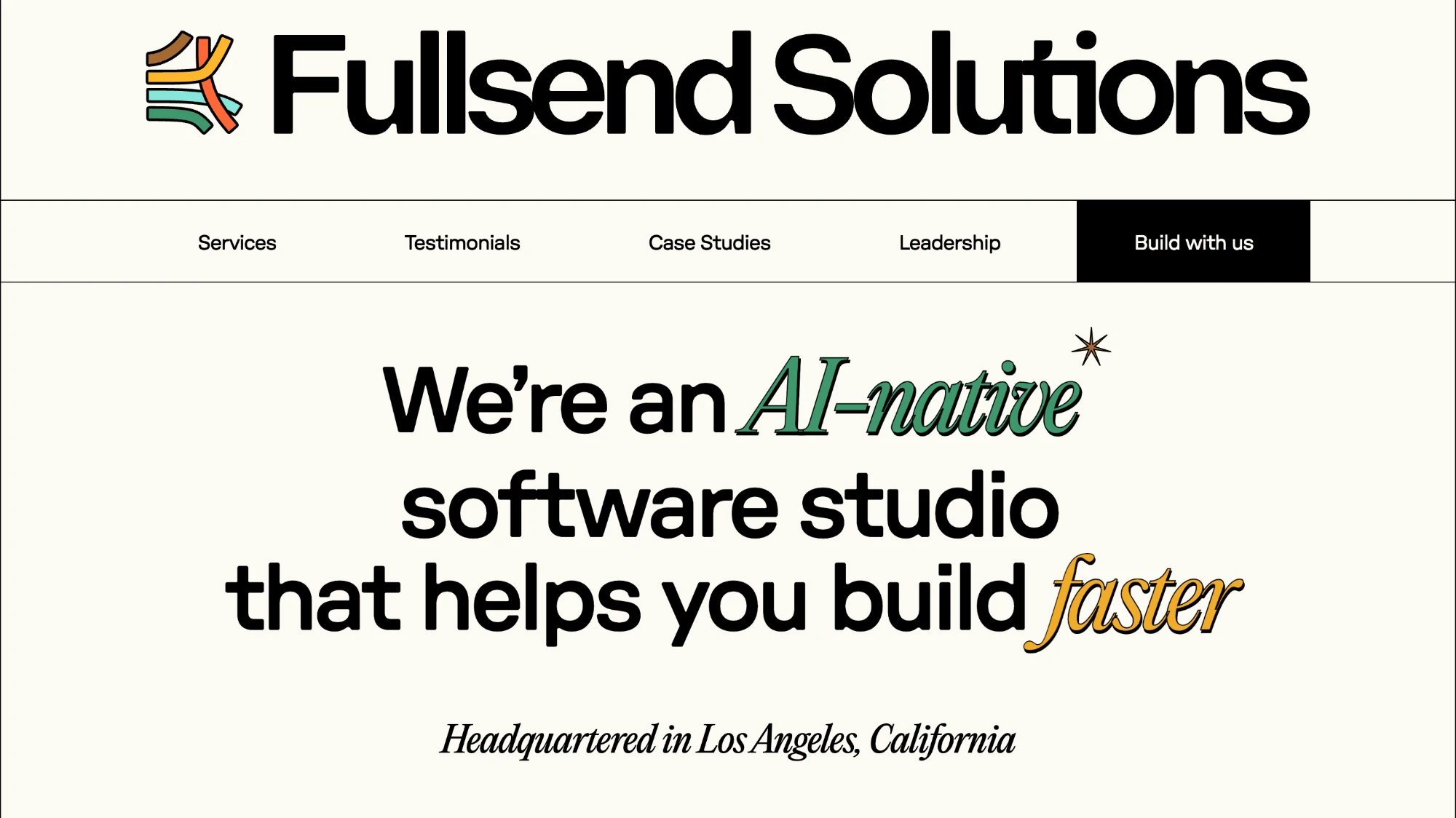
Fullsend Solutions is a Los Angeles agency that Find Design Agency lists as a Top Agency. It pairs motion graphics with branding, 3D, product video, UI/UX, and web design, and its clients include Stripe, Hopper, and LocketWidget.
- Key services: Motion graphics, branding, 3D, product video, UI/UX, and web design.
- Location: Los Angeles, California, USA.
- Best for: Early-stage product companies that need motion work without a flagship budget.
- Pricing: $10,000 to $20,000 for tight-scope motion deliverables with limited revisions, according to Find Design Agency (2026).
Subscription motion studios
These three agencies suit teams that need a steady stream of motion assets, such as ads, product demos, and website animations, instead of one large film.
magier
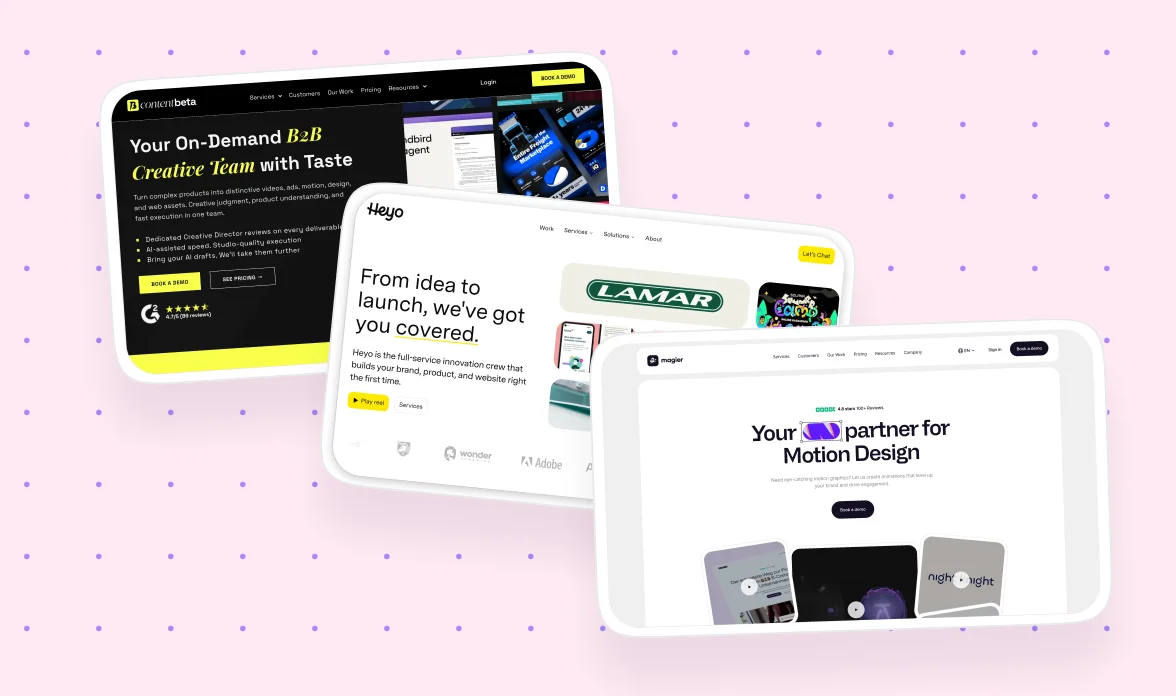
magier is a design and Webflow subscription for startups, scale-ups, and SMBs. Each account gets a dedicated project manager and an art director who reviews the work before delivery. Motion work runs through the same pipelines as design, so animated ads, explainer videos, announcement videos, and website animations come from one team. If you only need a single piece of motion, you can book a one-time project with a fixed scope and timeline instead of a subscription.
- Key services: Animated ads for Instagram, TikTok, and YouTube, explainer videos, website animations, announcement videos, branding, social media content, landing page design, illustrations, and Webflow development, including Figma-to-Webflow, GSAP animation, and migrations.
- Location: Berlin, Germany, with clients worldwide.
- Best for: Startups and scale-ups that want motion, design, and a Webflow site from one team on a steady stream of tasks.
- Pricing: Design starts from €2,750 per month, Webflow starts from €890 per month, and the combined plan costs €4,450 per month. One-time projects have a fixed scope and timeline. There are no long-term contracts, and you can cancel or pause anytime.
- Proof: We turn tasks around in 48 hours and include unlimited revisions. We have served 150+ brands, hold a 4.8 rating across 100+ reviews on Trustpilot and a 5.0 rating on Clutch, and are a Webflow Premium Partner.
- Where another agency fits better: A dedicated motion studio such as Giant Ant or Buck is the better choice for a long, character-led film or a large broadcast campaign.
Content Beta
Content Beta is a subscription studio built for B2B software teams. It produces product demo videos, onboarding explainers, and feature walkthroughs in clean 2D motion, which suits screen-based interfaces, and its clients span SaaS, AI, and cybersecurity.
- Key services: Product demos, onboarding explainers, feature walkthroughs, and UI animation.
- Location: Not publicly listed.
- Best for: SaaS teams with a steady need for product and onboarding video.
- Pricing: From $3,500 on a subscription, according to Broadcast2World (2026).
Motion The Agency
Motion The Agency is a London studio founded in 2019 and built around B2B SaaS and technology companies. Clients work directly with designers and animators, and the studio offers a free custom storyboard or short sample video before you commit. Its engagement with Planful ran as a 12-month subscription that produced more than 100 assets across four brands.
- Key services: Explainers, product demos, UI animation, sizzle reels, sales-enablement video, and in-house sound design.
- Location: London, UK.
- Best for: SaaS teams that need a steady stream of product and sales video instead of one big brand film.
- Pricing: Fixed-price projects, subscriptions, or credits, with prices on request.
More agencies worth knowing
This table covers thirteen more agencies, including studios in Europe, that suit narrower needs such as sports, wellness, luxury, or animation mixed with live action.

What is motion graphics?
Motion graphics are design elements that move over time, such as logos, typography, icons, charts, and interface screens. A motion graphics video needs no cameras, locations, or actors, because designers build every frame on a computer. That makes the work easy to update when your product changes, which is why software companies use it so often.
Live action records real people and places, while motion graphics draws everything from scratch. Live action suits testimonials and real environments, and motion graphics suits abstract ideas, data, and software that has no physical form. Many brands use both, and some studios in this guide, such as ManvsMachine, combine them in one film.

Main types of motion graphics
Motion graphics comes in seven main types, and most agencies specialize in a few of them.
- Logo animation: Your logo moves in a short intro or sting, which makes every video feel like it belongs to your brand.
- Kinetic typography: Text becomes the main moving element, which works well for social clips watched without sound.
- UI and product animation: Your interface comes to life in short loops, which shows how the product works.
- Data visualization: Charts and numbers animate, which makes statistics easier to follow.
- Explainer-style graphics: Icons and shapes walk a viewer through an idea, which simplifies complex topics.
- Social and ad motion: Short animated assets are built for feeds, usually in vertical formats.
- Brand motion systems: Rules, templates, and files define how a brand moves everywhere, so every asset feels consistent.
Where businesses use motion graphics
Businesses use motion graphics in six places, and each one needs a slightly different format and length.
- Website: Hero animations, product loops, and micro-animations replace static screenshots.
- Launch and announcement videos: One video supports the homepage, the announcement post, and investor updates.
- Social and paid ads: Short animated ads run on Instagram, TikTok, and YouTube.
- Sales decks: Animated slides explain a product faster than text.
- Events: Screens and openers support talks and booths.
- Onboarding: Short walkthroughs teach new users the first steps.
According to Wyzowl's Video Marketing Statistics (2026), as cited by Broadcast2World, 96% of people have watched an explainer video to learn about a product. That helps explain why so many software teams start with explainers, so the next section separates explainers from motion graphics before you hire anyone.
Motion graphics vs motion design, 2D animation, and explainer videos
These four terms get used as if they mean the same thing, but each one is a different product with a different price and a different kind of studio.
The table below separates the four terms by what they are, where they are used, and which kind of studio usually makes them. Motion design is often used as a synonym for motion graphics, so the overlap between those two is the most common source of confusion.
Find Design Agency (2026) makes a similar split, describing motion graphics as design in motion and 2D animation as character-and-story work. Booking a character animation studio for a six-second logo animation is like hiring a film crew to take a passport photo. It works, but the invoice will surprise you.
Which one to buy
Three rules cover most briefs. Each one starts from your goal, because the goal decides the product.
- If you need your brand to move consistently, buy motion graphics or a brand motion system, because logos, type, and transitions must follow shared rules.
- If you need to tell a story with characters, buy 2D animation, because that skill is the core of those studios.
- If you need to explain a product with a script, buy an explainer video, and check that the studio can also handle your UI, because explainers often include screens.
"Most teams ask us for an explainer when what they really need is three short product loops for their website. We always start from where the animation will live, because that decides the format"

What motion graphics agencies cost in 2026
This section compares published prices side by side, marks which agencies keep prices private, and lists the five things that change the number.
Price comparison table
The table keeps every price in its original currency and separates prices that agencies publish from estimates that directories report. Compare rows by model first, because a monthly subscription and a one-time film are priced very differently.
Let's face it, hidden prices make comparison hard, and Studio Huncho (2026) reports that none of the six studios on its list publishes a price. The estimates above still show how wide the market is, from a few thousand dollars for a short video to six figures for a multi-format campaign. Use them to set a range before you request quotes, and treat directory estimates as starting points instead of final prices.
What changes the price
Five factors move the cost of a motion graphics or explainer video quote the most, and each one has a clear reason.
- Scope: A single video costs less than a system your team reuses for years, because a system includes templates, rules, and files.
- Style: 3D costs more than 2D, according to Synqro (2026), because modeling and rendering take more time.
- Length and versions: Total seconds of finished animation drive cost, and so does every cut-down and aspect ratio, because each version needs extra work.
- Sound: Original music and sound design cost more than licensed tracks, because a composer or sound designer has to be paid.
- Revision rounds: Studios usually cap revisions, because Find Design Agency (2026) notes that motion revisions are expensive to produce.
Project, subscription, or retainer: which pricing model fits?
Motion graphics agencies sell in three ways, which are a fixed project quote, a monthly subscription, or an hourly retainer. This section explains each one and shows which fits your workload.
The three models compared
Content Beta and Motion The Agency sell subscriptions or credits, and magier sells a subscription plus one-time projects. Ninja Promo is an example of an hourly retainer that bundles motion with other marketing services.
How to choose a model
Three rules cover most teams, and they depend on how many assets you need in a year.
- If you need one or two pieces a year, choose a project quote, because you pay only for the work you use.
- If you need new assets every month, choose a subscription, because a set team learns your brand and works faster over time.
- If you need motion plus wider marketing help, consider a retainer, because the hours can cover several channels.
You might wonder what the catch is with a subscription. The catch is that a quiet month costs the same as a busy one, so a subscription pays off only when you send requests regularly.
Website animation: when to use Webflow, GSAP, Lottie, or Rive
Some motion, such as UI motion design, belongs inside your website instead of in a video file. The table compares video with three web-native options, which are Lottie, Rive, and GSAP. Lottie and Rive are file formats for lightweight animation, and GSAP is a JavaScript animation library that developers use to build scroll-based effects.
Studio Huncho (2026) notes that Lottie and Rive files load faster than video on the web and can respond to scroll or hover. That is the main reason a short product loop in Lottie often serves a page better than the same loop exported as an MP4.
When web motion beats video
Web motion beats video in four situations, and each has a practical reason.
- Your page needs to load fast: Lightweight formats load faster than video, so visitors see the animation before they leave.
- The animation should react to the visitor: Lottie and Rive respond to scroll or hover, while a video only plays.
- The product changes often: Rebuilt and editable animations are easier to update than a flattened video, as Studio Huncho (2026) points out about rebuilt UI.
- The page must fit every screen: Vector-based formats scale to any screen size without a separate export for each one.
Picture a visitor on your homepage who sees a static screenshot of your product while a competitor's page shows the product working in a short loop. Autoplaying a heavy hero video on a pricing page is a bit like sending a sofa through the mail. It arrives eventually, but the visitor left before the doorbell rang.
Who builds Webflow animation into a live site
Many film-led studios deliver finished videos, and Studio Huncho (2026) advises asking for timing values and exported assets if the motion has to live in your product. A film studio and a Webflow team solve different problems, so the right choice depends on whether you need a video or an animated page. That's where magier comes in, because our Webflow developers and GSAP animation specialists build website animations inside the live site, with a staging and push-to-live workflow that lets you review changes before they go public.
See how magier handles Webflow development if your motion needs to live on your site instead of in a video file. If you need a long film as well, you can pair a dedicated motion studio with a Webflow team and share the exported assets between them.
Which motion graphics to start with: launch, rebrand, redesign, or ad volume
This table matches five common business moments to the type of motion to start with and the type of agency that suits it. Most teams do not need every type at once, so start with the row closest to your situation.
How to choose a motion graphics agency
Choosing an agency takes three steps, which are running the specialist test, asking six questions on the first call, and writing a clear brief.
Step 1: Run the specialist test
The specialist test is one question you ask every agency on your shortlist. Ask, "What share of your work is motion graphics, as opposed to 2D animation or explainer video?" It takes about ten seconds, and the answer shows what the agency does most often.
Find Design Agency (2026) argues that the best motion graphics studios specialize in design-led motion and only dabble in character animation and explainers. A studio that mostly ships cartoon explainers will quote quickly but tends to miss on brand motion, while a specialist shows logo animation, UI motion, and brand systems in its portfolio. Judge the agency by more than its cover reel, because the reel shows its best five minutes and the answer shows its everyday work. Ask yourself whether your project needs brand motion or a story, because brand motion points to a specialist.
Step 2: Ask six questions on the first call
Six questions cover most of the risk, and each one has a reason attached.
- Who works on my project day to day? Find Design Agency (2026) warns that senior people often pitch while junior people deliver, so you need to know who animates.
- What do your revision rounds cover? Two rounds with a tight scope is a different offer than unlimited revisions at the same headline price.
- How do you handle my product UI? Studio Huncho (2026) says rebuilt UI looks sharper and stays editable, while screen recordings are harder to change.
- Which file formats will I receive? For the web, Lottie or Rive files load faster than video, so the formats decide where the motion can live.
- Which usage rights are included? Music, fonts, and stock footage should be cleared for every place you will use them, and Synqro (2026) notes that broadcast and paid media rights cost more.
- How do you approach the script? A clear method shows whether the studio plans the message before it animates.
Step 3: Write a motion graphics brief
A short brief prevents rework, because each missing input usually turns into a revision later. Asking for something modern without references is like telling a barber to cut your hair normal, because you will get a haircut, but probably not yours. Include these six inputs.
- Goal: State what the motion should achieve, such as explaining a feature or lifting demo requests, so the studio can judge its own work.
- Audience: Name who watches and what they should understand first, because that shapes the opening seconds.
- Formats and aspect ratios: List every place the motion will run, since Synqro (2026) notes that vertical 9:16 is now a common starting point for social content.
- Sound-off viewing: Say whether the motion must work without audio, because many feeds play silently and need strong visuals or captions.
- References: Share examples you like and dislike, because words describe motion poorly.
- Technical limits: Mention your CMS, framework, performance needs, and accessibility needs, which prevents effects that cannot be shipped.
What a motion graphics proposal should include
A good proposal lists seven items, and a missing item is a warning sign. This section gives the checklist and the reason behind each item.
A proposal this detailed might sound like overkill for a 30-second video. Synqro (2026) points out that a very low quote often hides templates or a sharp cut in feedback rounds, and these seven items expose that early.
- Style frames or a storyboard: You should approve the look before animation starts, because changing the style later costs the most.
- Listed deliverables: The proposal should name formats, lengths, and aspect ratios, so nothing is argued about at handover.
- Source files and templates: Without project files, every later change means going back to the studio, according to Studio Huncho (2026).
- Usage rights: Music, fonts, and stock footage should be cleared for each channel, which avoids takedowns and surprise fees.
- Revision scope: The proposal should state how many rounds you get and at which stage, because late changes are the most expensive.
- Developer exports: If the motion lives in your product, ask for timing values and exported assets, because your developers cannot copy them from a video.
- Timeline with milestones: Clear review points keep deadlines visible, and Synqro (2026) says a good agency offers structured support from script to final delivery.
Picture a folder that holds only final MP4 files on the day your product interface changes, so every screen in the video is out of date. Source files turn that day into a quick edit instead of a new project.
How a motion graphics project works, step by step
Most projects follow eight steps from brief to export, and published timelines range from two to twelve weeks depending on scope. This section lists the steps and the timelines that agencies and guides report.
- Brief: You define the goal, audience, formats, and limits.
- Script: The studio writes the narrative structure and any voiceover.
- Storyboard: Each scene appears as a still frame so you can approve the story.
- Moodboard and style frames: The studio defines the look, colors, and type.
- Animation: Designers set the approved elements in motion, often in tools such as After Effects and Cinema 4D.
- Sound design: Music and effects are added.
- Review and revisions: You give feedback, and tools such as Frame.io let you comment directly on frames.
- Export: The studio delivers each format and the source files.
Next steps
The right motion graphics agency depends on your moment, your pricing model, and whether the motion lives in a video or on your site. The specialist question from earlier is the fastest filter, and the proposal checklist protects you after you choose. Executing all of this takes real work, especially when your team is already stretched.
You might worry that handing motion to an outside team means losing control of your brand. A proposal with style frames, source files, and a named project contact keeps approval in your hands. This is where magier comes in, because we cover animated ads, explainer videos, website animations, and Webflow development in one subscription, with one-time projects for single pieces. Book a free demo with magier if you would like to talk through your brief.
Pick the section closest to your situation, such as the price table or the proposal checklist, and start there. You can apply the first step today.
FAQ
Motion graphics is animated graphic design, such as moving text, shapes, icons, and interface screens. It needs no cameras or actors, which makes it easy to update when your product changes.
Buck, ManvsMachine, Golden Wolf, Giant Ant, Oddfellows, and Heyo appear most often in 2026 roundups and Google's AI Overview. For subscriptions, look at magier, Content Beta, and Motion The Agency.
This guide focuses on motion, so for motion work the 13 agencies above are the better starting point. Directories such as Find Design Agency list graphic design agencies by country and specialty.
Directory estimates run from about $10,000 for tight-scope work to $100,000 and above for multi-format campaigns, while some agencies publish lower starting prices. Scope, style, length, sound, and revision rounds move the number most.
Motion graphics is design in motion, such as logos, type, UI, and data. 2D animation is character and story work, and the two need different kinds of studios.
Mostly yes, because many studios use these labels interchangeably. Motion design is sometimes used as a broader label that includes UI and 3D, so check the portfolio instead of the name.
A quote should list style frames or a storyboard, deliverables, source files, usage rights, revision scope, developer exports, and a timeline. The proposal section above explains the reason for each item.
Published timelines run from 2 to 4 weeks for launch videos to 6 to 12 weeks for full productions. Feedback rounds and the number of versions usually decide the length.
Heyo, Vidico, and Fullsend Solutions suit product-led SaaS brands, and Content Beta and Motion The Agency suit teams with steady product video needs. magier suits SaaS teams that also want website animation and Webflow work.
Yes, Content Beta, Motion The Agency, and magier offer subscription or credit models. A subscription pays off when you request assets regularly, and magier also offers one-time projects for teams that need a single piece.
Ask for source files, every exported format, templates, and timing values if developers need them. Also confirm that music and fonts are licensed for each place you will use them.
Some do, but many film-led studios deliver finished videos. Webflow and GSAP teams build the animation inside the page, so choose based on whether you need a video or an animated site.
It depends on the job. Studio Huncho (2026) notes that Lottie and Rive files load faster than video and can respond to scroll or hover, while video suits launch films and ads.
Brands still need animated ads, product videos, and website motion, which is why the agencies in this guide exist. This guide focuses on hiring an agency, so for career advice, look at job boards and studio career pages.
Brands keep asking for motion across ads, product videos, and websites, as the agencies above show. Synqro (2026) notes that some studios use AI for repetitive tasks such as rotoscoping, while concept and art direction still need people.