Marketing SWOT Analysis: Guide, Examples, and TOWS (2026)
Ever feel like your marketing strategy is just throwing ideas at a wall and hoping something sticks? Yeah, been there. While that feeling could be imposter syndrome, it could also just mean you need to get some clarity. That’s why I swear by a Marketing Strategy SWOT Analysis – because guesswork isn’t a strategy.
If you're running a new campaign, refining your brand message, or trying to break into a new market, taking the time to assess your strengths, weaknesses, opportunities, and threats can give you clarity and help you make smarter moves.
But here’s the thing – most people stop at SWOT. The real magic happens when you take it a step further with a TOWS analysis (more on that later).
Let’s break it all down.
{{freebie}}
What Is a Marketing Strategy SWOT Analysis?
A Marketing Strategy SWOT Analysis helps you assess and optimize your marketing efforts. It covers:
- Strengths – What makes your marketing stand out?
- Weaknesses – Where are the gaps?
- Opportunities – What external factors can you leverage?
- Threats – What risks could impact your success?
When done right, a SWOT analysis gives you a roadmap for a stronger, more intentional marketing strategy.

How to Conduct a Marketing Strategy SWOT Analysis
Step 1: Identify Strengths 🔥
Ask yourself:
- What makes our brand stand out?
- What marketing tactics have worked best?
- Do we have strong brand awareness or customer loyalty?
Step 2: Identify Weaknesses 🤔
- What marketing strategies haven’t performed well?
- Do we lack resources, expertise, or brand recognition?
- Are there gaps in our content, SEO, or advertising?
Step 3: Identify Opportunities 🚀
- Are there emerging trends we can leverage?
- Can we expand into new markets or demographics?
- Are there partnerships that could strengthen our marketing?
Step 4: Identify Threats ⚠️
- Are competitors gaining an edge?
- Do we face regulatory or industry challenges?
- Are there changing consumer behaviors that could impact us?
Step 5: Review and Update on a Structured Cadence
- Quarterly: Full team review of the SWOT and TOWS matrix. Reassess whether assumptions still hold, whether new factors have emerged, and whether priorities need to shift.
- Monthly: Lighter review of territory-level or campaign-level SWOT factors, especially for fast-moving channels like paid media and social.
- Event-triggered: Update immediately when a significant change occurs, such as a major competitor move, a regulatory change, an algorithm update, or an economic shift.
A SWOT analysis that is reviewed only once a year becomes outdated within weeks in fast-moving markets. The cadence should match the pace of change in your industry.
For the external audit (opportunities and threats), consider pairing SWOT with a PESTLE analysis. PESTLE examines Political, Economic, Social, Technological, Legal, and Environmental factors. Running a PESTLE scan before completing your SWOT ensures you do not miss external forces that fall outside your immediate competitive view. For example, a PESTLE analysis might surface upcoming privacy regulations (Legal) or a shift in consumer sentiment toward sustainability (Social) that would not appear in a standard competitive review but should absolutely appear in your threats or opportunities quadrant.

{{cta}}
What to Do After a SWOT Analysis? Hello... TOWS Analysis!
A SWOT analysis is a great start, but it’s not enough to turn insights into action. That’s where TOWS analysis comes in (trust me, this will CHANGE how you see SWOT and you'll see so much potential!).
What is a TOWS Analysis?
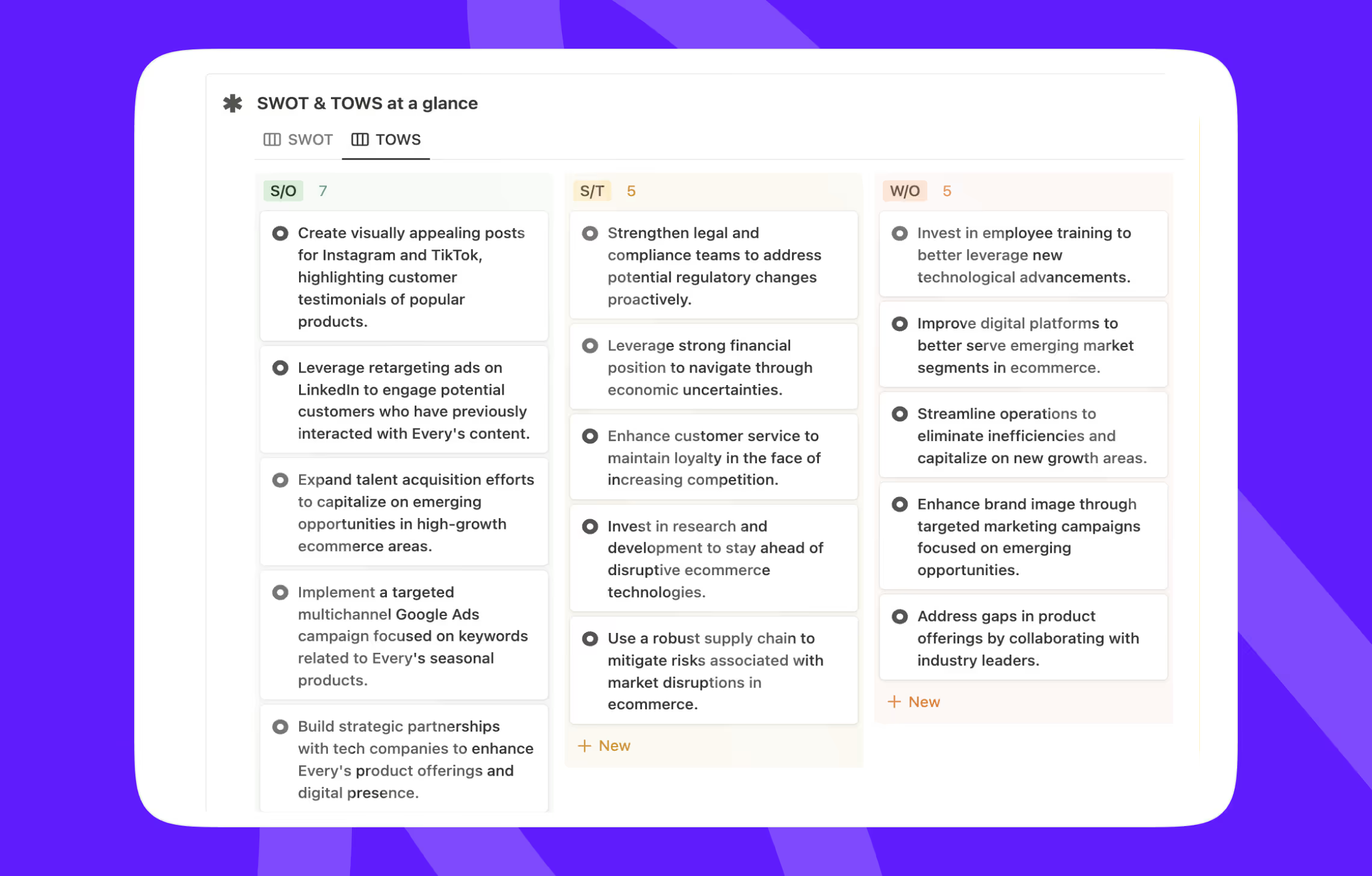
A TOWS analysis takes your SWOT insights and turns them into actionable strategies by analyzing how different factors interact:
- Strengths + Opportunities: Use your strengths to capitalize on new opportunities.
- Strengths + Threats: Leverage your strengths to mitigate external risks.
- Weaknesses + Opportunities: Improve weak areas to take advantage of opportunities.
- Weaknesses + Threats: Develop strategies to minimize risks and address weaknesses.
TOWS takes the SWOT findings and turns them into actionable strategies. The framework was introduced by Heinz Weihrich, a professor at the University of San Francisco, in a 1982 paper published in Long Range Planning. Weihrich identified a fundamental problem with SWOT: it produces four disconnected lists, but it does not derive actions from them. The TOWS matrix solves this by systematically cross-referencing internal and external factors to generate concrete strategic options.
A 1997 study by Hill and Westbrook found that among fifty companies studied, not a single one had systematically translated its SWOT results into strategies. The lists were created, presented, and then ignored. This is precisely the gap that TOWS is designed to close.
TOWS Example
Let’s say your SWOT analysis finds that you have strong brand loyalty (Strength) and there’s a growing interest in sustainability (Opportunity). A TOWS strategy might be launching an eco-friendly product line to build on existing customer trust.
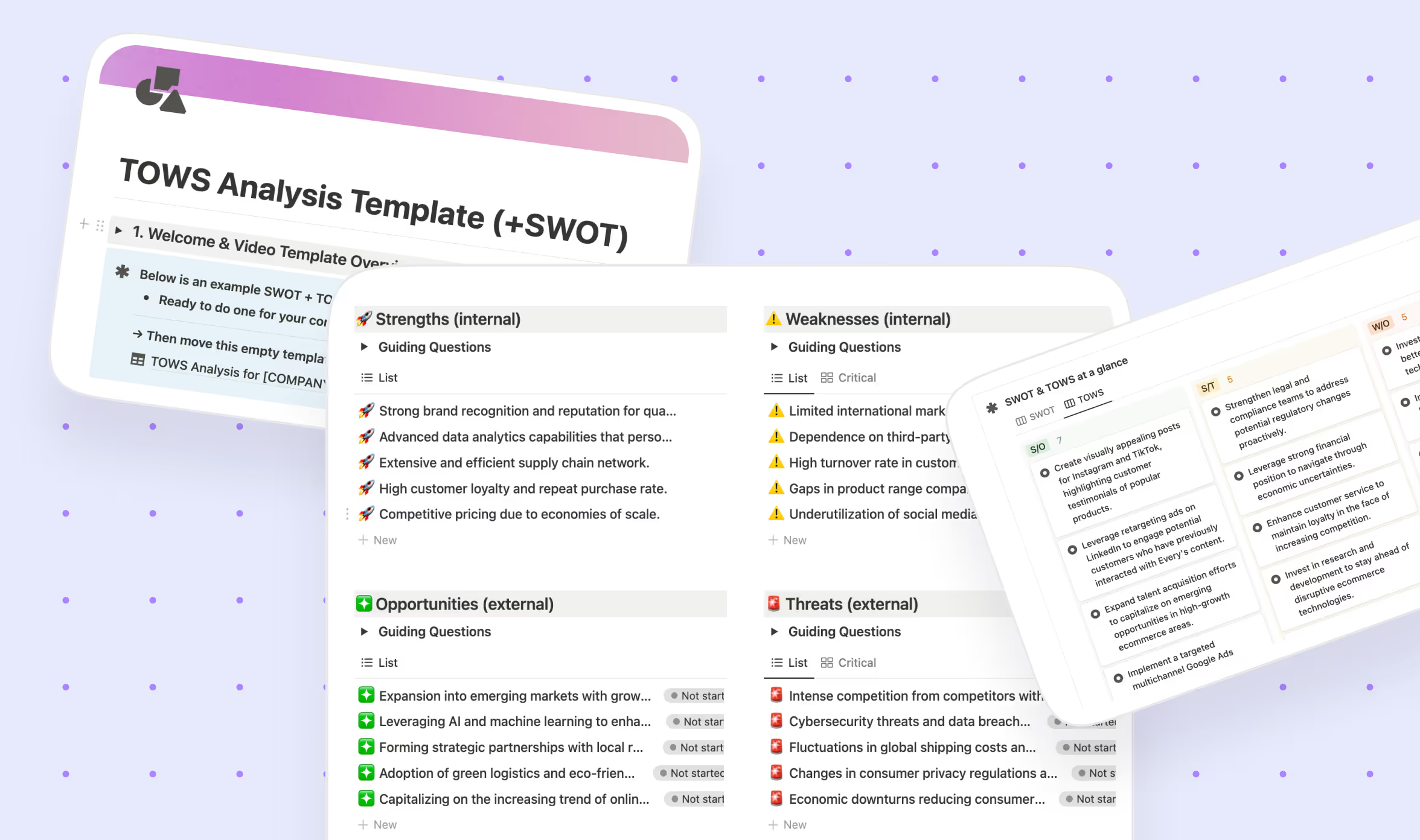
Want to try this out yourself? I created a free TOWS template that integrates SWOT insights into an actionable plan. Grab it here.
What a SWOT + TOWS Template Looks Like
A complete SWOT + TOWS template typically includes two main sections:
Section 1: The SWOT grid
A four-quadrant grid with Strengths and Weaknesses in the top row (internal factors) and Opportunities and Threats in the bottom row (external factors). Each quadrant should include:
- A set of guiding questions to prompt specific entries
- Space for 5-8 prioritized items per quadrant
- A column for impact rating (High / Medium / Low) to help prioritize
Section 2: The TOWS action matrix
A second grid that crosses internal factors with external factors to generate four strategy types:
- SO (Strengths + Opportunities): Growth strategies
- WO (Weaknesses + Opportunities): Improvement strategies
- ST (Strengths + Threats): Defensive strategies
- WT (Weaknesses + Threats): Risk reduction strategies
Each TOWS quadrant should include space for the strategy description, an assigned owner, a timeline, and a success metric.
Common Mistakes to Avoid When Doing a SWOT Analysis
🚫 Being too vague – Instead of “we have good marketing,” say “our email open rate is 40%, and our paid ads convert at 3%.”
Fix: Use real data and competitor benchmarks to add precision.
🚫 Ignoring external factors – It’s easy to focus internally, but opportunities and threats come from outside forces.
Fix: Look at industry trends, competitors, and market shifts.
🚫 Not taking action – A SWOT analysis isn’t useful unless you act on your insights – which is why a TOWS strategy is critical.
Fix: Convert insights into actionable marketing plans.
SWOT for Sales Teams
SWOT analysis is not limited to marketing strategy. Sales teams use the same framework at three levels:
Team level: Evaluate the overall sales organization. What are the team's strengths (e.g., deep product knowledge, strong CRM discipline)? What are the weaknesses (e.g., long ramp time for new hires, low outbound conversion rates)? What opportunities exist (e.g., expansion into a new vertical, a competitor exiting the market)? What threats should the team prepare for (e.g., economic slowdown reducing deal sizes, a new competitor entering with aggressive pricing)?
Territory level: Analyze specific markets or segments. A territory SWOT might reveal that one region has strong brand recognition (strength) but limited partner coverage (weakness), with growing demand from mid-market companies (opportunity) offset by a dominant local competitor (threat).
Deal level: For complex B2B sales, running a SWOT on an individual opportunity helps identify where your proposal is strong, where it is vulnerable, what factors in the buyer's environment work in your favor, and what risks could cause the deal to stall or go to a competitor.
Sales-focused SWOT reviews should happen monthly at the territory level and at each stage gate for major deals.
SWOT Example for an Ecommerce Brand
This example uses specific numbers (NPS scores, load times, open rates, CPC increases) rather than generic labels. That specificity is what makes a SWOT analysis useful for actual decision-making.
FAQ: Marketing Strategy SWOT Analysis
1. What is the difference between SWOT and TOWS analysis?
A SWOT analysis helps you identify internal strengths & weaknesses and external opportunities & threats. TOWS analysis takes it a step further by turning those insights into actionable strategies, showing how you can use strengths to leverage opportunities and mitigate threats.
2. How often should I conduct a SWOT analysis?
I recommend doing a SWOT analysis at least once a year or whenever there’s a major change in your business, industry, or marketing strategy. If you're launching a new product, expanding to a new market, or facing strong competition, it's a good time to reassess.
3. Can I use a SWOT analysis for a startup marketing strategy?
Absolutely! Startups benefit massively from SWOT analysis because it helps them focus on their strengths (even if they’re limited), identify opportunities in a competitive market, and mitigate risks before scaling.
4. How do I turn a SWOT analysis into an actual marketing strategy?
That’s where TOWS analysis comes in! Once you’ve mapped out your SWOT, use TOWS to connect strengths with opportunities and create actionable strategies. For example, if you have strong brand loyalty (strength) and sustainability is trending (opportunity), you might launch an eco-friendly product line.
5. Where can I find a SWOT and TOWS template?
I’ve created a free plug-and-play TOWS template that helps you turn SWOT insights into an action plan. Grab it here and start mapping out your strategy instantly.
6. What are the 5 points of SWOT analysis?
The five core components of a SWOT analysis are: (1) Strengths, the internal advantages your business or marketing has over competitors; (2) Weaknesses, the internal limitations holding your performance back; (3) Opportunities, external trends or market conditions you can capitalize on; (4) Threats, external risks that could negatively affect your business; and (5) Action planning, the step where you convert your SWOT findings into strategic initiatives. Many frameworks stop at the first four, but the analysis is only complete when it leads to specific decisions.
7. What are the four SWOT marketing strategies?
The four SWOT marketing strategies come from the TOWS matrix, which crosses internal and external factors to generate four types of strategic action: (1) SO strategies, where you use strengths to capitalize on opportunities; (2) WO strategies, where you use opportunities to address weaknesses; (3) ST strategies, where you use strengths to reduce or neutralize threats; and (4) WT strategies, where you minimize weaknesses to avoid threats. Together, these four quadrants turn a descriptive SWOT into a concrete action plan.
8. What are 5 examples of strength in SWOT analysis?
Five common examples of strengths in a marketing SWOT analysis are: (1) high organic search rankings for commercial keywords, (2) a large and engaged email subscriber list, (3) strong brand recognition and customer trust, (4) low customer acquisition cost relative to competitors, and (5) an experienced marketing team with deep channel expertise. The most useful strength entries are specific and measurable rather than generic.
A SWOT analysis is a powerful tool, but only if you turn it into action. That’s why using a TOWS framework ensures that you’re not just identifying strengths and weaknesses – but actually building a winning marketing strategy from them.
If you want a plug-and-play SWOT + TOWS template, grab the free template here and start mapping out your strategy today!


%202%20(1).webp)

.avif)