%202%20(1).webp)
GEO Audit: How to Check if AI Search Engines Can See Your Content
Your site ranks in position 3 on Google, but when someone asks ChatGPT for providers in your category, your brand doesn't show up. A GEO audit makes exactly this gap visible. It shows you whether AI search engines find your content, understand it, and use it as a source. And if they don't, it shows you where things break down.
At Friendventure, we run these audits for startups and mid-sized companies. The most common reaction in the final call is something like: "We thought good SEO was enough." Unfortunately, it isn't quite enough. In this article, I'll show you what a GEO audit checks, how to set one up yourself, and which tools and metrics you need.
What is a GEO audit?
A GEO audit is a structured check of how visible your brand is in AI-powered search tools. This means systems like ChatGPT, Perplexity, Gemini, or Google AI Overviews, which write a finished answer to a question instead of showing ten blue links.
GEO stands for Generative Engine Optimization, meaning optimization for generative search engines. You will also see the term AEO (Answer Engine Optimization). Both mean essentially the same thing, so in practice an AEO audit and a GEO audit are almost impossible to tell apart.
The key difference from a ranking check is this: instead of measuring positions, you measure whether and how you appear in answers. An AI visibility audit answers three questions:
- Are you mentioned when users ask about your category?
- Is your website linked or cited as a source?
- Is what the AI says about you correct, and does it sound the way you want to be perceived?
The third question is often underestimated. In our tests, we keep noticing that the linked sources don't support every statement in the answer. The AI pieces together information from several pages, and outdated details or information about competitors sometimes end up in the description of your brand.
{{freebie}}
Why a GEO audit matters right now
Google is not dead, and I put little faith in predictions that announce the end of classic search. What has changed is the place where purchase decisions are prepared.
There are fresh numbers for B2B software. According to the G2 report "The Answer Economy," 51% of surveyed software buyers now start their research more often in an AI chatbot than on Google. In April 2025, that figure was still 29%. In March 2026, a total of 1,076 B2B decision-makers were surveyed.
Something is also changing inside Google itself. An analysis by the Pew Research Center, using real browsing data from 900 US adults, shows that when an AI summary appears, users click a classic search result in 8% of cases. Without a summary, it's 15%. Only 1% click on the source links inside the summary itself.
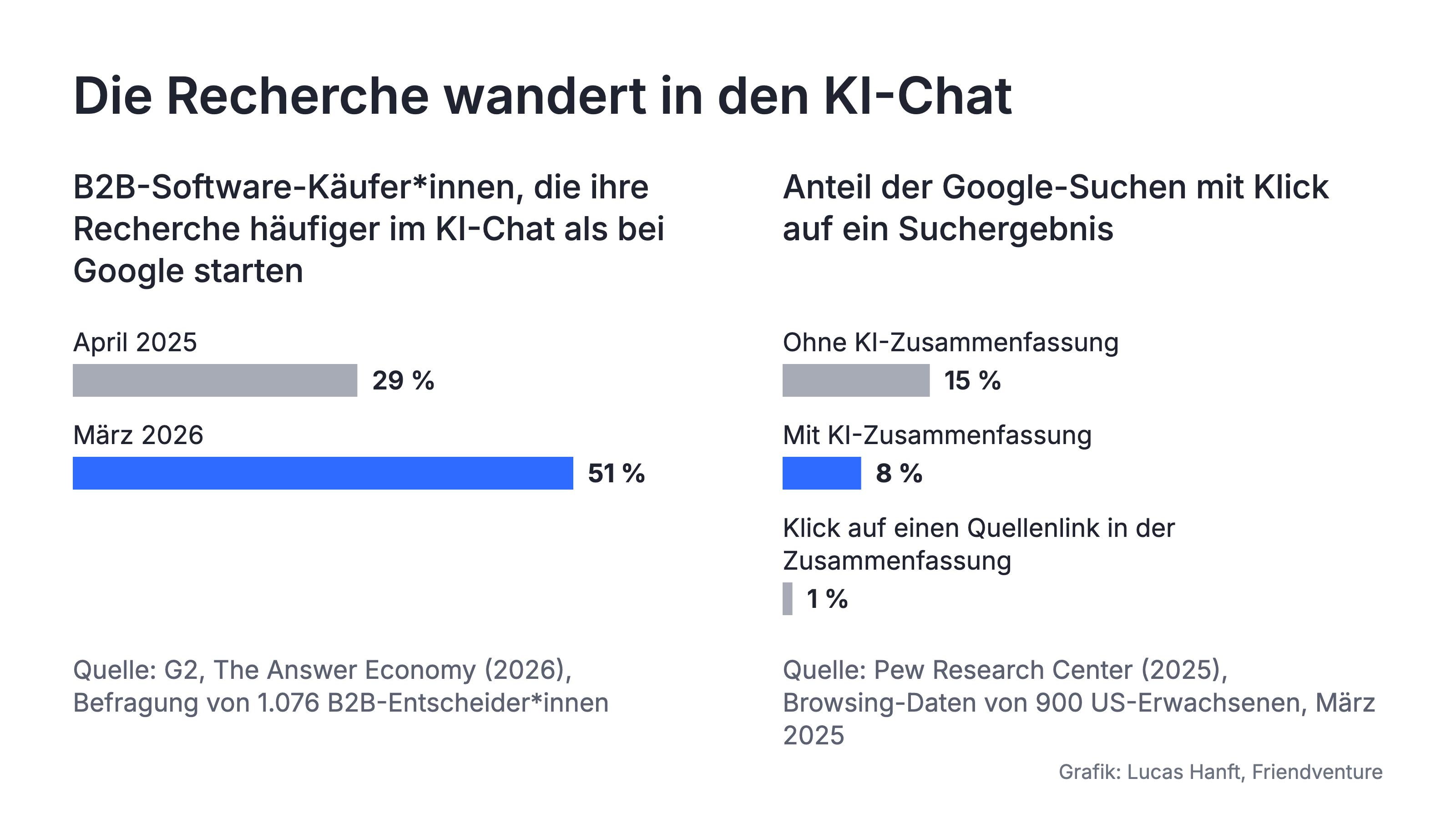
For you, this means the shortlist increasingly forms inside the AI answer. If you're missing there, you won't even be compared. And a good Google ranking only partly protects you, because AI systems select their sources by different criteria than the ten blue links. A GEO audit measures exactly this gap between ranking and AI visibility.
{{cta}}
GEO audit vs. SEO audit
When it comes to GEO vs. SEO, it's rarely an either-or question. An SEO audit checks whether Google finds your pages and ranks them well. A GEO audit checks whether AI systems know your brand, categorize it correctly, and recommend it. The following table shows the differences:
The two audits overlap more than many people think. Clean technology, structured data, and E-E-A-T (experience, expertise, authoritativeness, trustworthiness) help in both worlds. If your site is technically weak, sort out the basics first, for example with a classic SEO audit. A good starting point is the magier article on designing a website for SEO.
What a GEO audit covers
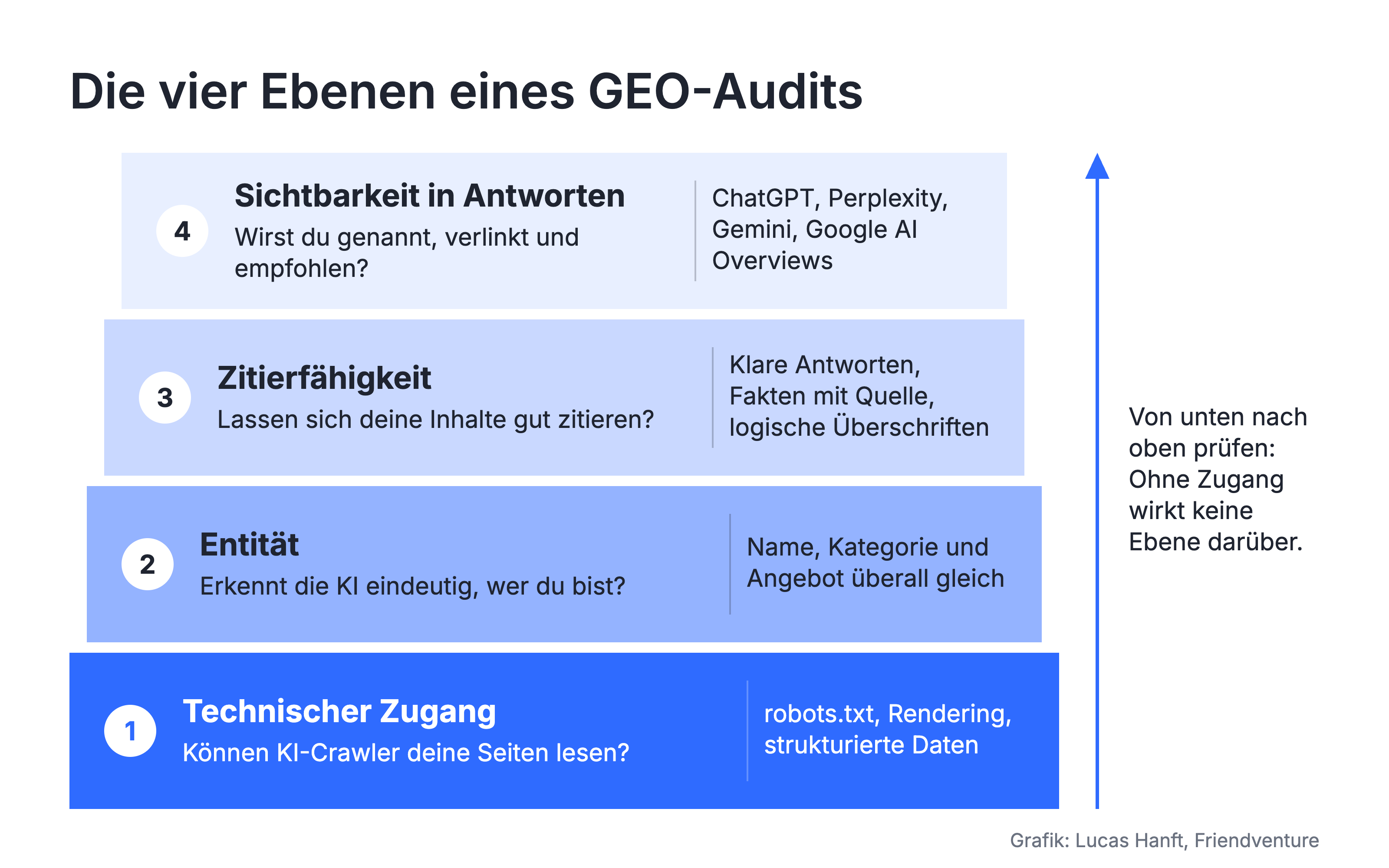
A complete audit looks at four levels: how you appear in answers, how well your content can be cited, how clearly your brand is recognizable as an entity, and whether AI crawlers can even reach your pages.
AI visibility across platforms
ChatGPT, Perplexity, Gemini, and Google AI Overviews draw on different sources. That's why you check each platform individually. You record whether your brand is mentioned, in which position, in what tone, and which sources are linked.
This also includes tracking brand mentions on third-party sites such as review platforms, trade media, or Reddit, because these sites often feed directly into the answers. At Friendventure, we therefore also look closely at reviews in the audit: how many there are, how good they are, and whether the company responds to them. A brand with three old reviews simply gives a language model very little to work with.
Content structure and citability
AI systems pull individual passages out of pages. A paragraph that answers a question clearly in two sentences is more likely to be cited than a long introduction that only gets to the point in the fifth paragraph. In the audit, you therefore check the following. Do your most important pages answer specific questions directly? Are there numbers, definitions, and comparisons with sources? And is the heading structure logical enough for a system to assign sections cleanly?
In my experience, this is usually where the biggest lever is. Many pages are well written for humans but hide their core statements in running text without clear structure.
Entities, knowledge graph, and technical accessibility
An entity is a clearly identifiable thing, such as your company, your product, or your founder. Search systems store such entities and their relationships in a knowledge graph. In the audit, you check whether name, description, category, and offering are worded the same everywhere: on your website, on LinkedIn, in industry directories, and in Wikidata, if you have an entry. Contradictions confuse the models.
The technical check mainly covers these points:
- robots.txt: Are you accidentally blocking AI crawlers? The distinction at OpenAI is important. GPTBot collects training data, while OAI-SearchBot builds the index for ChatGPT search. According to OpenAI's crawler documentation, pages that block OAI-SearchBot do not appear in ChatGPT's search answers.
- JavaScript rendering: Many AI crawlers don't run JavaScript. Content that only loads in the browser is simply invisible to them. Server-side rendering or statically delivered pages have an advantage here, which also plays a role in the Webflow vs. WordPress debate for AI search.
- Schema markup: Structured data in JSON-LD format (such as Organization, Product, FAQPage, or Article) helps systems assign content to an entity.
- llms.txt: A text file in the root directory that gives AI systems a curated overview of your most important pages. The llms.txt specification is still only a proposal, and no major provider has officially confirmed that it evaluates the file. I therefore see it as a cheap extra, not a must-have.
How to run a GEO audit step by step
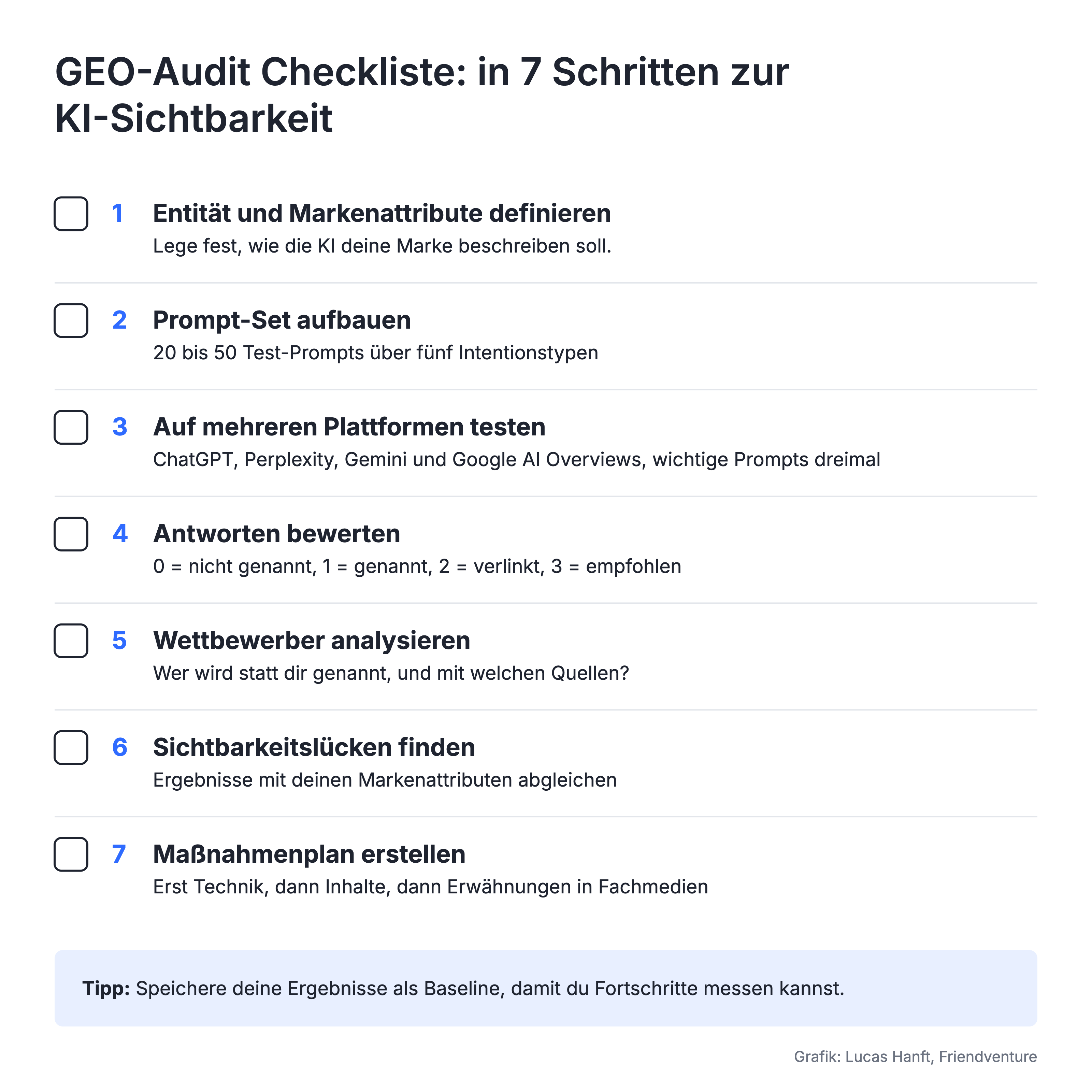
This is how we work at Friendventure when we set up a GEO audit for AI visibility. You can adopt the process one to one, even without a tool budget.
1. Define your entity and brand attributes
Write down how you would ideally like the AI to describe your brand: category, target group, core services, price level, and two or three distinguishing features. This list is your benchmark. Without it, you can't judge later whether an answer is correct.
2. Build a prompt set by intent type
Write 20 to 50 test prompts the way real customers would ask. The important part is the mix across five intent types:
Brand prompts alone are misleading. Almost every brand gets mentioned when you ask about it directly. Category and recommendation prompts are the meaningful ones, because they show whether you land on the shortlist.
3. Test on multiple AI platforms
Enter each prompt in ChatGPT, Perplexity, Gemini, and Google (for AI Overviews). Use a private browser tab or a fresh account without chat history, so that personalization doesn't distort the result. AI answers fluctuate, so I run important prompts at least three times.
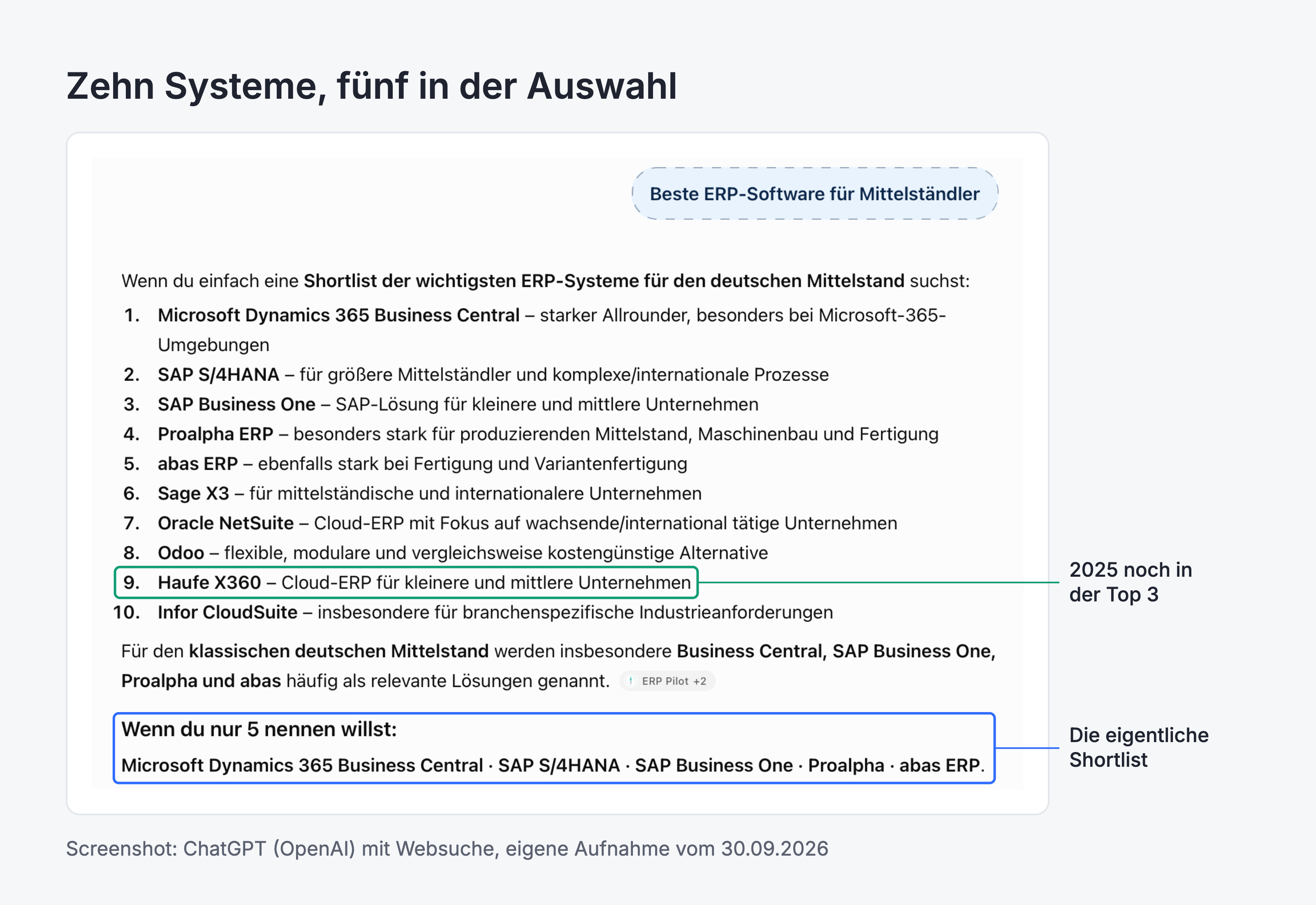
A test I ran for an article on the Friendventure blog shows how much AI answers change. Asked for the best ERP software for mid-sized companies, ChatGPT named exactly three systems in September 2025, including Haufe X360. When I tested again with web search on September 30, 2026, it named ten, which ChatGPT condensed into a selection of five at the end. Haufe X360 landed in 9th place and is missing from that selection. If you're missing from the shortlist, you won't even be compared.
4. Record and score the answers
Capture each answer in a table. For each prompt and platform, note the following. Are you mentioned? In which position? Are you linked? Is the description correct? What is the tone? A simple scoring scheme (0 = not mentioned, 1 = mentioned, 2 = mentioned and linked, 3 = recommended) is completely sufficient.
5. Analyze your competitors
Look at who gets mentioned instead of you and which sources the AI links for them. Often these aren't the competitors' own websites at all, but comparison articles, lists such as "Top 10 providers," or review platforms. That's a valuable insight, because that's where you can start.
6. Identify visibility gaps
Lay your results next to the brand attributes from step 1. Typical gaps are these: you're missing completely in category prompts, the AI describes you incorrectly or in an outdated way, or competitors are recommended through sources where you don't appear.
7. Create a prioritized action plan
Sort the actions by effort and impact. Technical blockers such as a misconfigured robots.txt always come first, because without access everything else stays ineffective. Content that answers key questions directly comes next, and only then long-term topics such as mentions in trade media.
Tools for a GEO audit
The right GEO audit tool depends mostly on how often you want to measure. For a first audit, free tools and some patience are enough. If you want to track regularly and across many prompts, you need dedicated software.
Ahrefs Brand Radar and the Semrush AI Visibility Toolkit show you how often your brand appears in answers from ChatGPT, Perplexity, Gemini, or Google AI Overviews, and compare that with your competitors. Both cost a three-digit amount per month. In my opinion, that only pays off once you actually implement actions after the first audit and want to track their impact.
More affordable specialist tools like Otterly.ai are a good middle ground. At Friendventure, we combine such tools with manual checks, because automated analysis counts mentions but rarely recognizes whether a description is accurate.
One tool is missing from many stacks: Bing Webmaster Tools. For its web search, ChatGPT draws on Bing, among other sources, as far as is known so far. If you're poorly indexed there, you also have worse chances in ChatGPT.
A note on Google Search Console: clicks and impressions from AI Overviews are included in the normal web data, and there is no separate report for them. If you want to know more about how Google handles AI features, you'll find the details in Google's Search Central documentation.
Key metrics in a GEO audit
You can derive five metrics from your scoring table. Each one answers a different question:
Here is an example for AI share of voice: if 200 brands are mentioned in total across your 40 category prompts and yours is mentioned 30 times, your share is 15%.
If you can report only one number to your management, use the recommendation rate. Mentions are nice, but they say little about whether the AI puts you on the shortlist.
Next steps
A complete GEO audit is work. For 50 prompts on four platforms with three runs each, you can quickly spend two to three days on testing and analysis. But it doesn't all have to happen at once.
My advice: start where your biggest risk lies. If you have a large JavaScript frontend, check crawler access and rendering first, which takes an hour. If you suspect that competitors are taking the shortlist away from you, start with ten category and recommendation prompts. And if the AI describes your brand incorrectly, clean up your entity data first.
If you'd rather not do the audit yourself, it's worth looking at a specialized GEO agency or at the overview of top AEO agencies here on the magier blog. However you proceed, the numbers from your first audit are your baseline. Without them, you won't know in six months whether your actions worked.



.avif)
%20(1).avif)