Top 12 AEO Agencies in 2026: How to Find the Right Fit for Your Brand
Did you know that AI search traffic has grown 7x compared to 2024, alongside a Gartner projection of a 25% drop in traditional search volume by 2026?
If those numbers don't make you rethink your SEO strategy, this one might: AI-generated responses now influence 43% of purchase decisions.
And here's the bitter truth – if your brand isn't being cited in ChatGPT, Perplexity, or Google AI Overviews, you're basically invisible to a growing chunk of your potential customers.
Traditional SEO can get you rankings on search engines like Google and Bing. But rankings don't matter much when someone asks an AI assistant, "what's the best project management tool for remote teams?" and gets a direct answer without ever seeing a search results page.
That's where answer engine optimization comes in. AEO is the practice of structuring your content in a way so that AI systems can easily extract, cite, and recommend it when users ask questions around your content. And like how brands would take help from agencies for SEO needs, there's a surge in AEO agencies that can help you get maximum LLM visibility.
However, because of this market saturation of AEO agencies – everyone claiming to be the best in the industry – finding the right one for your brand is no longer straightforward.
We spent the last 3 weeks reviewing over 50 agencies claiming to offer AEO services. Unfortunately, most were underwhelming; they either repackaged SEO or vague promises about "AI visibility" with nothing to back it up. But we found 12 AEO agencies that stood out with documented results, proprietary tools, and clear methodologies.
This guide covers who they are, what they charge, and how to figure out which one makes sense for your business.
So that once you’ve read this article, you know which AEO agency deserves your time and money.
TL;DR: the 12 best AEO agencies at a glance
{{freebie}}
How we evaluated these agencies
We looked at over 50 agencies offering AEO services and narrowed the list based on criteria that actually matter:
Documented results: Not vague claims about "increased AI visibility". We reviewed actual case studies showing citation rates, trial increases, or revenue impact. If an agency couldn't show us specific numbers, they didn't make the cut.
Proprietary tools or strong partnerships: The agencies doing real AEO work have built their own tracking systems or partnered with platforms like Profound, Scrunch, or SE Ranking to monitor AI citations across multiple platforms.
Technical depth: AEO requires understanding schema markup, entity optimization, and how retrieval-augmented generation (RAG) works. We prioritized agencies that could explain the technical "why" behind their strategies.
Client portfolio: We looked at who they've actually worked with and in which industries. An agency that's helped B2B SaaS companies may not be the right fit for healthcare or e-commerce.
Pricing transparency: Agencies that hide pricing until you're deep into a sales process often have something to hide. We favored those who are upfront about costs.
Geographic focus: We specifically selected agencies serving the US and European markets, with a mix of both.
{{cta}}
The 12 best AEO agencies in 2026
1. Graphite
Graphite is led by Ethan Smith, who's been doing SEO for 18 years and is one of the most recognized voices in AEO. If you've listened to Lenny's Podcast or taken a Reforge course, you've probably heard him break down how AI search actually works.
Graphite's philosophy centers on what they call "The 5%" – the idea that most SEO and AEO work is wasted, and a small number of strategies drive outsized results. It's a refreshingly honest take in an industry where agencies love to show you a 50-item roadmap full of busywork.
Their client list consists of big names, such as: Webflow, Notion, MasterClass, Robinhood, BetterUp, and OpenAI. Graphite has built their reputation helping high-growth tech companies scale organic visibility – first with SEO, and now increasingly with AEO as AI search traffic explodes.
Specialties:
- AI visibility tracking and share-of-voice measurement
- Question cluster research and landing page optimization
- Citation-building across Reddit, YouTube, and earned media
- Programmatic SEO at scale
Pricing: Enterprise-focused, custom quotes
Best for: Product-led B2B companies and growth-stage tech companies with substantial content operations who want a data-driven agency that's genuinely researching what works in AEO
2. Radyant
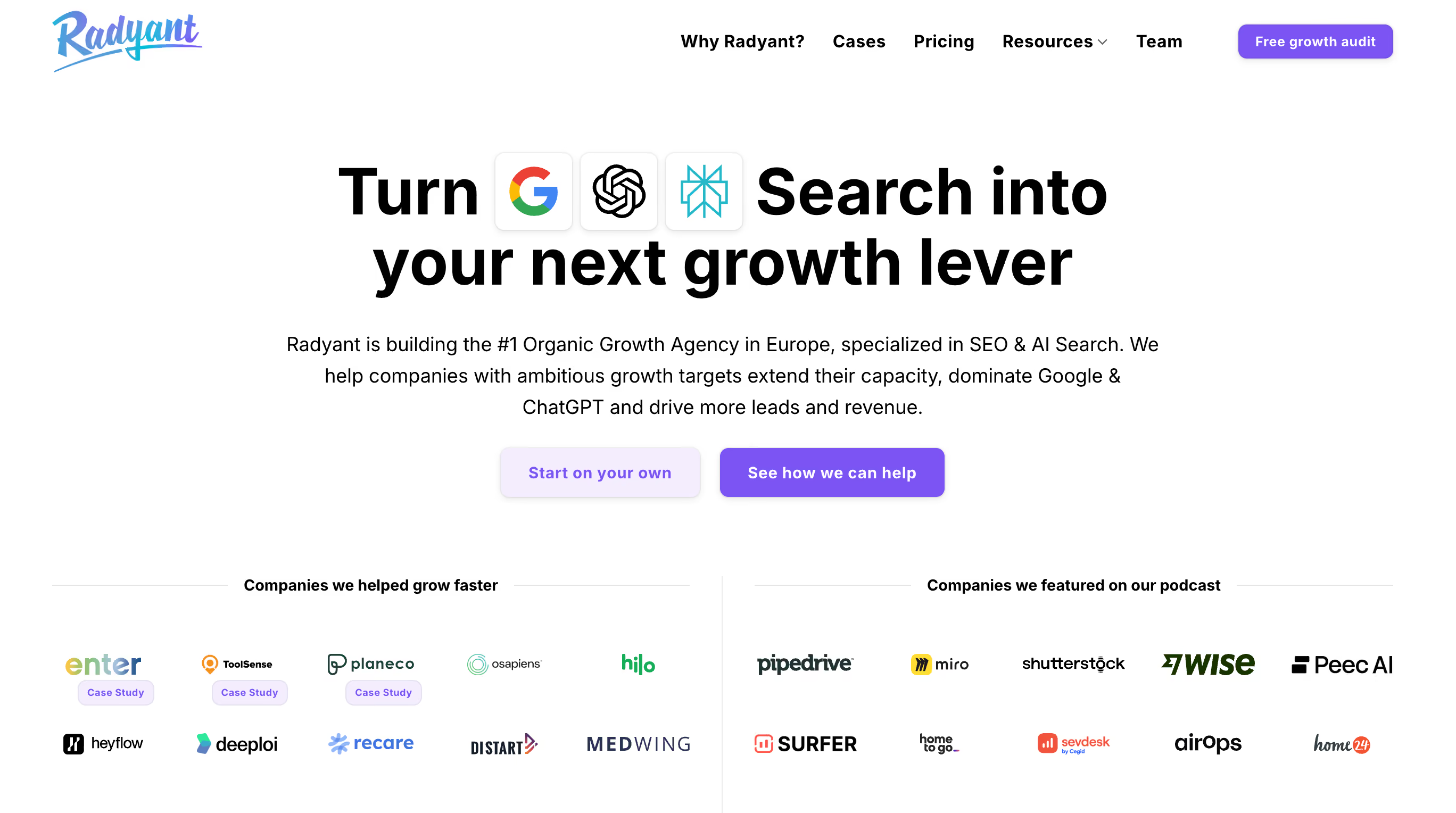
Radyant is building what they call "the #1 organic growth agency in Europe", and they're specifically focused on SEO and AI search for fast-growing companies with ambitious growth targets. Founded in 2019 and headquartered in the DACH region, they've since expanded across Europe.
What makes Radyant interesting is their explicit focus on pipeline and revenue over traffic. Their CEO Niklas puts it bluntly: legacy agencies hide behind vanity metrics. Radyant measures success in qualified leads, pipeline value, and revenue impact.
They've worked with 30+ fast-growing companies including Heyflow, ToolSense, Osapiens, and Enter. Their approach combines custom-built AI infrastructure (which allows them to move faster than traditional agencies) with deep strategic integration. Clients love how they extract knowledge from teams through structured interviews and turn it into content that actually converts.
Specialties:
- Pipeline-focused organic growth strategy
- AI search (AEO) combined with SEO
- Custom AI tooling for faster content production
- Conversion optimization and CRM attribution
Pricing: Custom based on scope
Best for: Fast-growing companies in DACH and the EU who want an agency that measures success in pipeline and revenue. Especially strong fit if you're in the DACH region or expanding across European markets, relevant for B2B SaaS, but equally for HealthTech, RegTech, PropTech, ClimateTech, and other sectors with research-intensive buyers.
3. First Page Sage
First Page Sage was the first agency to offer dedicated AEO services back in 2023, and they've maintained that lead by publishing proprietary research on AI visibility every quarter. Based in San Francisco, they've built their reputation on combining thought leadership content with technical AEO implementation.
Their approach centers on creating content that serves two purposes: establishing your brand as an industry authority while meeting the technical requirements that make AI systems want to cite you. They work primarily with B2B companies in technology, healthcare, and professional services.
What makes them different is their research. They study what's actually working across AI platforms and publish their findings. That means their strategies evolve as the landscape changes.
Specialties:
- Thought leadership SEO integrated with AEO methodology
- Quarterly proprietary research on AI citation patterns
- Enterprise-scale implementations across multiple markets
Pricing: Premium, enterprise pricing
Best for: Enterprise B2B brands that want a research-backed, established methodology and can invest at the premium tier
.avif)
4. iPullRank
iPullRank is Mike King's agency, and if you've followed the technical SEO industry, you know the name. Based in New York, they've been doing enterprise SEO since 2009 and have evolved their approach to include what they call "relevance engineering", optimizing content at the passage level for AI extraction.
Their client list reads like a Fortune 50 roster: SAP, American Express, HSBC, LG, Citi. These are complex organizations with massive websites and intricate technical requirements. iPullRank thrives in that environment.
They've developed in-house tools for tracking AI visibility across multiple platforms and specialize in the kind of technical implementation that most agencies can't handle – multi-language AEO, advanced schema at scale, and integration with complex content management systems.
Specialties:
- Passage-level engineering and relevance optimization for AI retrieval
- Complex technical implementations for large-scale enterprise sites
- Proprietary tools for multi-platform AI visibility tracking
Pricing: Custom quotes only, enterprise-focused
Best for: Fortune 500 companies and large enterprises with complex site architectures and the budget to match
.avif)
5. Discovered Labs
Discovered Labs takes an engineering-led approach to AEO, built around their proprietary CITABLE framework. Founded by Ben Moore (ex-Stripe and Coinbase) and Liam Dunne, they focus specifically on growth-stage B2B SaaS companies.
Their most impressive documented results includes scaling a client from 550 to 3,500+ trials in just 7 weeks. They achieved this through a combination of high-velocity content production (2-3 pieces per day), Reddit marketing for third-party validation, and aggressive citation optimization.
The CITABLE framework breaks down into seven components: clear entity structure, intent architecture, third-party validation, answer grounding, block-structured content for RAG, consistent information across platforms, and entity graph optimization. It's methodical and specific.
Specialties:
- CITABLE framework for systematic AI citation optimization
- Reddit marketing and third-party validation strategies
- High-velocity content production with daily output
Pricing: Mid-market range
Best for: Growth-stage B2B SaaS companies (2M-50M ARR) that want aggressive scaling and can handle high content velocity
.avif)
6. Siege Media
Siege Media has been doing content-led organic growth for 13 years, and their 90-person team has generated over $148 million in yearly traffic value for clients. They're based across Austin, San Diego, and Chicago.
Their AEO approach builds on their content expertise. They create premium, research-backed content for fintech, SaaS, and e-commerce brands, then optimize it for AI extraction. The philosophy is that substance, originality, and credibility matter more to answer engines than technical tricks alone.
What sets them apart is the quality bar. They're not a content mill churning out volume. They invest heavily in competitor research, SERP analysis, and LLM testing to create content that genuinely deserves to be cited.
Specialties:
- Premium content creation for fintech, SaaS, and e-commerce
- AI-enhanced content strategies with deep competitive analysis
- Strong E-E-A-T signal building through original research
Pricing: Mid to high tier
Best for: Content-heavy brands in competitive verticals that prioritize quality over quantity
.avif)
7. Omnius
Omnius is a Berlin-based agency that operates very differently from the others on this list. They only accept 8 clients per year (typically 2 per quarter) because they believe meaningful AEO results require deep integration with each client's business strategy.
They work exclusively with B2B SaaS, fintech, and AI companies in Europe and have built proprietary AI visibility tracking software called Atomic AGI. This tool provides real-time analytics and predictive citation insights across ChatGPT, Perplexity, Gemini, and Claude.
Their selective approach means they're not for everyone. But if you're a European B2B company that values white-glove service and wants an agency that treats your AEO as a strategic function (not just a marketing tactic), Omnius is worth the conversation.
Specialties:
- Multi-platform AI optimization with proprietary Atomic AGI tracking
- Deep strategic integration with client business goals
- Specialized expertise in European B2B SaaS and fintech
Pricing: Premium tier, selective client base
Best for: European B2B SaaS, fintech, and AI companies wanting highly personalized service
.avif)
8. Omniscient Digital
Omniscient Digital is known for what they call "surround sound SEO": the idea that you need to show up everywhere your buyers are looking, not just on your own website. Based in Austin, they've worked with companies like Jasper, Smartling, and other technically complex B2B brands.
Their AEO work builds on this philosophy. They create content ecosystems that establish topical authority across multiple platforms, so when an AI system looks for authoritative sources on a topic, your brand appears consistently. They generated $3.7M in pipeline for Smartling and helped Jasper achieve 400x product signups.
They also focus heavily on content-to-revenue attribution. They don't just track citations; rather, they connect AI visibility to actual business outcomes.
Specialties:
- "Surround sound SEO" creating multi-platform authority
- Content-to-revenue attribution and pipeline tracking
- Citation engineering through strategic content placement
Pricing: Varies by scope, accessible for established mid-market brands
Best for: Established B2B brands with technical complexity that want authority-driven growth
.avif)
9. Quoleady
Quoleady helped scale Expandi from $0 to $8M ARR, which tells you something about their ability to drive growth for SaaS startups. They specialize in high-volume content production combined with LLMO audits.
What makes them interesting is their focus on high-intent prompt identification. They research the specific questions and prompts that potential buyers are actually asking AI tools, then build content specifically designed to be the answer. It's a practical, research-driven approach.
They work primarily with B2B SaaS startups in the early to mid stages – companies that need to produce significant content volume without sacrificing quality or strategic direction.
Specialties:
- High-intent prompt identification and content mapping
- SEO/LLMO integrated content strategy
- High-volume production with quality control
Pricing: Startup-friendly, mid-market range.
Best for: Early to mid-stage B2B SaaS startups that need both volume and strategic direction.
.avif)
10. Amsive
Amsive occupies an important niche: AEO for regulated industries. If you're in healthcare, finance, or insurance, you know that marketing comes with compliance constraints that most agencies don't understand. Amsive does.
They have partnered with Profound, a visibility platform that tracks brand performance across five major AI engines: Google AI Overviews, AI Mode, ChatGPT, Perplexity, and Bing Copilot. This gives them granular data on how brands appear in AI responses across different platforms.
Their research shows that AI traffic converts significantly better than traditional organic search – one insurance client saw 3.76% conversion from LLM traffic versus 1.19% from organic. For regulated industries where trust is everything, that's meaningful.
Specialties:
- Compliant AEO for healthcare, finance, and insurance
- Profound platform integration for comprehensive AI visibility tracking
- E-E-A-T optimization for trust-sensitive industries
Pricing: Enterprise and mid-market, custom based on scope
Best for: Healthcare, finance, and insurance brands that need compliance-first AEO from an agency that understands regulatory constraints
.avif)
11. RevenueZen
RevenueZen takes a different approach than most agencies on this list. Their "RZ System" is built around interview-led workflows. This means that they extract unique insights from your subject matter experts and turn those into content that AI systems can't find anywhere else.
This matters because LLMs prioritize original information. If your content just summarizes what's already out there, you're competing with everyone else who did the same thing. Original insights from real experts give you something unique to be cited for.
They also offer AEO workshops and training, which makes them a good choice if you want to build in-house capabilities alongside agency support. They've helped companies like Expensify and Bloomfire turn internal expertise into AI citations.
Specialties:
- SME interview extraction and original content creation
- AEO workshops and in-house team training
- Authority-led SEO with AEO integration
Pricing: Mid-market B2B range
Best for: B2B companies with deep subject matter expertise who want to build internal AEO capabilities
.avif)
12. Chilli Fruit Web Consulting
Chilli Fruit is a UK-based agency that approaches AEO through the lens of digital PR. Their philosophy is that the authority signals that make AI systems trust and cite you come from being mentioned and linked across credible third-party sources.
Their most impressive result was helping Future Processing achieve 12.5% AI search coverage – outranking Amazon and Deloitte for relevant queries. They did this through HARO and Qwoted campaigns, strategic editorial placements, and systematic brand mention building.
For European tech companies that need to build authority signals from scratch, Chilli Fruit offers an accessible entry point into AEO that doesn't require enterprise budgets.
Specialties:
- HARO/Qwoted campaigns for authority signal building
- Editorial placements designed for LLM visibility
- Brand mention strategy across trusted sources
Pricing: Accessible for mid-market, lower entry point than US enterprise agencies
Best for: Tech brands in Europe that need to build authority signals and third-party validation
.avif)
More AEO agencies: honorable mentions
Here are a few other agencies worth knowing about:
GenOptima offers a result-as-a-service (RaaS) pricing model where you pay based on measurable AI visibility improvements rather than monthly retainers. They reported a 90.9% recommendation rate across 1,500 model outputs for one client.
Rock The Rankings runs a focused 120-day SaaS GEO program. 86% of their clients reach top-10 AI visibility within 6 months.
Sterling Sky specializes in local-intent AEO. If your business depends on "near me" queries and local search, they're the experts – founded by Joy Hawkins, who's been a leader in local SEO for years.
OuterBox focuses on e-commerce AEO, helping product-based brands show up in AI shopping recommendations. They're frequently mentioned alongside SmartSites for product-focused AI visibility.
Ten Speed takes an editorial-led approach to GEO, specializing in content refreshes and citation lifting for brands that already have substantial content libraries.
Avenue Z combines AEO with brand authority and PR strategy. They treat AI visibility as an extension of public presence – useful if you want consistent positioning across both traditional media and AI answers.
SmartSites is another strong option for e-commerce brands, particularly those needing a full-service approach that combines AEO with paid media and web development.
House of Growth focuses on early-stage startups and VC-funded SaaS. Founded by John Ozuysal, they specialize in "narrative control" – making sure AI systems describe your product the way you want it described. They generated 25% of the pipeline for Warmly through AEO alone.
Single Grain (led by Eric Siu) has developed what they call "Answer Everywhere Optimization" – a broad approach covering AI assistants, voice search, and generative platforms simultaneously. Good for brands wanting comprehensive coverage.
Notebook Agency was founded by Steve Toth and built around their proprietary "Truth Alignment Framework" designed to position brands as preferred solutions in LLM responses. They recently expanded to serve enterprise clients.
What is an AEO agency?
An AEO agency helps your brand show up in AI-generated answers. That's it in plain English.
When someone asks ChatGPT, "What CRM should I use for a small sales team?" or searches Google and gets an AI Overview instead of ten blue links, an AEO agency's job is to make sure your brand gets mentioned, cited, or recommended in that response.
This is different from traditional SEO. SEO focuses on getting your pages to rank high so people click through to your website. AEO focuses on getting your content cited directly in the answer, sometimes without a click happening at all.
The platforms AEO agencies optimize for include ChatGPT, Perplexity, Claude, Google Gemini, Microsoft Copilot, and Google AI Overviews. Each one pulls and synthesizes information slightly differently, which is why this has become a specialized skill set.
But the truth is that most traditional SEO agencies have added "AEO" to their websites without actually changing how they work. A real AEO agency understands how large language models retrieve and cite information – and builds strategies specifically for that.
When working on AEO, it is important you prioritize your webdesign. If you're looking for budget-friendly options, check out our blog on affordable webdesign agencies.
AEO vs GEO vs LLMO: what's the difference?
You'll see these acronyms thrown around a lot, often interchangeably. But they're not the same thing, and understanding the difference helps when you're evaluating agencies.
Answer engine optimization (AEO)
It is the broadest term. It covers optimizing for any system that provides direct answers – voice assistants like Alexa and Siri, featured snippets in Google, and AI chatbots. The goal is to be the answer, not just rank near it.
Generative engine optimization (GEO)
GEO is more specific. It focuses on AI platforms that generate paragraph-style responses by synthesizing information from multiple sources – think ChatGPT, Claude, Perplexity, and Google AI Overviews. GEO is really a subset of AEO.
Large language model optimization (LLMO)
This one goes deeper. It's about influencing how your brand appears in the foundational training data and knowledge graphs that LLMs use. This includes things like Wikipedia presence, Wikidata entries, and consistent entity information across the web.
Why does this matter? Because some agencies specialize in one area while claiming to cover all three. If you're primarily concerned with showing up in ChatGPT responses, you want an agency strong in GEO. If you need voice search optimization, that's classic AEO territory. And if you're playing the long game on brand perception within AI models, LLMO expertise matters.
The best agencies understand all three and can tell you which approach fits your situation.
As a team, we learned a lot about AEO by subscribing to these marketing newsletters. You could try them, too.
What SEO tools should agencies use for AEO recommendations?
When you're evaluating agencies, ask what tools they use to track AI visibility. The answer tells you a lot about how seriously they take AEO.
Dedicated AEO/GEO platforms:
- Scrunch covers monitoring, auditing, optimization, and content delivery. Their Agent Experience Platform (AXP) can serve AI-optimized content directly to LLMs. Pricing starts at $250/month for brands.
- Profound tracks brand performance across five major AI engines and provides competitive positioning data. Amsive and several other agencies use this for client reporting.
- Adobe LLM Optimizer launched in late 2025 as part of Adobe Experience Cloud. It's enterprise-focused and works best for companies already in the Adobe ecosystem.
- Semrush AI Visibility Toolkit adds AI search tracking to their existing SEO platform. Good for teams that want everything in one place.
- SE Ranking offers AI answer tracking and citation pattern analysis at a more accessible price point.
Proprietary agency tools:
Several top agencies have built their own tracking infrastructure:
- Atomic AGI by Omnius: Real-time LLM analytics and predictive insights
- Goodie by NoGood: Monitors visibility across ChatGPT, Gemini, Claude, and Perplexity
- CITABLE infrastructure by Discovered Labs: Tracks citations and share of voice
- Luminr by Found: Maps AI assistants and social search feeds
- Barracuda by Go Fish Digital: Semantic analysis with helpfulness scoring
- InteroBOT by Intero Digital: Crawler that mimics search engine ingestion
If an agency can't tell you specifically how they track AI visibility, that's a red flag. The technology to monitor this exists – agencies doing real AEO work are using it.
How to choose the best AEO agency for your marketing goals
Match the agency to your industry
Not every AEO agency works well for every business. Here's a quick guide:
Questions to ask before signing
Before committing to any agency, get clear answers to these:
Contract considerations
- Start small if possible. Many reputable agencies offer 8-12 week trial engagements or fixed-scope projects (like an audit plus roadmap) before requiring long-term commitment.
- Avoid 12-month lock-ins without a proof of concept. If an agency won't let you test the relationship first, ask why.
- Clarify deliverables upfront. Ask questions, such as: What exactly do you get each month? How often will you receive reports? Who owns the content and strategies if you part ways?
Red flags: how to spot fake or underqualified AEO agencies
The AEO space is still young, which means it's full of agencies making promises they can't keep. Here's what should make you walk away:
Run from "guaranteed" AI placements
Any agency promising you'll definitely appear in ChatGPT or get a specific number of citations is lying. AI outputs are probabilistic – they change based on the user's location, how they phrase the prompt, and factors nobody fully controls. Good agencies improve your odds significantly, but they don't guarantee outcomes.
Demand specific metrics, not vague "visibility" claims
If they can't show you citation rates, share of voice, or specific tracking methodology, they probably aren't measuring anything meaningful. "Increased AI visibility" without data to back it up is meaningless.
Don't fall for rebranded SEO dressed as AEO
Watch out for agencies that pitch the same old tactics – "we'll build links, fix technical issues, and publish content" – and call it AEO. Real AEO requires specific techniques for AI extraction. If they can't explain how their approach differs from traditional SEO, it probably doesn't.
Walk away if they have no tracking tools
The technology to monitor AI citations exists. Agencies that are actually working for AI visibility use these tools constantly. But if they're flying blind or using traditional SEO tools, it would be in your best interest to walk away.
Be skeptical if they can't explain the technical "why”
A competent AEO agency can explain how schema markup helps AI systems understand your content, why RAG-optimized formatting matters, and what entity disambiguation means. If they just promise results without explaining mechanisms, it is okay to be skeptical.
Think twice about pay-per-answer pricing
Some agencies offer pricing tied to specific AI appearances. This is high-risk because AI outputs fluctuate constantly. You could pay for a citation that disappears the next day.
Question enterprise pricing with no breakdown
Quotes of $20,000+/month aren't inherently suspicious. The truth is that enterprise AEO is complex work. But if they can't break down what you're paying for (how much goes to content, tools, reporting, strategy), that opacity usually hides inefficiency.
Green flags to look for
Proprietary tracking infrastructure or named platform partnerships
The best AEO agencies have invested in tools to actually measure what they're doing. Whether they've built something in-house like Omnius did with Atomic AGI, or they partner with platforms like Profound, Scrunch, or SE Ranking – they should have a concrete answer when you ask how they track AI visibility across ChatGPT, Perplexity, Claude, and Google AI Overviews.
Clear methodology that they can explain in plain language
A competent AEO agency can walk you through exactly how they structure content for answer engines. They should be able to simplify concepts like schema markup implementation, RAG-optimized formatting, and entity disambiguation. If they can't explain their approach without hiding behind jargon or vague promises, they probably don't have one. The best agencies make complex technical concepts easy to understand.
Focus on revenue and pipeline impact, not just visibility metrics
Citation rate and share of voice matter, but they're not the end goal. Strong agencies connect AEO performance to business outcomes, such as, trial signups, qualified leads, and actual revenue. Ask how they attribute results. If they only talk about "increased AI visibility" without tying it to your bottom line, that's a sign they're optimizing for only vanity metrics.
Willingness to start with a trial engagement
Agencies confident in their work don't need to lock you into 12-month contracts upfront. Look for those offering 8-12 week trial periods or fixed-scope projects like an AEO audit plus roadmap. This lets you evaluate their approach, communication style, and early results before making a bigger commitment. But also note that to see results, it is important that you give these agencies at least 3 months.
Case studies with specific, verifiable numbers
Vague claims like "improved AI presence" mean nothing. The agencies worth hiring can show you specific results like citation rate improvements, share of voice gains, trial increases, or revenue impact. Discovered Labs scaled a client from 550 to 3,500+ trials in 7 weeks. Chilli Fruit helped Future Processing achieve 12.5% AI search coverage. Those are the kind of numbers that indicate real expertise.
How AEO agencies structure content for answer engines
Understanding the technical side helps you evaluate whether an agency actually knows what they're doing.
Block-structured formatting
AI systems using retrieval-augmented generation (RAG) pull specific chunks of content – typically 200-400 words – to synthesize answers. Good AEO agencies structure content in discrete, self-contained blocks that can be extracted as standalone answers.
Schema markup
This is the machine-readable code that tells AI systems what your content is about. Key schemas for AEO include FAQ, HowTo, Product, Organization, and Article. Schema acts as a translation layer that helps LLMs ingest your content with higher confidence.
Answer grounding
This means providing verifiable, fact-rich content that AI systems can use as a "source of truth." Original statistics, specific numbers, and unique data points give LLMs something concrete to cite.
Entity disambiguation
AI systems need to understand exactly who you are and not confuse you with similar names. This involves consistent presence across Wikidata, Wikipedia (where relevant), Crunchbase, and other knowledge sources that LLMs reference.
Definition lead format
The most important information goes first. Instead of building up to a conclusion, AEO-optimized content answers the question immediately, then provides context. This matches how AI systems extract information.
When you're talking to agencies, ask them to explain these concepts. If they can't, they're probably not so clear on how these concepts work and how to use them to optimize your visibility.
AEO pricing: what to expect in 2026
AEO pricing varies wildly, so here's a realistic breakdown:
Entry level: $1,500-$3,500/month
At this tier, you typically get basic audits, content optimization recommendations, and schema implementation. It's enough to get started but usually doesn't include ongoing content production or comprehensive tracking. Good for small businesses testing the waters.
Mid-market: $5,000-$10,000/month
This is where most serious AEO work happens. You get ongoing content creation, multi-platform citation tracking, regular reporting, and strategic optimization. Most B2B SaaS and mid-sized companies land here.
Enterprise: $15,000-$50,000+/month
Large-scale implementations with dedicated teams, custom tracking infrastructure, multi-market optimization, and deep strategic integration. Reserved for companies with complex needs and budgets to match.
Pricing models
- Monthly retainer is the most common. You pay a fixed amount for ongoing services.
- Project-based works for one-time needs like audits or initial setup.
- Performance-based (RaaS) ties payment to measurable improvements. GenOptima pioneered this model.
Hidden costs to watch for
- Tool subscriptions passed through at markup
- Setup or onboarding fees not mentioned upfront
- Content production billed separately from strategy
- Revision limits that result in extra charges
Always ask for a complete breakdown of what's included and what costs extra.
Final thoughts
AEO isn't a trend that's going away. As AI handles more of how people search and discover brands, the gap between companies that optimize for it and those that don't will only widen.
The agencies on this list represent the current leaders, but the space is evolving fast. What matters more is finding a partner that understands your specific situation, can explain their methodology clearly, and measures success in terms that matter to your business.
Start with clear goals. Vet thoroughly. Don't fall for guaranteed rankings or vague promises about "AI visibility."
And if you're not ready to hire an agency, at least start paying attention to how your brand shows up when people ask AI assistants about your category. That answer is increasingly where buying decisions begin.
FAQ
Is there an AEO platform for agency use?
Yes. Platforms like Scrunch, Profound, and Adobe LLM Optimizer let agencies (and brands) track AI visibility across multiple engines. Scrunch offers agency-specific plans starting at $500/month. Many top agencies also build proprietary tools – Omnius has Atomic AGI, Discovered Labs has CITABLE infrastructure, and NoGood built Goodie.
What's the difference between an AEO agency and an SEO agency?
SEO agencies optimize for rankings and clicks in traditional search results. AEO agencies optimize for citations in AI-generated answers. The technical requirements differ significantly – AEO requires schema markup expertise, entity optimization, and understanding of how LLMs retrieve information. The best agencies do both, but they approach each with distinct strategies.
How long does AEO take to show results?
Most documented case studies show meaningful improvements in 4-6 months, with ROI-positive results by month 6-9. Some agencies report faster wins – Discovered Labs scaled a client's trials in 7 weeks – but that's not typical. AI visibility is a leading indicator; traffic and revenue impact usually follow.
Can AEO agencies guarantee AI citations?
No, and any agency claiming otherwise is a red flag. AI outputs are probabilistic and vary based on user location, prompt phrasing, and constantly updating models. Reputable agencies improve your odds significantly through proven methodologies, but guarantees in this space are impossible.
Do I need AEO if I already do SEO?
Yes. SEO builds the foundation – site authority, content quality, technical health – that AEO builds on. But traditional SEO tactics alone won't get you cited in AI answers. AEO adds specific optimizations: structured content for RAG, entity clarity, schema markup, and third-party validation signals. Think of AEO as an extension of SEO, not a replacement.
How do AEO agencies measure success?
Key metrics include citation rate (how often you're cited for target queries), recommendation rate (how often AI recommends you on commercial shortlists), share of voice versus competitors, AI-referred traffic, and conversion rate from AI sources. Good agencies track all of these and tie them to business outcomes like pipeline and revenue.
.avif)