Top SaaS Design Agencies in 2026 (and How to Choose the Right One)
We have been designing for SaaS companies for a while now. From early-stage startups trying to get their first landing page right to Series B companies looking for a brand refresh — we've picked up quite a few lessons after working with 150+ brands.
One of those lessons is that most SaaS companies, especially the ones that already have a great product, often struggle because their design doesn't communicate the product's value properly. Even if they are attracting potential clients, this audience doesn’t understand what the product is about from the web design, and thus bounce off. According to Semrush and Databox, the median bounce rate for SaaS websites is 48.27%, which means nearly half of your visitors are leaving after viewing just one page without taking any meaningful action.
That's not a problem you can solve with a traditional design agency. The best SaaS design agencies are the ones that understand subscription psychology, complex onboarding sequencing, data-dense dashboards, pricing page optimization, and the ongoing challenge of reducing churn through better UX. Top SaaS design agencies like magier, MetaLab, Qubstudio, and Cieden can tie design decisions to the metrics that move the needle when it comes to business growth, such as activation, retention, and revenue.
To reduce your decision fatigue, we reviewed and compared the top SaaS design agencies operating in 2026. But before going ahead, here’s what we want to mention with utmost transparency: magier is featured on this list, and we've included ourselves because we believe our flexible subscription, one-time project scope, and SaaS expertise are truly valuable for SaaS brands. But we've been honest about every agency's strengths throughout, including ours, and the evaluation criteria have been the same for everyone.
In this guide, we have covered:
- Why SaaS companies need a specialized design agency
- How to choose the right one for your stage
- A quick comparison table of all 12 SaaS design agencies
- Detailed profiles of each agency
- Pricing breakdown by engagement model
- Common mistakes when hiring
...and more. Let's get into it.
Quick comparison: top SaaS design agencies in 2026
| Agency | Best for | Pricing model | Notable clients/results |
|---|---|---|---|
| heartbeat | Funded SaaS and fintech teams needing brand + product as one system | Project-based (from $25,000+) | Hyros, Corti, Neo4j, First Digital, GovEagle |
| MetaLab | Funded SaaS (Series B+) wanting premium polish | Project-based (premium) | Slack, Coinbase, Suno AI, Midjourney |
| magier | Scaling SaaS teams needing ongoing design + Webflow | Monthly subscription (from €2,750/mo) | 150+ brands, Upvest, Planted, Kyber |
| Qubstudio | Unified product + brand experience at scale | Project-based or partnership | Fintech, Healthcare, HRTech verticals |
| Cieden | Measurable design improvements tied to business metrics | Team extension / hourly (from $7,200/mo per person) | 8+ years SaaS, detailed ROI case studies |
| Excited! | Teams that need a partner willing to challenge assumptions | Project-based | XILO ($14M funding), Verida ($5M raise) |
| Arounda | Fintech and AI SaaS startups | Project-based | Admin panels, dashboards, multi-role platforms |
| Work & Co | Enterprise SaaS at massive scale | Project-based (premium) | Large-scale platforms, millions of users |
| Pony Studio | SaaS brands that want bold, distinctive design | Project-based | Creative/younger audiences, personality-focused |
| CodeTheorem | Pre-Series A startups on tight budgets | Project-based (cost-effective) | Dev-led teams, productivity tools |
| Lazarev Agency | Premium visual storytelling and motion | Project-based | Visually distinctive SaaS interfaces |
| Wavespace | Webflow-built marketing sites that convert | Project-based | SaaS startups, AI products |
| Brights | Non-technical founders needing design + dev | Project-based or retainer | Full-cycle, Eastern Europe |
{{freebie}}
What is a SaaS design agency?
A SaaS design agency is a design firm that specializes in working with software-as-a-service companies. Unlike generalist agencies that serve brands from all industries and use the same design framework, a SaaS design agency understands how software products grow, how users interact with subscription-based tools, and what design decisions actually move metrics like activation, retention, and revenue and designs accordingly.
The scope of what they offer can vary, but most SaaS design agencies cover some combination of the following:
- Product design (UI/UX): This is the core for many SaaS agencies. It includes designing the in-app experience, from onboarding screens and dashboards to settings pages and empty states. The goal is to make the product intuitive enough that users reach their "aha moment" before they consider canceling.
- Website design: Your marketing website is often the first thing a potential customer sees. SaaS design agencies build landing pages, pricing pages, feature pages, and homepages that are specifically designed to convert trial signups, demo requests, or paid subscriptions.
- Brand identity and visual systems: Logo design, color palettes, typography, iconography, and the brand guidelines that tie everything together. For SaaS companies, this also includes making sure the brand identity works consistently across the product interface, the marketing site, and all external communications.
- Ad creatives and social media design: Paid ads for LinkedIn, Meta, Google Display, and other platforms. Social media graphics for organic content. Creative assets for retargeting campaigns. SaaS companies run a lot of ads, and the design quality directly affects performance.
- Pitch deck and presentation design: Investor decks, sales decks, partner presentations, and internal strategy decks. For startups that are fundraising or closing enterprise deals, the design quality of these materials sends a signal about the company's professionalism.
- Ebook, whitepaper, and report design: Gated content is a major lead generation tool for B2B SaaS. Design agencies create the layouts, covers, and internal formatting for downloadable assets that marketing teams use to capture leads.
- Email and newsletter design: Onboarding email sequences, product update announcements, marketing newsletters, and lifecycle emails. These need to be on-brand, responsive, and clear.
- Illustration and iconography: Custom illustrations for the website, product, and marketing materials. Icon systems for the product interface. These small visual elements add up to create a cohesive brand experience across every touchpoint.
- Motion design and animation: Micro-interactions within the product, animated explainer sections on the website, social media video assets, and product demo animations. Motion design is becoming increasingly important for SaaS companies that want to stand out visually.
- Design systems: Component libraries, design tokens, and documentation that ensure visual consistency as the product and team scale. This is especially important for Series B+ companies where multiple designers and developers are working on the same product simultaneously.
Not every SaaS design agency offers all of these. Some specialize purely in product UI/UX. Others focus on marketing websites and brand identity.
How we chose the agencies on this list
Before we get into the individual profiles, here's how we evaluated and selected the agencies for this list:
- SaaS-specific experience: We only included agencies that have documented experience working with SaaS companies. Generalist agencies that happen to have one SaaS project in their portfolio didn't make the list.
- Documented case studies with real outcomes: We looked for agencies that show more than just screenshots. Case studies with specific metrics (conversion lift, churn reduction, funding raised, activation improvement) received more weight than visual portfolios alone.
- Client reviews and third-party ratings: We checked Clutch, Trustpilot, G2, and Dribbble ratings where available. Agencies with consistently high ratings and verified client reviews ranked higher in our evaluation.
- Range of services relevant to SaaS: We evaluated whether each agency covers the design services SaaS companies actually need: product UI/UX, marketing websites, brand identity, ad creatives, design systems, and Webflow or front-end development.
- Pricing transparency and engagement flexibility: Agencies that are upfront about their pricing models (subscription, project-based, retainer) and offer flexible engagement options scored higher than those with opaque or rigid pricing structures.
- Team size and capacity: We considered whether the agency has the capacity to take on new clients and deliver within reasonable timelines. Award-winning agencies with six-month waitlists are less useful to a SaaS company that needs help now.
- Ownership and deliverables: We confirmed whether each agency transfers full ownership of design files, code, and assets to the client. Agencies that retain ownership of deliverables were flagged in their profiles.
- Community and industry reputation: We looked at how often each agency appears in industry publications, ranking articles, and community discussions on Reddit (r/SaaS, r/startups) and design forums. Agencies that are frequently recommended by peers carry more credibility than those that only appear in their own marketing.
- Stage fit: We made sure the list includes agencies for every company stage: pre-seed startups on tight budgets, Series A companies focused on growth metrics, and Series B+ enterprises that need design systems and regulatory compliance. Not every agency is right for every stage, and we've been clear about that in each profile.
The top SaaS design agencies in 2026
1. heartbeat (best for funded SaaS and fintech teams that need brand and product design as one system)
heartbeat is a product and brand design studio with 15 years of experience working with fintech, AI, and SaaS founders. Their team of seven senior designers has worked together for an average of nine years, and the studio operates with no juniors and no account layers. Their approach treats brand and product as one connected system, so positioning, identity, product UI, website, and motion all follow the same logic.
Their portfolio includes work for Hyros, Corti (Series B, $60M), First Digital ($3B stablecoin issuer), GovEagle (YC W23), and Neo4j (Series F, $325M). Companies they've worked with have raised more than $1B combined. Their design system, Pulse, is listed alongside IBM, Atlassian, and Adobe in the "Awesome Design Systems" directory.
Key services:
- Brand identity and visual systems
- Product design (UI/UX)
- Website design and development
- Design systems
- Motion design
Best for:
- Funded SaaS and fintech companies (Series A+) that need brand and product aligned under one system
- Teams going through a rebrand, launch, or repositioning where the stakes are high
Rating: 5.0/5 on Clutch (11 reviews)
Pricing: Project-based. Minimum project size starts at $25,000+.
Pros:
- All-senior team with no junior handoffs
- Brand, product, and website are designed as one connected system
- Strong track record in complex verticals like fintech, AI, cybersecurity, and healthtech, where design has to account for compliance, data density, and trust
- Every engagement is designed to leave the client with a durable system their own team can extend independently
Cons:
- Small team of seven might meanlimited capacity
- Project-based only
2. MetaLab (best for funded SaaS companies wanting premium product design)
MetaLab is the team behind Slack's original design, and that reputation is well earned. Based in Canada with a team of over 200 people, they've helped build products for 18 unicorns that collectively serve over 2.2 billion users. Their specialty is making complex enterprise tools feel as intuitive and polished as consumer apps.
MetaLab is well-known in the industry for their depth of thinking. They think through the product model alongside the visual system, which makes them a genuine strategic partner rather than a production studio. Their recent work with Suno AI (an app that rocketed up the charts within 24 hours of launch) and Midjourney (designing "Rooms," a multiplayer ideation space for 3M+ daily active users) shows they're ahead of the curve on AI-first design.
Key services:
- Product strategy and UI/UX design
- Branding and visual identity
- Design systems
- Zero-to-one product launches
Best for:
- Funded SaaS companies (Series B+) that need premium polish and credibility
- Teams building in new product categories where the product model itself needs design thinking
Rating: 4.8/5 on Clutch
Pricing: Custom pricing.
Pros:
- One of the strongest portfolios in SaaS product design (Slack, Coinbase, Midjourney, Suno AI)
- Strategic depth that goes beyond visual design into product model thinking
- 200+ person team with the capacity to handle large, complex projects
- Proven track record with zero-to-one product launches
Cons:
- Premium pricing puts them out of reach for most early-stage startups
- Project-based model means no ongoing support unless you engage them for a new scope
- Long lead times for project kickoff due to demand
3. magier (best for scaling SaaS teams that need ongoing design + Webflow development)
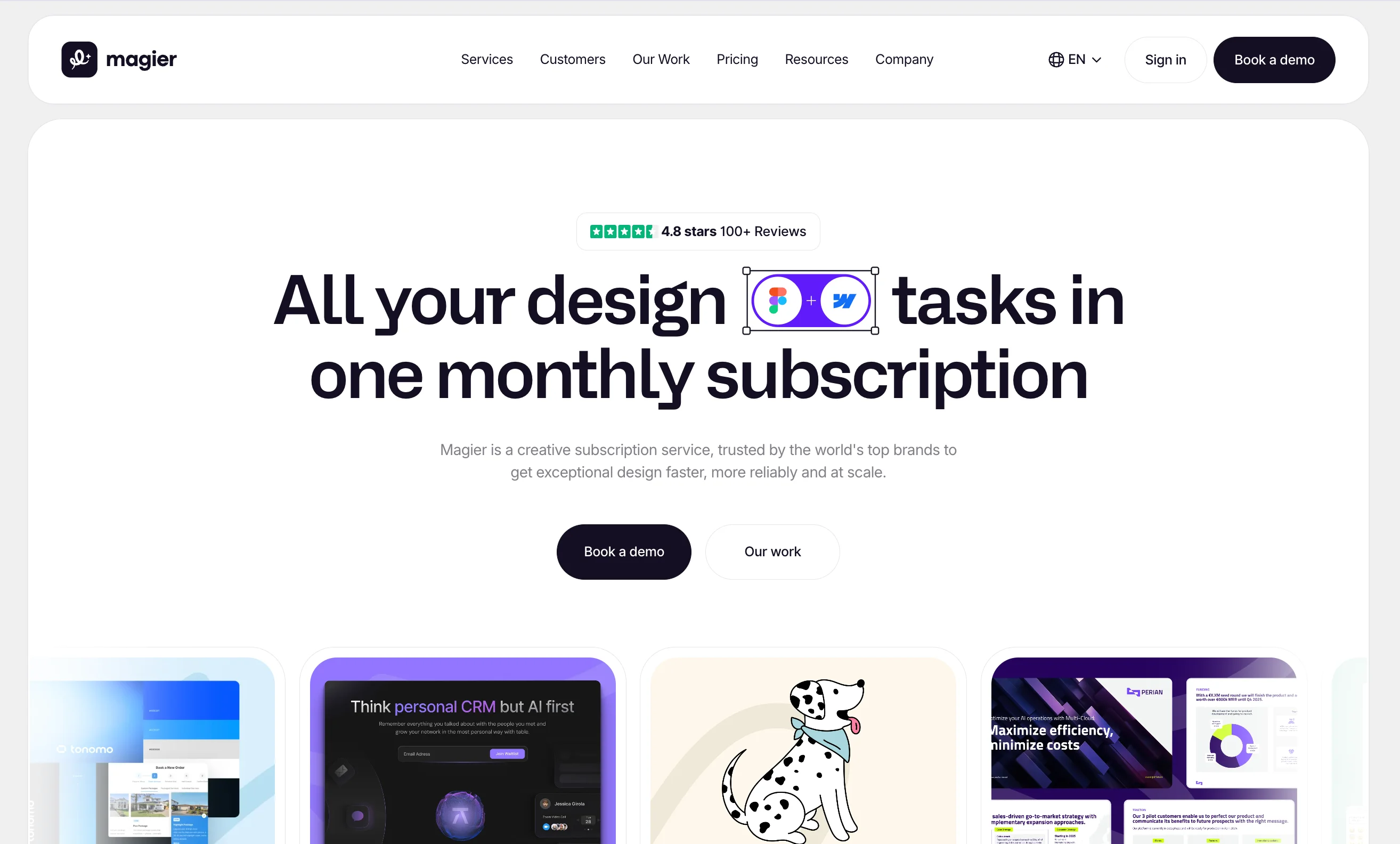
Compared to the other agencies on this list, magier offers SaaS design as part of a design subscription service. If you're a scaling SaaS company that's tired of overpaying agencies for individual projects, waiting weeks for deliverables, and constantly asking "how much will this cost?", magier is built to solve that problem.
Think of us as the extension to marketing teams that have a lot of design needs but struggle to execute them all in-house. You can submit design requests through a simple ticket system, get your dedicated team of designers and a project manager, and receive completed work within 48 hours. You can also go through multiple rounds of revisions until the designs suit your needs. For companies that don't have a constant need for a subscription, magier also takes on one-time projects with the same team quality and turnaround speed.
We've worked with over 150+ brands, including Upvest, Planted, Kyber, and Sparetech, and have completed over 1,000+ SaaS ad creatives for B2B SaaS companies. Our team specializes in SaaS web design and Webflow development, which means we handle both the design and the build under one subscription. That combination is rare in this space, and it removes the coordination overhead that comes from managing separate design and development partners.
Key services:
- Graphic design (ads, social media, presentations, brand collateral)
- Webflow design and development
- Landing page and pricing page design
- Brand identity design
- Motion design
- Pitch deck and presentation design
Best for:
- Startups and scaleups (Series A+) that need ongoing, high-volume creative work with fast turnaround and predictable costs
- Companies that want both design and Webflow development from one partner
- Marketing teams that need a wide range of design services without hiring multiple vendors
Location: Berlin, Germany (serves clients globally, fully remote)
Pricing: Starts at 2750€/month.
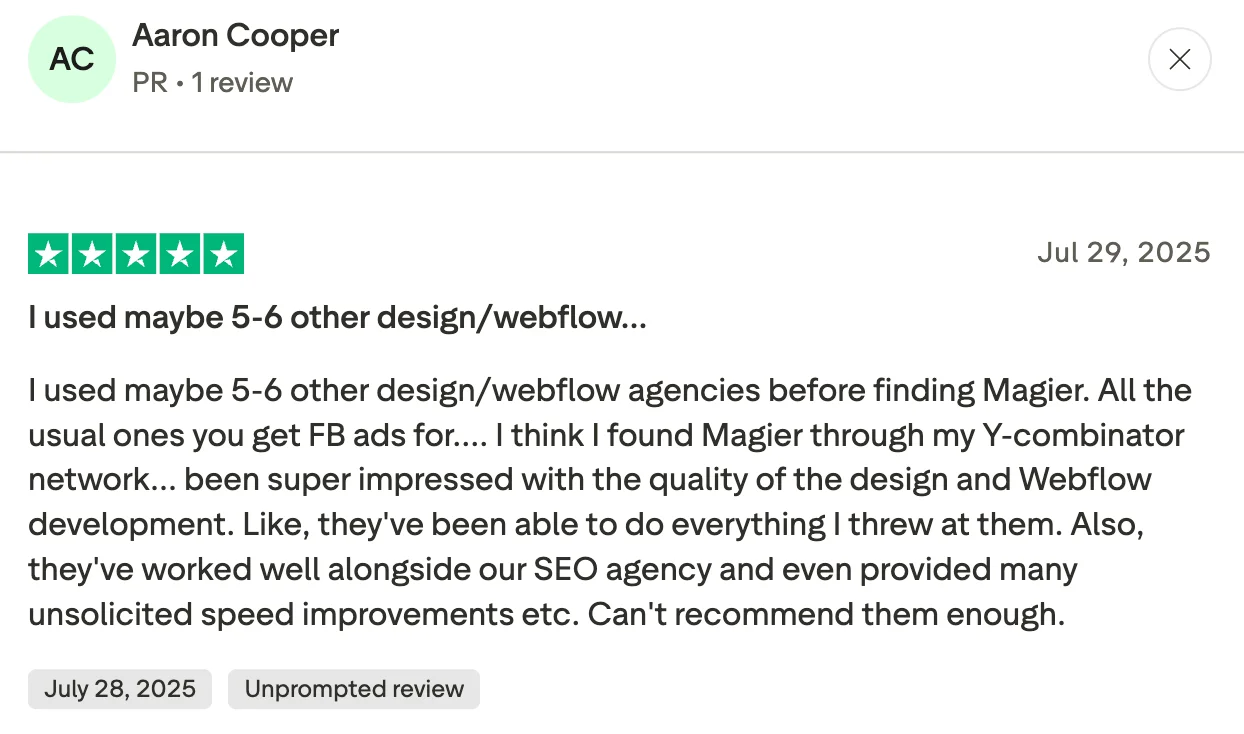
Rating: 4.9/5 on Trustpilot (100+ reviews)
Pros:
- Flexible engagement: choose between a monthly subscription or a one-time project depending on your needs
- Wide range of design services under one roof (ads, landing pages, brand identity, Webflow, presentations, motion) so you don't need separate vendors for each
- Affordable and predictable pricing for Series A+ companies compared to traditional project-based agencies
- Fast turnaround (48 hours average per task) with multiple revisions included
- You own everything they create, including all design files and Webflow builds
- Webflow design and development handled by the same team, which eliminates the "design doesn't match the build" problem
Cons:
- Does not offer specialized UI/UX product design services (in-app interfaces, user research, usability testing). If you need deep product design work, you'll need a dedicated product design agency alongside magier.
{{cta}}
4. Qubstudio (best for unified product + brand experience at scale)

Qubstudio is a digital experience design agency focused on building scalable SaaS products with unified UX and branding. Their approach combines research, product strategy, and design systems to ensure consistency across complex user journeys and touchpoints as products grow.
They work across verticals, including fintech, healthcare, HRTech, logistics, and EdTech, and their process is designed for teams that need both product design and website design to work as one system. Qubstudio also publishes some of the most detailed content on SaaS design topics, which speaks to their depth of knowledge in this space.
Key services:
- SaaS UI/UX design
- Digital product design and strategy
- Design systems and UX audits
- UX research
Best for:
- SaaS companies that need a unified experience across product, brand, and marketing from strategy through scale
- Teams working in regulated verticals that need both design quality and compliance awareness
Rating: 4.9/5 on Clutch
Pricing: Custom pricing
Pros:
- Strong focus on design systems and scalability, which pays off as your product and team grow
- Covers both product design and marketing design as one unified system
- Experience across regulated verticals (fintech, healthcare) where compliance awareness matters
- Publishes high-quality thought leadership on SaaS design, which reflects genuine expertise
Cons:
- Project-based pricing can make it hard to predict total costs for evolving scopes
- Better suited for companies that need a full strategic engagement rather than quick tactical design work
- Smaller team compared to agencies like MetaLab, which can affect capacity for very large projects
5. Cieden (best for measurable, growth-focused SaaS design)
Cieden is a growth-focused SaaS design agency with over 8 years of experience and some of the most detailed case study documentation in the space. Where many agencies show pretty screenshots, Cieden shows specific metrics: funding raised, churn decreased, revenue grown, and sign-ups increased.
They've built a reputation for pairing deep analytical thinking with strong visual execution. Their published content on SaaS design is also among the most comprehensive available, which reflects the level of strategic thinking they bring to client work.
Key services:
- SaaS product design and UX strategy
- Growth-focused design (conversion, activation, retention)
- Branding for SaaS companies
- Design systems
Best for:
- SaaS companies that need design improvements tied directly to business metrics
- Teams that want an agency partner who can articulate design decisions in terms of ROI
Rating: 4.9/5 on Clutch
Pricing: Team extension starts at $7,200 /month per person. Hourly model also available.
Pros:
- Case studies include specific metrics (churn reduction, conversion lift, funding raised), not just visual showcases
- 8+ years of focused SaaS experience across multiple verticals
- Strong analytical approach that ties design decisions to business outcomes
- Comprehensive published content that demonstrates genuine expertise
Cons:
- Project-based only, so no subscription or retainer option for ongoing work
- Growth-focused approach may not be the best fit if you need pure brand or visual identity work
- Based in Ukraine, which may involve timezone coordination for US-based teams
6. Excited! (best for SaaS teams that value strategic pushback over blind execution)

Excited! is a Ukraine-based agency with over 30 Red Dot and Webby awards. They openly describe themselves as refusing to be "order takers," which means they'll challenge your product logic, stress-test your user flows, and challenge when they think something isn't working. For teams that want a partner, not a production studio, that's a valuable quality.
Their portfolio includes work that directly contributed to client funding rounds: XILO (insurtech) secured $14M after their redesign, and Verida (Web3) raised $5M with brand and UX work from Excited!.
Key services:
- SaaS product design and UX
- Branding and visual identity
- Complex platform design (legacy modernization)
Best for:
- SaaS companies that want honest, challenging design feedback
- Teams with complex products that need someone to stress-test the UX logic
Rating: 4.9/5 on Clutch
Pricing: Custom pricing.
Pros:
- 30+ Red Dot and Webby awards, which is one of the strongest award portfolios in this space
- Willingness to challenge product decisions and push back on weak UX logic
- Direct link between their design work and client funding outcomes (XILO $14M, Verida $5M)
- Strong with legacy modernization and complex platform redesigns
Cons:
- The "we push back" approach isn't for every team. If you need fast execution on a clear brief, this dynamic can slow things down.
- Project-based pricing with no subscription option
- Smaller team, so capacity can be limited during peak demand
7. Arounda (best for fintech and AI SaaS startups)
Arounda is a UX-first design agency that specializes in fintech, AI, and Web3 platforms. They're particularly strong with admin panels, analytics dashboards, and platforms with multiple user roles. Their approach centers on fast prototyping and regular UX testing, which means they catch usability issues before development begins.
For SaaS companies in highly technical verticals, Arounda's ability to make complex functionality intuitive and organized is a significant advantage. If you need to ship fast but still want the UX to hold up, they can handle that balance.
Key services:
- UX/UI design for SaaS products
- Fast prototyping and usability testing
- Dashboard and admin panel design
- Multi-role platform design
Best for:
- Fintech and AI SaaS startups
- Companies with data-heavy products that need clear, intuitive interfaces
Rating: 4.8/5 on Clutch
Pricing: Custom pricing.
Pros:
- Deep specialization in fintech, AI, and Web3 verticals where most generalist agencies struggle
- Strong with complex interfaces: admin panels, dashboards, and multi-role platforms
- Fast prototyping approach catches usability issues before development starts, saving time and money
- Regular UX testing baked into the process, not offered as an add-on
Cons:
- Vertical specialization means they may not be the best fit for consumer-facing SaaS or simpler products
- Project-based only, no ongoing subscription option
- Less focus on marketing website design compared to product UI/UX
8. Work & Co (best for enterprise SaaS at massive scale)

Work & Co is a digital agency that creates large, complex products for enterprise companies. They often work on SaaS platforms used by millions of users around the world, and their focus is on stability, performance, and scalability.
What distinguishes Work & Co is the depth of their strategic process. They define not only how something is going to look but what the product should be in the first place. They do significant thinking around user needs, business goals, and technical constraints before they move into design. For enterprise SaaS companies that need products designed for international growth and long-term use, Work & Co operates at that level.
Key services:
- Product strategy and design
- Enterprise SaaS UI/UX
- Large-scale platform design
- Design systems for complex organizations
Best for:
- Enterprise SaaS companies with large user bases
- Products that need to support international growth, subscription models, and complex user flows
Rating: 4.7/5 on Clutch
Pricing: Custom pricing.
Pros:
- Built for enterprise scale, with products used by millions of users globally
- Deep strategic process that defines what the product should be, not just how it looks
- Strong with international growth requirements and multi-market considerations
- Design systems built for complex organizations with large product and engineering teams
Cons:
- Enterprise-level pricing makes them inaccessible for startups and most scaleups
- Long engagement timelines typical of enterprise projects
- Not the right fit if you need quick, tactical design support or marketing assets
9. Pony Studio (best for SaaS brands that want bold, distinctive design)

Pony Studio stands out for its bold, playful design language. In a SaaS landscape where most products default to the same clean-but-generic aesthetic, Pony brings personality and character without sacrificing usability.
They bring a lot of creative energy to the table, but none of it comes at the cost of usability. They're a strong fit for SaaS brands targeting younger or creative audiences, or for any product that wants its visual identity to be a genuine differentiator rather than a template with different colors.
Key services:
- Brand identity and visual design
- UI/UX design for SaaS
- Playful, personality-driven design systems
Best for:
- SaaS products that want to stand out visually in a crowded market
- Brands targeting creative, younger, or design-forward audiences
Rating: 5.0/5 on Clutch (limited reviews)
Pricing: Custom pricing.
Pros:
- Distinctive visual style that sets your brand apart in a sea of similar-looking SaaS products
- Design work that has genuine personality without sacrificing usability
- Strong fit for brands that want to use design as a competitive differentiator
- Perfect 5.0 Clutch rating (though based on fewer reviews)
Cons:
- The bold, playful style isn't right for every brand. If you're targeting enterprise buyers who expect conservative design, this may not be the fit.
- Smaller team with limited capacity
- Less focus on data-driven conversion optimization compared to growth-focused agencies like Cieden
10. CodeTheorem (best for early-stage SaaS on tight budgets)

CodeTheorem is a lean design and development partner based in India with a fully remote global client base. They handle both UI/UX design and software development under one roof, which eliminates the coordination overhead that comes from managing separate design and dev partners.
For pre-Series A SaaS startups that need something functional, well-designed, and launched quickly without a massive budget, CodeTheorem is the right choice. They understand tight timelines and limited runways, and they deliver accordingly.
Key services:
- UI/UX design
- Software development
- AI development
- Full-cycle product design and build
Best for:
- Pre-Series A SaaS startups with limited budgets and aggressive timelines
- Dev-led teams that need design support integrated with the development process
Rating: 4.8/5 on Clutch
Pricing: Custom pricing
Pros:
- Design + development under one roof, which removes coordination overhead and speeds up delivery
- Significantly lower rates than US or European agencies without a proportional quality drop
- Experience with AI development alongside traditional SaaS
- Good fit for MVPs and first versions where speed matters more than pixel-perfect polish
Cons:
- India-based team means timezone gaps for US and European companies (though they work remotely across timezones)
- Less suited for premium brand-driven design, where visual craft is the primary requirement
- Smaller portfolio of recognizable SaaS brand names compared to agencies like MetaLab or Excited!
11. Lazarev Agency (best for premium visual storytelling)

Lazarev Agency is known for creating visually striking SaaS interfaces with a focus on motion design and storytelling. Their work has a premium feel that goes beyond standard SaaS aesthetics, and they've been recognized in publications and design communities for their creative quality.
If your SaaS product's visual identity is a competitive advantage for you, Lazarev brings a level of craft and polish that's genuinely hard to find elsewhere. They work best with teams that have a clear product vision and want a design partner who can elevate it visually.
Key services:
- SaaS product design
- Motion design and visual storytelling
- High-fidelity interface design
Best for:
- SaaS companies that want a visually premium, distinctive product experience
- Teams that value motion and micro-interaction design as part of the user experience
Rating: 4.9/5 on Dribbble and Behance (community recognition)
Pricing: Custom pricing.
Pros:
- Some of the strongest visual craft and motion design in the SaaS agency space
- Premium aesthetic that elevates how a product feels, not just how it looks
- Strong community recognition on Dribbble and Behance
- Motion and micro-interaction expertise that most agencies don't offer at this level
Cons:
- Visual-first approach may prioritize aesthetics over conversion optimization
- Less documented case study data showing specific business metric improvements
- Project-based only, no ongoing support model
- Smaller team, so availability can be limited
12. Wavespace (best for Webflow-built SaaS marketing sites)

Wavespace is a Webflow-focused agency with a strong understanding of how design translates into a live, performant website. They work primarily with SaaS startups and AI companies, and their strength is building marketing sites that are both visually polished and technically sound.
Because they specialize in Webflow, the handoff from design to live site is smooth. There’s no separate development phase or frustration around problems like "the build doesn't match the mockup". They deliver dev-ready files, responsive layouts, and performance-focused implementations.
Key services:
- Webflow website design and development
- SaaS marketing website design
- Responsive design and performance optimization
Best for:
- SaaS startups that want a Webflow-built marketing site that actually converts
- Teams that want the design-to-live-site process handled by one partner
Rating: 5.0/5 on Clutch (limited reviews)
Pricing: Custom pricing.
Pros:
- Webflow specialization means design-to-live-site is handled by one team with no handoff friction
- Performance-focused builds that score well on Core Web Vitals
- Strong fit for SaaS startups and AI companies specifically
- Clean, responsive implementations that work well on mobile
Cons:
- Webflow-only, so if you need a WordPress, React, or custom-coded site, they're not the right fit
- Focused on marketing websites, not product UI/UX design
- Smaller, newer agency with a limited track record compared to more established players
- Project-based only
13. Brights (best for non-technical founders needing design + development)
Brights is a full-cycle design and development agency based in Eastern Europe. They handle both the design and the build, which makes them a strong option for SaaS founders who don't have an in-house development team and want to avoid managing separate design and dev partners.
Their pricing reflects the Eastern European cost advantage, meaning you can get quality comparable to US agencies at significantly lower rates. They also maintain partnerships with other design agencies for complex projects, which gives them flexibility on the creative side.
Key services:
- UI/UX design for SaaS products
- Full-cycle software development
- Product strategy and UX audits
- Design system creation
Best for:
- Non-technical SaaS founders who need both design and development from one partner
- Teams that want strong quality at Eastern European pricing
Rating: 4.7/5 on Clutch
Pricing: Custom pricing.
Pros:
- Full-cycle design + development under one roof, which is ideal for non-technical founders
- Eastern European pricing means comparable quality at significantly lower costs than US agencies
- Flexible engagement models (project-based or retainer)
- Partnerships with other design agencies give them creative flexibility for complex projects
Cons:
- Less brand recognition compared to higher-profile agencies on this list
- Quality can vary depending on which team members are assigned to your project
- Not the best fit if you need premium visual craft or award-winning design
- MVP pricing starting at $15,000 may still be steep for very early-stage bootstrapped startups
We also have a separate detailed comparison of SaaS website design agencies that covers agencies specializing in web design only, if that’s what you’re looking for.
Why SaaS companies need a specialized design agency
A common mistake done by most traditional agencies is that they approach SaaS designs like designing websites. But the truth is that these brands, because of their product type, needs of complex, multi-role systems where a single poorly designed workflow can cause a user to abandon the product and cancel their subscription within the same week.
SaaS design requires an understanding of subscription models, activation metrics, feature adoption, empty states, onboarding sequencing, and retention-focused interface patterns. A generalist agency rarely has the frameworks to recognize these challenges, let alone solve them.
There's also an important distinction between product design (the post-login experience where users actually work inside the tool) and marketing design (the pre-login experience where you convince someone to sign up). The best SaaS design agencies can handle both because they understand that the product experience and the website experience are part of the same funnel.
The numbers back this up. According to Forrester Research, every $1 invested in UX returns $100 on average. And McKinsey's Design Index found that design-led companies outperform their peers by up to 211% over a 10-year period. For SaaS companies where user experience directly impacts retention and revenue, these aren't abstract statistics. They're the difference between growing and leaking.
How to choose the right agency for your stage
Choosing a SaaS design agency isn't about finding the "best" one in absolute terms. It's about finding the right one for where your company is right now.
| Stage | What you need | What to look for in an agency |
|---|---|---|
| Pre-seed / MVP | Speed. Get something usable in front of users quickly. Pixel-perfect polish can come later. | Agencies with subscription models or lean engagement options that let you ship fast without a massive upfront commitment. |
| Series A / scaling | Metrics. Design work tied to measurable business outcomes, not just visual improvements. | Agencies that prioritize conversion rates, activation, and retention. Ask to see case studies with real numbers. |
| Series B+ / enterprise | Design systems, brand consistency, and the ability to work within regulatory constraints (HIPAA, SOC2, GDPR). | Agencies that can build scalable systems your product team, marketing team, and future hires will all use and grow with. |
A quick evaluation framework: Before engaging any agency, ask about their SaaS experience specifically, look at case studies with real metrics (not just pretty screenshots), check whether they design things developers can actually build, and make sure their pricing model fits your runway.
SaaS design agency pricing: what to expect in 2026
One of the most common questions we hear is "How much does this actually cost?" Here's a transparent breakdown of the main pricing models in this space.
| Model | Typical cost | Best for |
|---|---|---|
| Monthly subscription | €2,000 – €6,000/month | Ongoing design needs, scaling teams that need predictable costs |
| Project-based | $15,000 – $200,000+ per project | One-time redesigns, launches, or major product overhauls |
| Hourly retainer | $25 – $199+/hour (varies by region) | Flexible, ad-hoc design support |
| Dedicated designer | $3,000 – $6,000/month | Teams that want an embedded designer without the hiring overhead |
A few things worth knowing about pricing:
- Eastern European and Indian agencies typically deliver comparable quality to US-based firms at 2-3x lower rates. This doesn't mean they're "cheap” or the quality of their work is inferior. It means the cost of living difference works in your favor.
- Subscription models (like magier's) work well for SaaS companies with ongoing design needs because you get predictable monthly costs, unlimited revisions, and the flexibility to scale up or down. Project-based models work better for one-time redesigns or launches where the scope is clearly defined.
- Before signing with any agency, clarify what "unlimited revisions" or "unlimited requests" actually means in practice. Some agencies cap the complexity of individual requests. Others limit the number of active tasks at any given time. Ask for specifics.
Read this detailed blog on unlimited graphic design subscriptions to learn more about it
Common mistakes when hiring a SaaS design agency
After working with SaaS companies ourselves and watching others go through this process, here are the mistakes we see most often.
Choosing based on portfolio aesthetics instead of SaaS understanding
A beautiful Dribbble profile doesn’t provide enough information to make an investment. An agency might make visually impressive mockups, but that doesn't mean they understand subscription psychology, onboarding sequencing, or how to design a pricing page that actually converts. Therefore, before you get drawn in by the visuals, ask them directly: what SaaS products have you worked on? What metrics did the design work improve? If they can't answer those questions with specifics, you need to move on.
Hiring a generalist agency that doesn't get SaaS
Here's the thing: SaaS products are not marketing websites. They're complex, multi-role systems with onboarding sequences, feature adoption curves, and retention challenges that generalist agencies have no framework for. The most common output from a generalist agency is a set of beautiful mockups that don't match how users actually think, can't be built within the existing tech stack, and break under real user workflows. As a result, you end up paying twice: once for the original work, and again to fix it with someone who actually understands SaaS.
Not asking about developer handoff
This is one of the most painful mistakes, and it usually shows up after the design is already "done." If an agency delivers flat designs without responsive specifications, your developers will spend weeks guessing how the UI should behave across different screen sizes, edge cases, and interactive states. Before signing, ask how they handle the design-to-development transition. Do they use component libraries? Design tokens? Do they deliver responsive specs, or just static screens? The answer to these questions will tell you whether the agency has actually shipped real products or just made things that look good in Figma. Better off, work with an agency like magier that offers both services.
Picking the cheapest option without checking case study metrics
You might have saved a few bucks by choosing the cheaper option in the list. But what if you end up paying more for fixes and revisions? We've seen SaaS companies go with the cheapest agency bid, get a set of deliverables that looked decent on the surface, and then watch their activation rate stay flat, or their bounce rate go up. That’s the actual cost of working with a cheap agency: the revenue you lose while the design underperforms. Look for agencies that can show measurable results from past SaaS projects: conversion lift, churn reduction, activation improvement. Once you’re satisfied with these results, only then go ahead.
Not clarifying ownership of design files and code
While we were doing our research, this problem came up repeatedly on community discussions. Some agencies retain ownership of the Figma files, the code, or even the domain. Which means if you ever want to switch agencies or bring the work in-house, you're starting from scratch. Before you sign anything, confirm in writing that you own all design files, all code, and all assets created during the engagement. If an agency cannot facilitate that, that's all the information you need to walk away.
Skipping the reference check
It's tempting to skip this step when the portfolio looks good and the proposal sounds tantalizing. But portfolios show the best 10% of an agency's work, and proposals are sales documents. Hence, if possible, talk to their past SaaS clients directly. A 15-minute call with a former client will tell you more than a 45-minute sales pitch ever will.
Hiring for a full redesign when a UX audit would have solved the problem
If your product works but metrics are underperforming (high churn, low activation, long time-to-value), the answer might not be a full redesign. It might be a UX audit that identifies the three or four specific friction points causing the drop-off. A good UX audit costs a fraction of a redesign and can deliver faster results because you're fixing targeted problems rather than rebuilding everything from scratch. Ask the agency whether an audit makes more sense before agreeing to a full redesign scope. If they push for the bigger engagement without even considering an audit, that should be your sign to look for the next option.
"We've redesigned websites where the previous agency delivered beautiful work that completely ignored how SaaS buyers think. A homepage that talks about the company instead of the product. A pricing page with no clear CTA. These aren't design problems. They're SaaS understanding problems."

Wrapping up
The right SaaS design agency isn't necessarily the most expensive or the most awarded. It's the one that understands your product, fits your budget, and can actually move the metrics you care about. If you were to take one piece of advice from this guide, it’d be matching the agency to your stage. If you're early, prioritize speed and cost-efficiency. If you're scaling, prioritize measurable impact. If you're an enterprise, prioritize design systems and brand consistency.
And whatever you do, make sure whoever you hire understands SaaS. The difference between a generalist and a specialist will show up in your activation rates, your churn numbers, and ultimately, your revenue.
If you're looking for a subscription-based design partner with SaaS experience and Webflow expertise, our team at magier is ready to help. You can also explore our work with SaaS companies or book a demo to see how it works.
FAQ
It depends on the engagement model. Subscription services typically run €2,000 to €6,000 per month. Project-based work ranges from $15,000 to $200,000+, depending on scope and complexity. Hourly rates vary from $25 to $199+ per hour, depending on the agency's location and seniority level. Most SaaS design agencies in 2026 deliver MVP redesigns in 3 to 4 months. Enterprise platforms can take 6 to 12 months.
A SaaS design agency understands subscription models, onboarding optimization, churn reduction, activation metrics, feature adoption, pricing page psychology, and the difference between product UI and marketing websites. A regular web design agency might make things look good, but they often lack the frameworks to design for long-term user engagement and recurring revenue.
Agencies are faster to ramp up, bring cross-client pattern recognition (they've seen what works across dozens of SaaS products), and don't require benefits, overhead, or months-long hiring cycles. In-house designers are better for deep product integration over time. Many SaaS companies use both: an agency for the initial build or redesign, and in-house designers for ongoing product iteration.
If your product works but metrics are underperforming (high churn, low activation, long sales cycles), start with an audit. A good UX audit will identify exactly where users drop off, get confused, or abandon, and the fixes might be smaller than you think. If the visual identity is outdated, the information architecture is fundamentally broken, or the brand no longer reflects who you are, a full redesign is the better path.
Yes, if you have ongoing design needs. They're more cost-effective than project-based pricing for teams that need continuous creative output. The predictable monthly cost also makes budgeting easier, and the unlimited revision model means you're not paying extra every time something needs a tweak. The trade-off is that subscription agencies handle more volume-oriented work, while project-based agencies sometimes invest more deeply in strategy and research for individual engagements.
.avif)

.webp)