Best Ad Design Agencies in 2026: A Guide for Marketing Teams That Need Creative Fast
We have found a flaw with most “best ad agencies” list on the internet.
They are built for brands with six-figure budgets and six-month timelines, and feature Pentagram, Wieden+Kennedy, and Droga5. While they might the right answer if you are repositioning a Fortune 500 brand or launching a global campaign, if your marketing team needs 20 ad variants by next Thursday, those lists are not for you.
And because we were able to find this glitch, we decided to make amends through our blog. It covers the agencies, studios, and services that produce ad creative at the speed and volume that modern marketing teams actually need. That means social media ads, LinkedIn creatives, Meta campaigns, B2B banners, performance creative for paid channels, and the ongoing weekly output that keeps your campaigns fresh and your creative fatigue low.
Before we get into the list, here’s a stat worth knowing: research from NCSolutions and Nielsen, based on nearly 450 campaigns across digital and TV formats, found that creative quality contributes 49% of the incremental sales lift generated by advertising, more than reach, targeting, recency, and brand equity combined. Your ad creative is not a production cost. It is your biggest performance differentiator if your primary growth channel is paid marketing. This is why, who you hire to produce it matters accordingly.
At magier, we are a design subscription service used by 150+ brands to produce ad creative, landing pages, and marketing collateral at speed. We are on this list, and every recommendation here is based on the same criteria we used to evaluate everyone else.
Here is what this guide covers:
- What an ad design agency actually does (and what it does not)
- Five types of ad design agency and which teams they serve
- The best agencies for social media ads, B2B creative, LinkedIn, and performance creative
- How to choose by budget, team size, and output volume
- Pricing across every tier, from subscription to retainer
- What to do when the big agencies are out of reach
Quick comparison: best ad agencies in 2026
| Agency | Type | Best for | Location | Pricing model |
|---|---|---|---|---|
| Buck | Motion and social studio | Established brands wanting high-craft motion-led social advertising | LA, New York, Sydney, Amsterdam | Project-based |
| Golden Wolf | Motion and social studio | Brands wanting character-led animation as the core of their ad campaign | London | Project-based |
| magier | Design subscription | Startups and SaaS teams needing ongoing ad creative at volume and speed | Berlin (global, remote) | Fixed monthly subscription |
| Monks | Enterprise production | Enterprise brands needing high-volume ad production across multiple markets | Global (30+ countries) | Project-based and retainer |
| Gravity Global | B2B specialist | Enterprise B2B brands needing full-funnel campaign creative | London, New York, Europe | Retainer-based |
| Transmission | B2B specialist | Mid-market and enterprise technology companies needing demand generation | London, New York, Singapore | Retainer-based |
| Hey Digital | Performance creative (SaaS) | SaaS companies needing paid acquisition creative built alongside media strategy | Remote (Europe and US) | Monthly retainer |
| inBeat Agency | Performance creative | DTC and growth-stage brands treating creative as a testing pipeline | Montreal (global) | Monthly retainer |
| Darkroom | Performance creative | Growth-stage brands wanting creative production and media buying integrated | Remote (US) | Monthly retainer |
| DEPT | Integrated performance agency | Enterprise and mid-market brands needing performance creative at scale | Global (30+ offices) | Retainer-based |
{{freebie}}
Five types of ad design agency (and which one you need)
There are five meaningfully different models operating under the same "ad design agency" label, and they serve very different clients with very different budgets and output requirements. Choosing the wrong tier is the most common mistake marketing teams make before they even start talking to anyone.
1. Global creative networks
Global creative networks are the firms most people picture when they think of advertising agencies. They have hundreds or thousands of staff across offices in major cities worldwide, and they offer a full spectrum of services from brand strategy and TV campaigns to digital transformation and PR.
These agencies are the right choice for multinational brands running sustained campaigns across dozens of markets simultaneously with the infrastructure to support it. They are not the right choice for most marketing teams reading this guide. Entry-level engagements typically start in the six-figure range, timelines run in months, and the day-to-day work is usually handled by junior teams rather than the senior creatives shown in the pitch.

2. Independent creative agencies
Independent agencies sit below the global networks in scale but often above them in creative ambition. These are typically founder-led studios of 20 to 100 people with a strong creative point of view and a track record of producing work that earns attention because of quality.
The best independent agencies are well suited to challenger brands that need a campaign with cultural impact. Studios like Uncommon Creative Studio, 72andSunny, Mother, Serviceplan Group, and Jung von Matt have built reputations for producing work that generates coverage and conversation beyond its media spend. If you need a campaign that will be talked about, this is the tier to look at.
The limitation is operational. Independent agencies are built for campaign-led production, not ongoing high-volume creative output. Their timelines are typically measured in weeks to months, their pricing is project-based, and they are not structured to produce 30 ad variants on a weekly refresh cycle. If that is what you need, the next two tiers are more relevant.
3. Performance creative agencies
Performance creative agencies are a relatively new category, and they operate in a fundamentally different way from traditional agencies. Where a traditional agency produces a campaign and moves on, a performance creative agency treats ad design as a continuous testing pipeline. They produce static, video, and UGC-style ads designed to be iterated at velocity, testing format against format and concept against concept until the data shows what is actually working.
This model exists because the data has made it necessary. Research from Nielsen confirms that creative quality drives between 49% of sales lift from advertising, and with platforms like Meta and Google providing real-time performance feedback at the creative level, the agencies that treat ad design as an ongoing optimization discipline consistently outperform those that treat it as a one-off production problem.
Performance creative agencies are best suited to DTC, e-commerce, and growth-stage SaaS companies running paid social at meaningful volume. They tend to structure their work around volume and testing rather than individual hero executions, and they measure success by CTR, ROAS, and CAC rather than awards.
4. Design subscription services
Design subscription services are the fastest-growing tier in ad creative production, and for many marketing teams they represent the most practical answer to the ongoing creative problem. The model is simple: you pay a flat monthly fee, you submit design requests through a brief or ticket system, and you receive completed work within 24 to 48 hours. No scoping, no retainer negotiations, no waiting three weeks for a kickoff call.
This tier exists because most marketing teams do not need a strategic partner for their weekly ad production. They need execution. They need the Meta carousel refreshed, the LinkedIn banner resized, the landing page hero updated, and the new campaign asset delivered before the campaign goes live. Design subscription services are built for exactly that kind of work, and they do it at a fraction of the cost of a traditional retainer.
Pricing across this tier ranges from roughly $700 per month for SMB-focused services up to $5,000 or more per month for enterprise-grade platforms like Superside. magier sits in this tier, and it is what we built specifically for marketing teams and SaaS companies that produce high volumes of ad creative on a consistent schedule.
"Most marketing teams don't have an ad creative problem. They have a throughput problem. They know what good looks like. They just can't produce it fast enough to keep up with their campaigns."

5. In-house creative teams as benchmarks
The best ad creative in the world right now doesn’t always come from agencies. For companies like Apple, Notion, Stripe, Linear, Figma, HubSpot, Canva, Spotify, and Nike, they come from in-house teams. These teams set the standard for what category-defining ad design looks like at each channel level.
Studying their work will help you understand the quality bar that audiences have been trained to expect by the brands they admire most. When briefing any external agency or service, showing reference work from these in-house teams is one of the most effective ways to communicate the level of craft and intentionality you want. You can find them in our ad examples page.
| Type | Best for | Price range | Turnaround | Output model |
|---|---|---|---|---|
| Global creative network | Multinational brands with large budgets | Six figures+ | Months | Campaign-led |
| Independent agency | Challenger brands wanting distinctive creative | $20K–$100K+ per project | Weeks to months | Campaign-led |
| Performance creative agency | DTC, e-commerce, growth SaaS running paid social | $3K–$15K/mo | Days to weeks | Testing pipeline |
| Design subscription | Marketing teams needing ongoing ad creative at volume | $700–$5K+/mo | 24–48 hours | Ongoing requests |
| In-house team | N/A (reference benchmark) | Internal cost only | Immediate | Internal |
The best ad design agencies for social media ads
Social media ad design has its own discipline. The visual conventions, format requirements, and creative fatigue cycles on Meta, Instagram, and TikTok are different from print, display, or broadcast. The agencies that understand those differences can produce measurably better results than those applying general creative principles to a channel they do not know well.
The core challenge in social media ad design is producing enough creative variety to stay ahead of fatigue. On Meta specifically, a well-performing ad will typically see its CTR decline within two to three weeks as the platform's algorithm exhausts the relevant audience. Teams that can only refresh creative once a month are structurally at a disadvantage. The agencies below understand this problem and their services are structured to solve it.
Buck
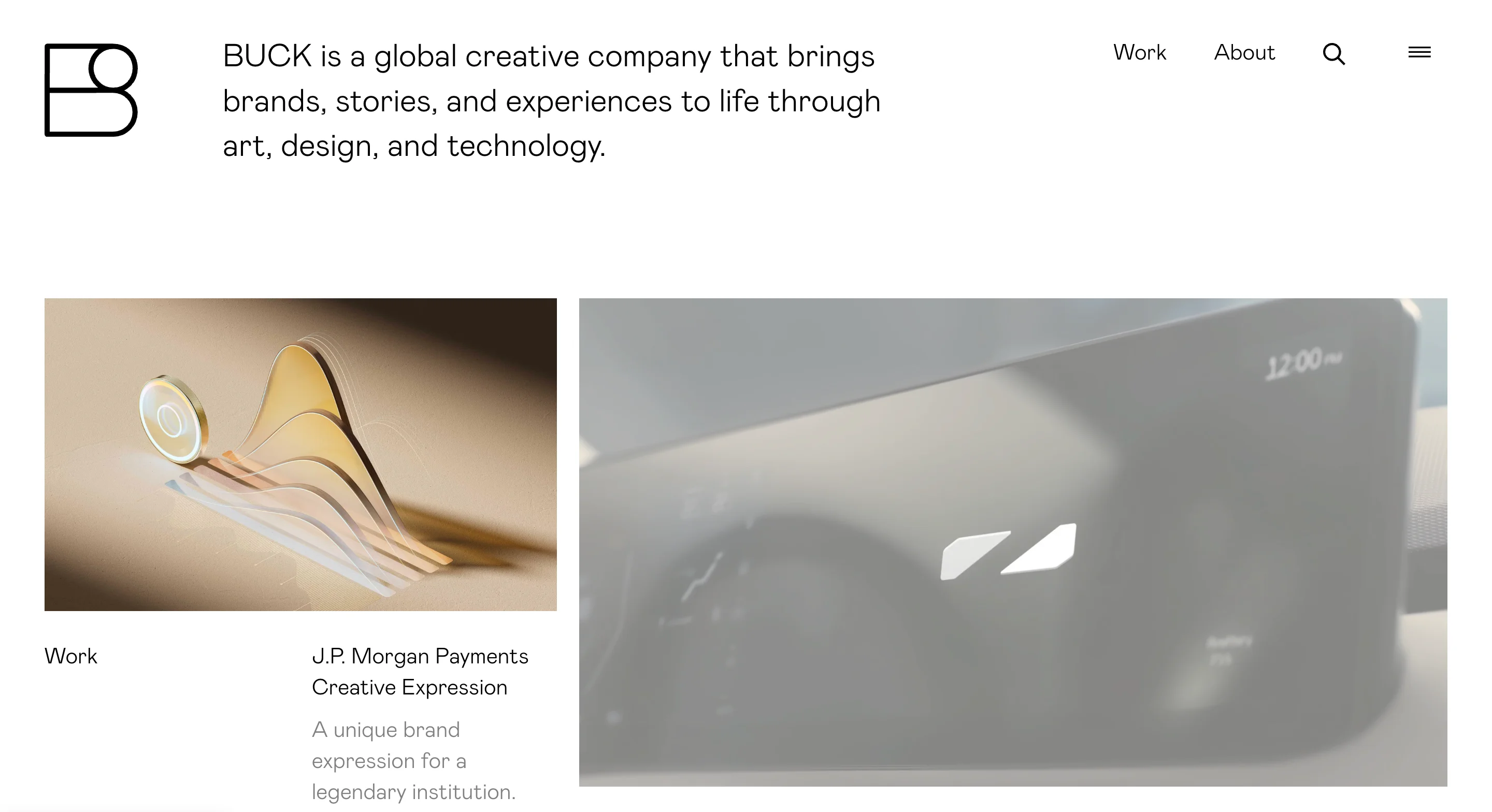
Buck is a creative studio with offices in Los Angeles, New York, Sydney, and Amsterdam that has built one of the strongest reputations in the industry for motion-led advertising and brand campaigns. Their work spans TV commercials, digital campaigns, social ads, and interactive experiences, and they are consistently referenced as one of the benchmarks for high-craft motion design in advertising.
For social media advertising specifically, Buck is most relevant for brands that want their ads to feel less like paid media and more like content worth watching. Their motion work tends to be visually distinctive without being stylistically indulgent, which is the balance that separates social ads that stop the scroll from those that blend into the feed.
The limitation is scope and scale. Buck works primarily with established brands on campaign-led projects rather than ongoing high-volume production. Engagements are project-based, timelines are measured in weeks rather than days, and their pricing reflects the level of craft they bring to every frame. For brands that want award-caliber motion work on a specific campaign, Buck is one of the best in the world. For teams that need weekly ad refreshes at production volume, a subscription service is a more practical fit.
Key services:
- Motion design and animation for advertising
- Brand campaigns and commercials
- Social and digital advertising
- Interactive experiences
- Brand identity and visual systems
Best for: established brands wanting high-craft motion-led social advertising for specific campaigns or brand moments
Location: Los Angeles, New York, Sydney, Amsterdam
Pricing: project-based (custom quotes)
Golden Wolf
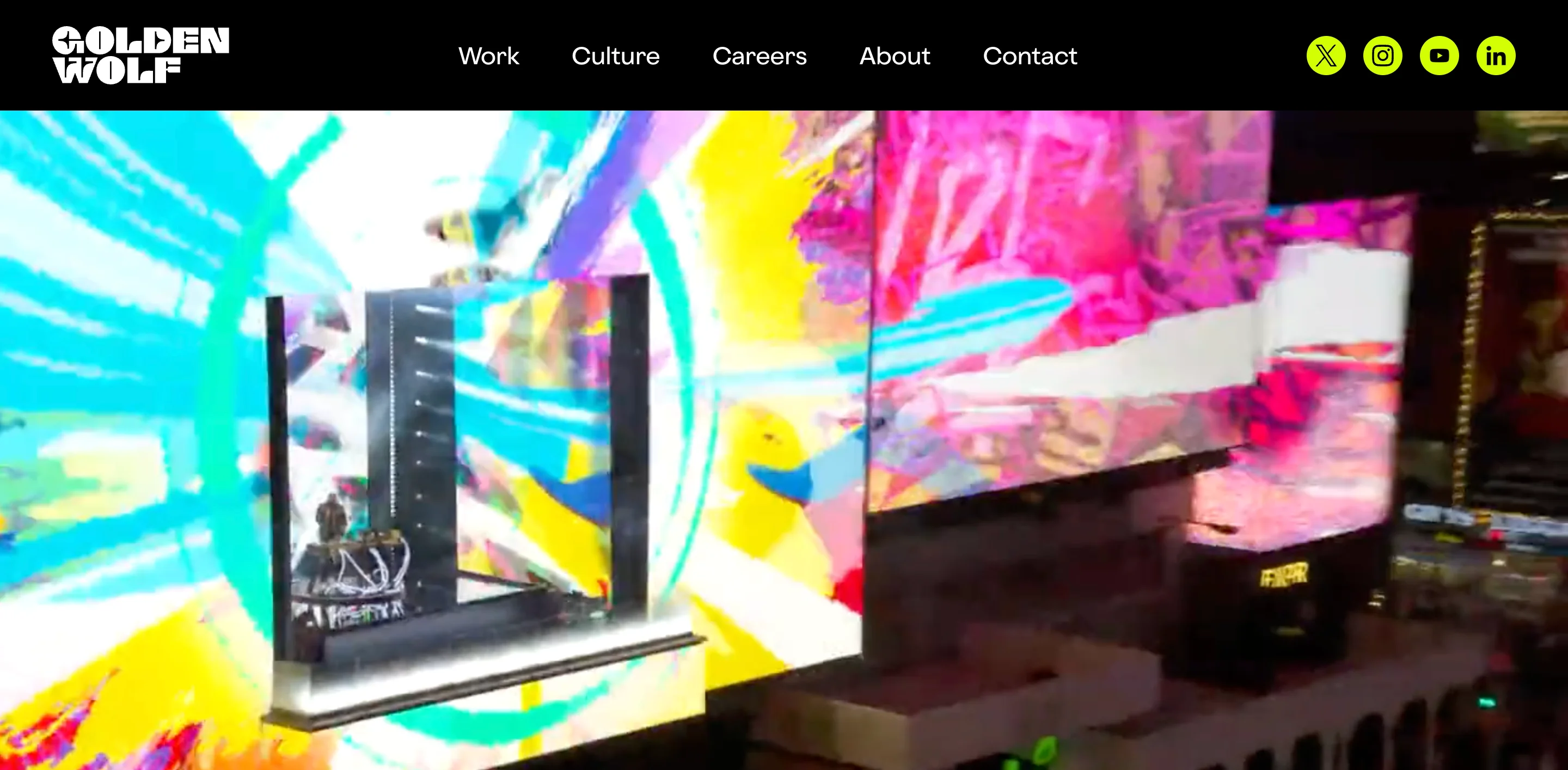
Golden Wolf is a London-based animation and motion design studio with a client list that spans global brands, entertainment companies, and digital-native businesses. They have become one of the most referenced studios in the motion advertising space for their ability to produce character-driven, stylistically distinctive animation that performs well in digital and social environments.
Their work is particularly strong for brands that want animation as their primary creative language rather than as a stylistic overlay on live-action footage. In a social media environment increasingly dominated by live video and UGC-style content, a well-produced animation campaign stands out because it signals a level of craft and intentionality that most competitors are not investing in.
Golden Wolf operates primarily on a project basis and works best when brought in for campaign-specific creative rather than ongoing production. Their team is compact relative to their reputation, which means their availability can be limited and lead times are typically longer than what a production-focused service can offer.
Key services:
- Character animation and motion design
- Advertising campaigns and brand films
- Social media and digital advertising
- Title sequences and broadcast design
- Creative direction and concepting
Best for: brands that want character-led animation as the core visual language of their advertising campaign
Location: London, UK
Pricing: project-based (custom quotes)
magier
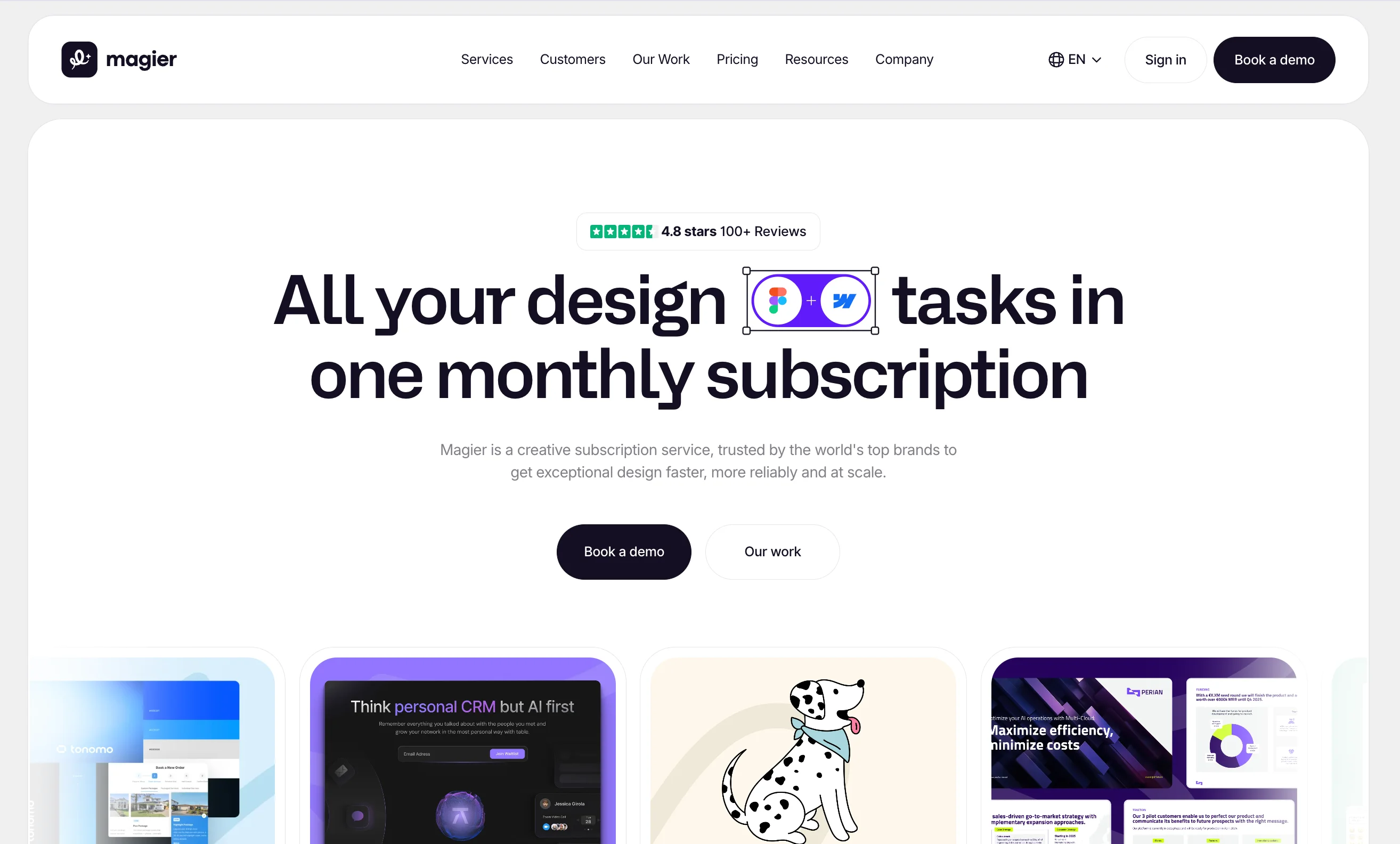
magier is a subscription-based design service that gives marketing teams access to a dedicated team of expert graphic designers and Webflow developers for a fixed monthly fee. You submit design requests through a simple ticket system and receive completed work within 48 hours. The model is built for teams that produce a consistent, high volume of marketing assets and need to do so without the unpredictable costs and slow turnaround of traditional agencies.
For social media ad design specifically, magier handles Meta ads, Instagram creatives, LinkedIn sponsored content, and animated social assets as part of its standard subscription. The service has delivered over 1,000 SaaS ad creatives for B2B companies and is used by Series A+ startups, scaleups, and enterprises that need to ship marketing assets at a pace in-house teams and traditional agencies cannot match.
With 150+ brands served, a 4.9/5 average rating on Trustpilot, and a model that removes the two biggest friction points in creative work, which are unpredictable costs and slow turnaround, magier is the strongest option for teams that need ongoing social media ad creative without building an in-house design function or managing a roster of freelancers.
Key services:
- Graphic design (ads, social media, presentations, brand collateral)
- Webflow design and development
- Landing page design
- Brand identity design
- Motion design
Best for: startups and scaleups that need ongoing, high-volume social media ad creative with fast turnaround and predictable costs
Location: Berlin, Germany (serves clients globally, fully remote)
Pricing: fixed monthly subscription and project-based (cancel anytime). See plans here.
{{cta}}
Monks
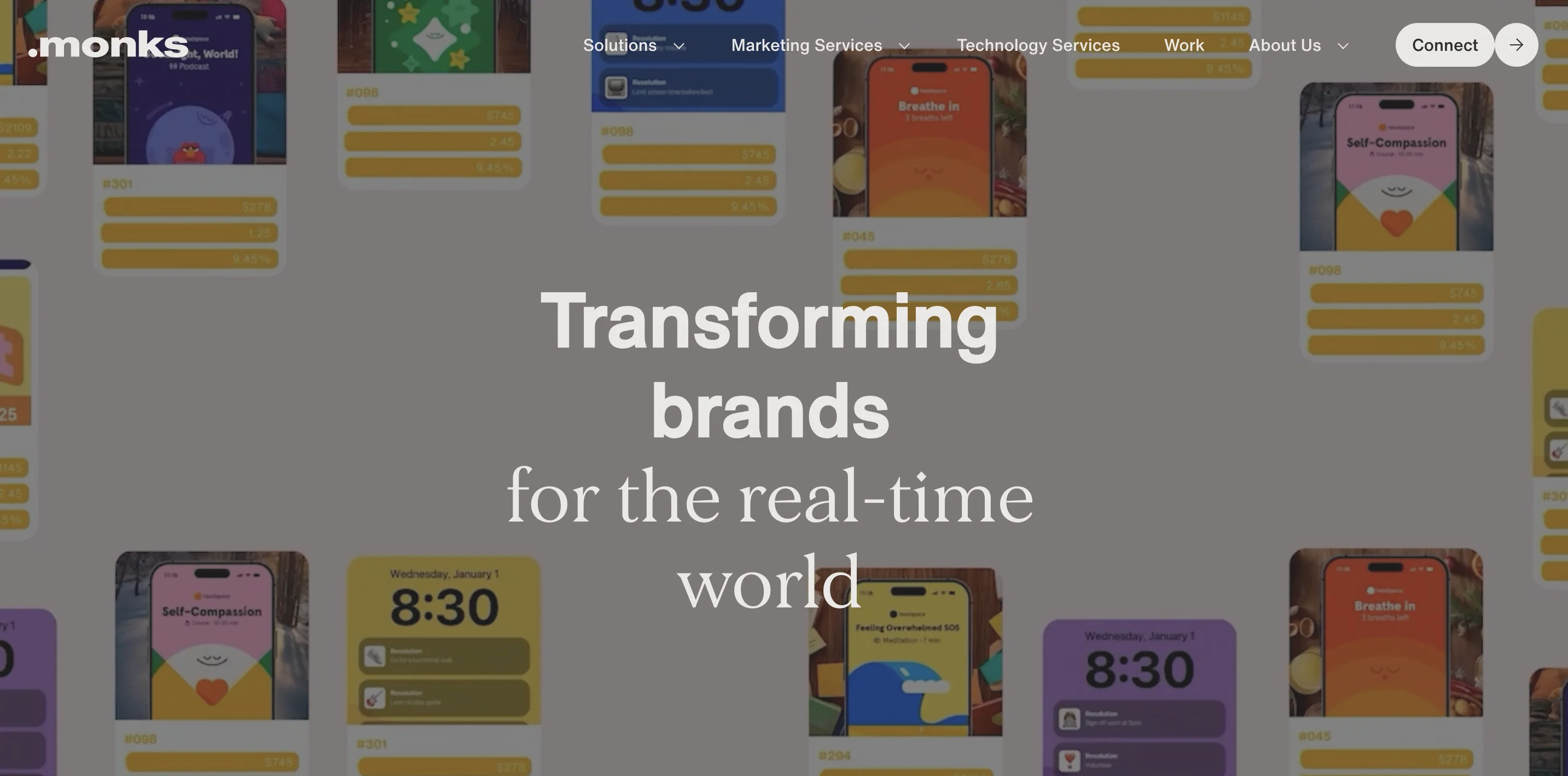
Media.Monks or Monks is a digital-first creative production company operating as part of S4 Capital with offices across more than 30 countries. Where most agencies are organized around campaigns, Media.Monks is organized around production at scale, which makes them one of the few partners capable of producing hundreds of ad variants across multiple markets and formats simultaneously.
Their strength is operational. They can handle the content volume that global and enterprise marketing teams generate, including localization, format adaptation, and multi-platform asset production, without the coordination overhead of managing multiple regional suppliers. For brands running global paid media at high volume, that operational capability is as valuable as the creative quality.
Media.Monks is not the right fit for startups or lean marketing teams. Their model is built for enterprise-scale creative production, and their pricing and engagement model reflects that. For teams with the budget and volume to justify it, they are one of the most capable partners available for social media ad production at scale.
Key services:
- Creative production at scale (social, digital, video)
- Content localization and format adaptation
- Data-driven creative and dynamic content
- Platform-specific campaign production
- Brand content and entertainment
Best for: enterprise and global brands needing high-volume social and digital ad production across multiple markets and formats
Location: Global (30+ countries)
Pricing: project-based and retainer (custom quotes)
The best ad design agencies for B2B and SaaS
B2B ad design is a different discipline from consumer creative, and treating it the same way is one of the most common reasons B2B campaigns underperform. The visual language is different. The channels are different. The buying journey is longer, the decision-making is more considered, and the audience is evaluating credibility as much as attention.
The biggest channel difference is LinkedIn. While Meta and Instagram reward emotional creative that earns an immediate response, LinkedIn works best with professional, informative creative that respects the context in which it appears. A B2B buyer scrolling their LinkedIn feed during the workday is in a completely different mental mode from someone scrolling Instagram in the evening, and the creative that reaches them needs to reflect that.
Beyond channel, B2B ad creative tends to work on a problem-solution structure rather than an aspirational one. The best B2B ads show the reader that you understand their specific problem before offering any kind of solution. Agencies that come from consumer creative backgrounds often struggle with this because it requires a different kind of strategic empathy.
magier
We covered magier in the social media section above, but it earns a second mention here because B2B and SaaS is where the subscription model makes the most practical sense. Most B2B marketing teams are not running one campaign at a time. They are managing multiple paid channels simultaneously, producing LinkedIn creatives, Google Display banners, email headers, ebook covers, and landing page assets on a continuous cycle. That volume is exactly what a subscription model is built for.
magier has delivered over 850 SaaS ad creatives for B2B companies specifically, which means the team understands the visual conventions that matter in this category: clean typography, data visualization, product UI integration, and the professional restraint that signals credibility to a buying committee rather than one consumer.
The 48-hour turnaround also matters differently in B2B than in DTC. B2B campaigns tend to run longer, refresh less frequently, and require more asset variants per campaign (one ad rarely runs to a whole audience segment). Having a design partner who can turn around a new variant or a format adaptation within two days, without scoping calls or revision budget negotiations, removes the operational friction that slows most B2B creative programs down.
Key services:
- Graphic design (ads, social media, presentations, brand collateral)
- Webflow design and development
- Landing page design
- Brand identity design
- Motion design
Best for: B2B and SaaS marketing teams producing ongoing ad creative across LinkedIn, Meta, and Google Display who need fast turnaround and predictable costs without managing freelancers or agency retainers
Location: Berlin, Germany (serves clients globally, fully remote)
Pricing: fixed monthly subscription and project-based (cancel anytime).
Gravity Global
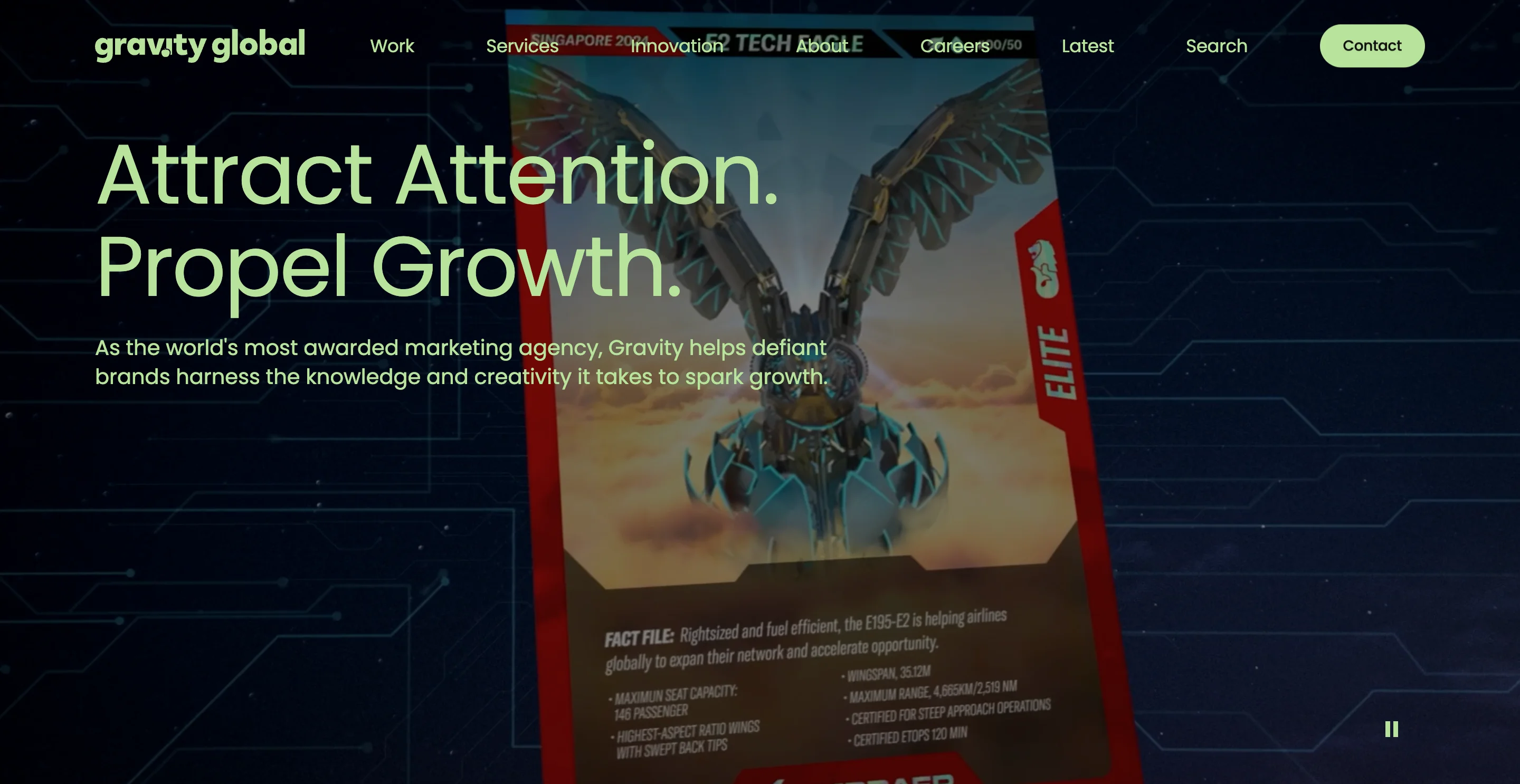
Gravity Global is a specialist B2B marketing agency with offices in London, New York, and across Europe that focuses exclusively on complex, long-cycle B2B marketing for enterprise clients. They have built their reputation on campaigns that perform across the full B2B buying journey rather than at a single stage, which is an operational distinction that most generalist agencies cannot match.
Their creative work is informed by a deep understanding of how B2B buying committees actually make decisions, through research, peer influence, and a gradual accumulation of trust signals rather than an isolated conversion moment. That understanding shapes their ad creative at the concept level, not just at the execution level, which is why their work tends to perform more consistently across the full funnel than creative produced by teams without genuine B2B experience.
Gravity Global works primarily with enterprise and large mid-market clients on sustained campaign programs rather than individual projects. Their engagement model is retainer-based and reflects the strategic depth they bring to each account, which makes them better suited to brands with the budget and timeline to benefit from that depth.
Key services:
- B2B brand strategy and positioning
- Integrated B2B advertising campaigns
- Account-based marketing creative
- Content and thought leadership
- Digital and social campaign production
Best for: enterprise B2B brands needing full-funnel campaign creative built on genuine understanding of complex buying journeys
Location: London, New York, and multiple European offices
Pricing: retainer-based (custom quotes)
Transmission
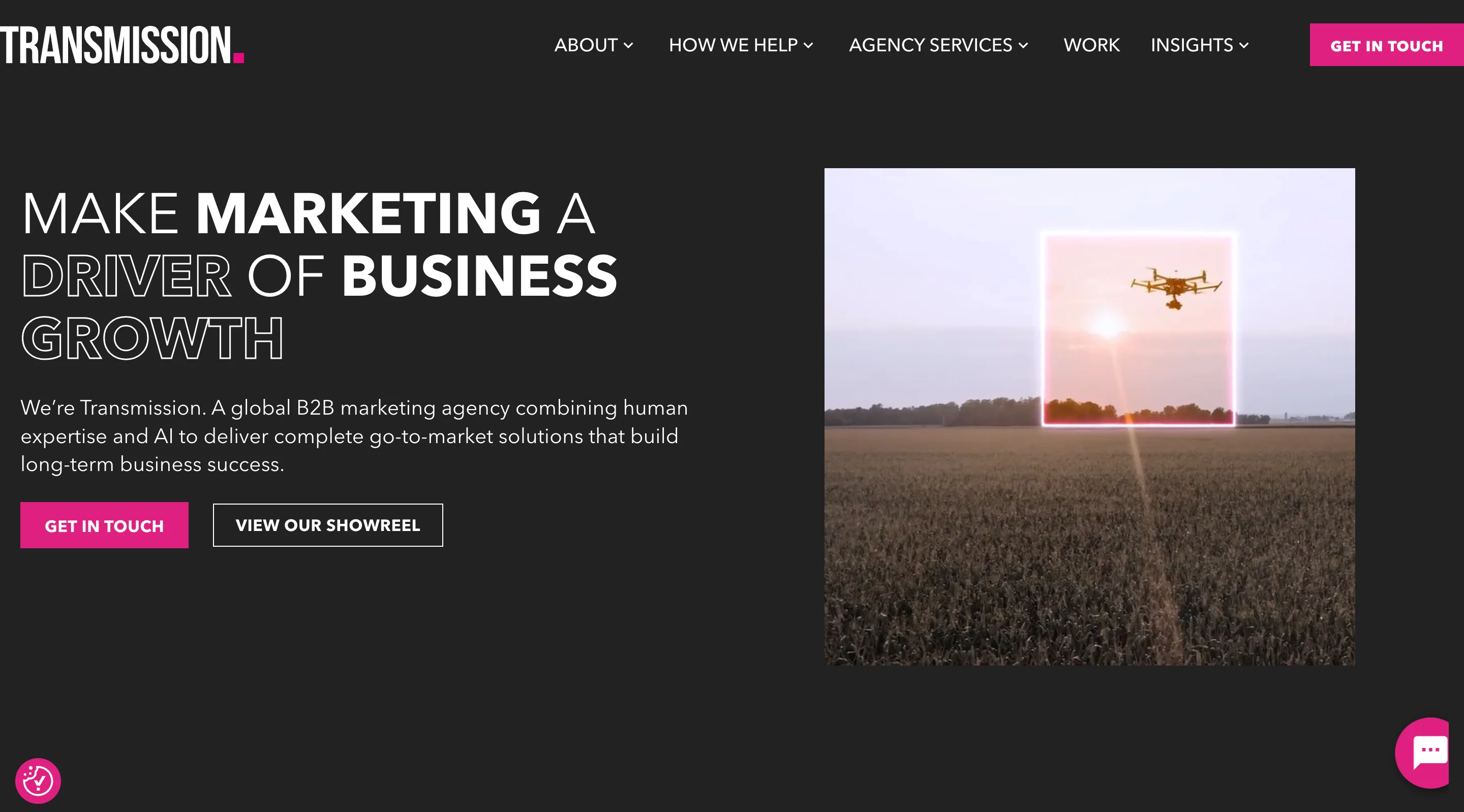
Transmission is a global B2B agency that specializes in demand generation for enterprise and mid-market technology companies. Where most B2B agencies focus on brand or content, Transmission is built around the commercial objective, which is getting the right creative in front of the right buyer at the right stage of their decision process.
Their work is particularly strong at the intersection of creative quality and targeting precision. They understand that a piece of B2B ad creative does not need to appeal to everyone, it needs to resonate deeply with a specific type of buyer at a specific point in the funnel. That account-based philosophy shapes how they approach creative concepting, format selection, and campaign architecture.
Transmission has delivered campaigns for some of the most recognizable names in enterprise technology and consistently ranks among the top B2B agencies in global agency surveys. Their size and structure are better suited to mid-market and enterprise brands than to early-stage startups, and their pricing reflects the strategic depth they bring to each engagement.
Key services:
- B2B demand generation campaigns
- Account-based marketing programs
- Digital advertising and paid social
- Content strategy and creative production
- Campaign measurement and attribution
Best for: mid-market and enterprise technology companies needing demand generation campaigns that connect creative to commercial outcomes
Location: Global (London, New York, Singapore, and additional offices)
Pricing: retainer-based (custom quotes)
Hey Digital
Hey Digital is a performance marketing agency that focuses exclusively on SaaS and technology companies. They run paid ad campaigns on Google and Facebook to scale free trial signups, demo bookings, and paid conversions, and their creative work is produced to serve those specific conversion objectives rather than broader brand goals.
What makes Hey Digital relevant in the B2B ad design category is the combination of creative production and paid media management under one roof. Most B2B teams either manage their own media and outsource creative, or hire an agency that does both but bills for both separately. Hey Digital's model is built around the insight that the creative and the media strategy need to be developed together, because an ad that performs well in one audience segment may need to look completely different in another.
Their work skews toward the performance end of the creative spectrum, which means clear value propositions, strong calls to action, and landing page creative designed to convert rather than to impress. For SaaS companies in growth mode that need paid acquisition to work harder, they are one of the most practically focused partners available.
Key services:
- Paid ad creative for Google, Facebook, and LinkedIn
- Landing page design and optimization
- Conversion rate optimization
- Campaign strategy and media management
- Creative testing and iteration
Best for: SaaS companies at growth stage that need paid acquisition creative designed to convert, built alongside the media strategy rather than separately from it
Location: Remote-first (Europe and US)
Pricing: monthly retainer (custom quotes based on ad spend and scope)
LinkedIn ad design: what makes it different
LinkedIn ad design is not the same as Meta ad design with a different logo, and treating it that way is one of the most reliable ways to waste a paid social budget. The visual conventions, the audience mindset, the format options, and the creative principles that work on LinkedIn are meaningfully different from what works on Meta or Instagram, and understanding those differences is the starting point for any LinkedIn campaign that performs.
The most important difference is context. A person scrolling LinkedIn during the workday is in a professional, relatively attentive mode. They are there to learn, to network, and to evaluate the professional world around them. That makes them more receptive to informative, substantive creative than to the attention-grabbing visual noise that cuts through on entertainment-focused platforms. On LinkedIn, a well-designed document ad with a clear insight can outperform a highly polished motion ad because it respects the audience's context rather than fighting against it.
| Element | Meta / Instagram | |
|---|---|---|
| Audience mindset | Professional, attentive, in learning mode | Passive, entertainment-focused, scrolling fast |
| Creative tone | Informative, substantive, credibility-first | Attention-grabbing, visual-first, emotional |
| Copy vs. visual weighting | Copy and visual work as co-equals; copy often does more work | Visual does most of the work; copy is secondary |
| Best performing format | Document ads, carousel with value progression | Short video, static single image, UGC-style |
| Design risk | Over-designing at the expense of substance | Under-designing; not stopping the scroll fast enough |
LinkedIn offers six ad formats, each with its own visual requirements and creative conventions:
- Single image ads — work at 1:1, 1.91:1, or 4:5 ratios. The visual and headline do the heavy lifting. Best for direct offers and brand awareness.
- Carousel ads — require multiple cards with consistent visual treatment. A strong headline on the first card and clear value progression across each card consistently outperforms a more visually impressive carousel where the copy adds nothing.
- Video ads — need to communicate the core message in the first three seconds before most viewers scroll past.
- Document ads — let users scroll through a PDF-style asset without leaving the feed. They need to deliver value on the first slide or the scroll stops immediately. One of the highest-performing formats for B2B lead generation.
- Thought leadership ads — amplify an employee's organic post as a sponsored unit. They work because they look native, not like ads.
- Conversation ads — appear in LinkedIn Messaging and use branching CTAs to guide the reader toward a specific action.
The copy relationship to visual is also different. On Meta, visuals typically do most of the work and copy is secondary. On LinkedIn, copy and visual work as co-equals and sometimes the copy does more work than the visual. A carousel with a strong headline on the first card and a clear value progression across the following cards consistently outperforms a more visually impressive carousel where the copy adds nothing.
For the agencies and services in this guide, magier, Gravity Global, Transmission, and DEPT all have genuine experience producing LinkedIn-specific creative that accounts for these differences. If LinkedIn is your primary B2B channel, make sure whichever partner you choose has a portfolio of LinkedIn work specifically, not just general digital creative that has been resized for the platform.
The best agencies for performance creative and ad testing
Performance creative is a discipline, not just a style of creative. The agencies in this section are built around the insight that the best-performing ad in your next campaign is probably not the one that looks the best in a design review. It is the one that emerges from a structured testing process where multiple hypotheses are run against real audience data and the winners are identified through performance rather than preference.
This is important to consider because the gap between average creative and great creative is large, and it compounds. Dynamic creative optimization (DCO) boosts CTR by 32% on average. AI-optimized creative delivers up to 2x higher click-through rates than manually designed equivalents. And 75.7% of agency and marketing professionals now measure creative effectiveness primarily by business outcomes including sales, conversions, and ROAS, according to Statista's May 2026 survey of US marketing professionals. The agencies below are organized around that measurement reality.
inBeat Agency
inBeat is one of the most practically focused performance creative agencies in the market, with a model built around high-volume production and structured testing rather than campaign-led creative. Their team handles creative strategy, UGC production, motion design, and ad copy within a workflow, which removes the coordination overhead that tends to introduce delays when creative and strategy are split across different suppliers.
Their approach to creative testing is methodical. Rather than producing one or two creative concepts and hoping one works, they develop multiple hypotheses at the format, messaging, and visual level simultaneously, then use platform data to determine which combinations drive the best performance. The result is a creative program that improves week over week rather than plateau-ing at launch.
inBeat works primarily with performance-focused brands in DTC, e-commerce, and growth-stage SaaS. Their pricing structure is retainer-based with clearly defined deliverable volumes, which makes it easier to plan creative budgets in relation to media spend than with traditional project-based models.
Key services:
- Performance creative for Meta, TikTok, and Instagram
- UGC-style ad production and creator sourcing
- Creative strategy and testing frameworks
- Motion and animated social ads
- Ad copy and creative concepting
Best for: DTC and growth-stage brands running high-volume paid social that need creative treated as a testing pipeline rather than a campaign production problem
Location: Montreal, Canada (serves clients globally)
Pricing: monthly retainer (custom quotes based on volume and channel mix)
Darkroom
Darkroom is a full-stack growth agency where creative production and media buying operate under one roof. That integration is the core of their value proposition. Because the same team makes decisions about what gets made and where it runs, the creative and the media strategy are optimized together rather than sequentially. The friction that typically exists when a creative agency hands off to a media agency, or when an in-house media team tries to brief an external creative supplier, is removed by design.
Their creative work is explicitly built for performance. Every asset they produce is designed from the first frame with a conversion objective in mind, and their production process is structured around velocity and iteration rather than individual hero executions. For brands running paid social at meaningful scale, this approach tends to produce better results than the traditional campaign model because it generates performance feedback faster and acts on it more aggressively.
Darkroom works across DTC, e-commerce, and growth-stage SaaS, with particular strength in performance-sensitive verticals where the relationship between creative quality and revenue outcome is most direct.
Key services:
- Full-funnel performance creative
- Media buying and paid channel management
- Creative strategy and testing
- Landing page design and conversion optimization
- Brand positioning and campaign strategy
Best for: growth-stage brands that want creative production and media buying integrated under one roof with performance as the primary measure of success
Location: Remote-first (US-based)
Pricing: monthly retainer (custom quotes)
DEPT
As an integrated agency, DEPT operates performance creative practices specifically for paid social and paid search that function independently of their brand and campaign work. Their performance creative offering is data-driven from the brief stage, connecting creative decisions directly to the audience and channel data their media team manages.
What makes DEPT particularly effective at performance creative is their scale of testing. Because they manage significant paid media budgets across hundreds of clients, they have accumulated a body of performance data that informs creative decisions at a level most individual brand teams cannot replicate. They know, from real campaign data, which formats, which creative approaches, and which messaging angles tend to work for specific audience types and industry verticals.
Their size means their performance creative practice operates at enterprise scale rather than growth-stage scale, and their pricing reflects that. For mid-market and enterprise brands with the budget to benefit from their data depth, they are one of the most capable performance creative partners available.
Key services:
- Performance marketing and paid media
- Data-driven creative production for digital and social
- Creative testing and optimization
- Technology and analytics infrastructure
- Brand strategy and content
Best for: enterprise and mid-market brands needing performance creative at scale with data-driven optimization built into the production process
Location: Global (30+ offices)
Pricing: retainer-based (custom quotes)
What an ad design agency actually does
An ad design agency produces ad creative. That means the visual assets that go into your paid media, including static social ads, animated banners, video ads, display creatives, LinkedIn sponsored content, Meta carousel ads, and the campaign visual systems that keep everything consistent across formats and channels.
What it does not necessarily include is media buying, campaign strategy, SEO, or brand identity work. That distinction matters because a lot of searches for "ad design agency" lead people to full-service advertising agencies that bundle creative into a much larger, much more expensive engagement. If you need the creative work specifically, you do not always need to buy the whole package.
Here is how to tell the four categories apart:
| Term | What they do | What they don't do |
|---|---|---|
| Ad design agency | Design the ad creatives | Buy the media or set the channel strategy |
| Full-service advertising agency | Strategy, creative, and media buying under one roof | Usually not built for high-volume ongoing production |
| Branding agency | Brand identity, logo, visual systems | Ongoing ad creative at production volume |
| Performance marketing agency | Manage ad spend and targeting | Often outsource the actual creative work |
Knowing which one you need before you start talking to agencies will save you a significant amount of time and money. A branding studio that wins design awards is not the right partner if you need 15 Meta ad variants refreshed every two weeks. Matching the type of agency to the actual problem is what this guide is designed to help you do.
How AI is changing ad design in 2026
AI is reshaping how ad creative is produced, tested, and optimized, and the agencies that are integrating it well are pulling ahead of those that are not. Research from Gartner's 2026 CMO Spend and Strategy Survey of 1,700 marketing leaders found that organizations with mature AI creative integration, defined as those using AI across more than 60% of their paid campaigns, reported ROI lifts averaging 31.4%, while early-stage AI adopters averaged 22.8%. Companies using AI in marketing campaigns more broadly see between 20 and 30% higher ROI. The performance gap between AI-capable and AI-novice creative teams is widening.
But the way AI is being used matters as much as whether it is being used at all. AI tools can accelerate concept generation, image manipulation, and production-speed tasks in ways that meaningfully reduce the time between brief and live asset. Agencies using AI well are deploying it to reduce the cycle between concept and execution, so that a creative hypothesis can be tested in days rather than weeks. That speed of iteration is the real competitive advantage, not the AI itself.
The risk sits on the other side. Lazy AI adoption produces homogenous creative that audiences learn to ignore. Because most AI image generation tools are drawing from the same training data, creative produced without human art direction and editorial judgment tends to converge toward a recognizable aesthetic that looks technically competent but feels generic. Audiences are pattern-recognizing this faster than most marketers realize.
The best agencies in this guide use AI as an accelerant rather than a replacement. They use it to generate more starting points faster, to test more variations in less time, and to handle production-speed tasks that would otherwise slow down their senior creatives. What they are not doing is using AI to skip the concept phase, replace art direction, or generate final creative without human review. When evaluating any agency on their AI capabilities, that is the distinction worth asking about.

How to choose an ad design agency: 7 questions to ask
The right ad design partner is not the most famous one. It is the one that matches your output requirements, your budget, your channel mix, and the way your team actually works. These seven questions will help you eliminate tiers and identify the right type of partner before you spend time on calls.
1. Do you need creative execution or creative strategy?
If you know what you want to communicate and you need someone to produce it well, you need an execution partner, meaning a subscription service or production-focused agency. If you need help figuring out what to communicate and how to position yourself, you need a strategic partner, meaning a full-service or independent agency. Most teams looking for an "ad design agency" need execution. Buying strategy when you need production adds cost and time to a problem that does not require them.
2. How many ad variants do you need per month?
Volume is the most reliable way to determine which tier you belong in. If you need fewer than five new assets per month, a project-based agency or freelancer is usually the most cost-effective option. If you need 10 to 50 assets per month consistently, a design subscription model almost always works out cheaper and faster than a retainer or per-project pricing. If you need hundreds of assets per month across multiple markets, you are looking at enterprise-scale production partners like Media.Monks or DEPT.
3. What channels are you running?
Meta, LinkedIn, Google Display, TikTok, and email all have different visual requirements, format specs, and creative conventions. An agency that excels at Meta creative may produce mediocre LinkedIn work because they have not studied how the platform's professional context changes what resonates. Before briefing any agency, be explicit about your channel mix and ask to see work from those specific channels.
4. What is your turnaround requirement?
If you need creative within 48 hours, you need a subscription service or a performance creative agency with a production-first model. If you can work on a two-week cycle, project-based agencies become viable. If your campaigns are planned months in advance, full-service agencies become relevant. Turnaround requirements often eliminate more options than budget does.
5. Do you need the agency to understand your specific industry?
B2B and SaaS creative has different requirements from DTC creative, which has different requirements from financial services or healthcare creative. Agencies that specialize in your vertical will produce better work faster because they already know the visual conventions, the compliance considerations, and the audience psychology. A generalist agency can learn, but that learning happens on your budget.
6. How do you want to manage the relationship?
Subscription services typically operate asynchronously through a brief or ticket system. Performance agencies typically have an account manager and a weekly check-in. Full-service agencies have a more intensive relationship with strategy sessions, creative reviews, and regular reporting. None of these is better than the others in absolute terms, but one of them will fit how your team actually works better than the others.
7. What does success look like, and will the agency measure it the same way you do?
Too many creative engagements end with both sides disagreeing about whether the work succeeded because they never agreed on the metric upfront. If you measure success by CTR and ROAS, hire an agency that tracks and reports on CTR and ROAS. If you measure success by brand recall and engagement, hire one that measures those. The agency's measurement framework tells you more about how they think about their work than their portfolio does.
Ad design agency pricing: what each model actually costs
Creative agency pricing is structured in four main models, and understanding which model a potential partner uses tells you a lot about how the relationship will actually work.
| Pricing model | Typical cost | What is included | What is often extra | Best for |
|---|---|---|---|---|
| Design subscription | $700–$5,000+/mo | Unlimited requests, fast turnaround | Motion/video at lower tiers, strategy | Teams needing ongoing volume at predictable cost |
| Project-based | $500–$10,000 per project | Scoped deliverables, defined revisions | Additional formats, strategy phases | One-off campaigns or specific launches |
| Agency retainer | $5,000–$15,000+/mo | Ongoing team access, strategy included | Media buying, production at enterprise scale | Continuous campaign work with strategic oversight |
| Percentage of ad spend | 10–20% of monthly media budget | Media management, often includes basic creative | High-volume creative production | High-spend accounts where media and creative are managed together |
A few costs that rarely appear in the headline price are worth knowing before you sign anything. Asset licensing covers stock imagery and font licensing that is not always included in the agency's quoted fee. Format adaptation means resizing and reformatting assets across platforms and dimensions, which some agencies treat as included and others bill separately. Additional revision rounds beyond the stated number are a common source of scope expansion at traditional agencies. And strategy and research phases at full-service agencies are sometimes presented as part of the engagement during the pitch but billed as separate line items once the contract is signed.
The practical heuristic is simple. The quoted fee is rarely the final number at a traditional agency. The monthly fee at a subscription service usually is.
Common mistakes when hiring an ad design agency
Finding the right agency is half the work. Avoiding the common errors that cause agency relationships to fail before they deliver value is the other half.
Choosing based on aesthetics rather than ad performance
A beautiful portfolio is not evidence of ad performance. It is evidence of visual taste. Strategic portfolios show you the business problem, the creative approach, and the measurable outcome. Aesthetic portfolios show you pretty pictures with no context about what they achieved. When evaluating any agency, ask them to walk you through a case study that includes performance data. What was the CTR? What was the ROAS? What happened to conversion rate after the creative went live? If every answer comes back to visual quality rather than commercial outcome, you are looking at a styling service, not a performance partner.
Confusing the agency type with your actual need
Hiring a full-service agency for weekly ad production is like hiring a chef to reheat your leftovers. It will work, but you are paying for expertise, infrastructure, and overhead that has nothing to do with the problem you are solving. If you need execution, buy execution. If you need strategy, buy strategy. The mistake of buying strategy when you need production adds months and five figures to a problem that a subscription service could solve in 48 hours.
Not specifying channel requirements upfront
LinkedIn creative is not Meta creative with a different logo. Google Display is not a resized Instagram ad. If you do not tell an agency which channels you are running before they start concepting, you will receive creative that needs to be redesigned rather than adapted. Always brief with your channel mix specified, with format requirements included, and with examples of work that performed well on those channels.
Underestimating volume needs
Most marketing teams discover their actual creative volume needs about three months into a campaign. Budgeting for eight new assets per month when your paid social strategy actually requires 30 is a reliable way to end up either rationing creative (and watching campaign performance decline) or going back to the agency for out-of-scope work (and watching your budget expand). Before you brief anyone, estimate your volume from the channel up, counting how many ad sets, how many formats per ad set, and how many refresh cycles per month.
Skipping the brief
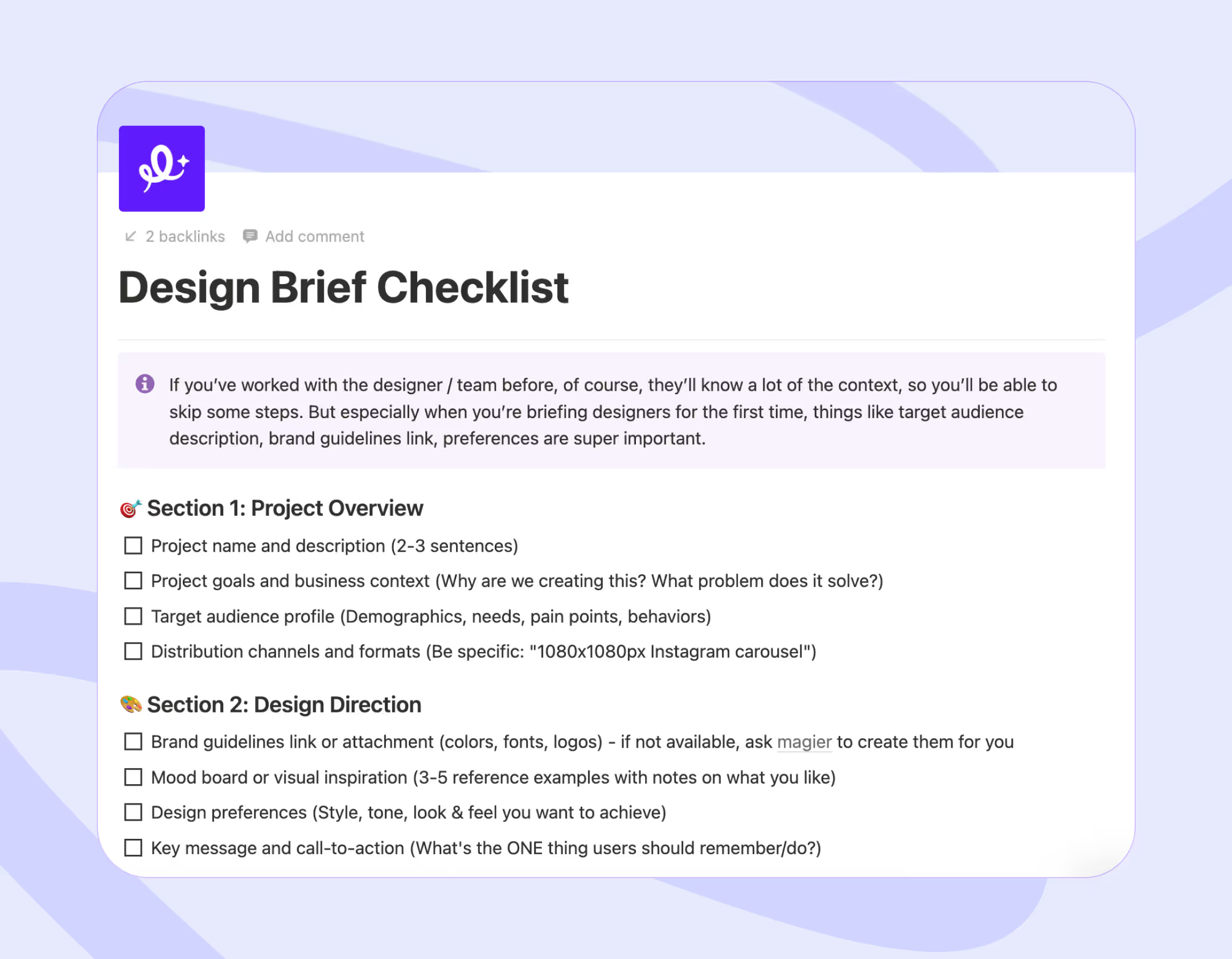
The biggest cause of poor ad creative is a poor brief. An agency that receives a vague brief will produce a vague ad. A brief that specifies the audience, the problem the ad is solving, the channel and format, the desired action, and reference examples of work that has performed well in your category will produce better creative faster than any amount of revision rounds on a poorly briefed first attempt. Most subscription services have brief templates that work well as a starting structure.
Paying for strategy when you need production
Strategic positioning work and ad creative production are two different skills, and most agencies are meaningfully better at one than the other. If your brand already knows what it stands for and you need that communicated well and produced consistently, you do not need a strategic agency. You need a production partner. Paying for positioning strategy you have already done adds cost and lead time to an execution problem.
Final thoughts
The agency you hire for ad creative shapes every paid impression your audience has with your brand. The decision most marketing teams get wrong is not which agency, but which type of agency. A performance creative agency and a design subscription service are not two versions of the same thing. One builds testing pipelines for growth teams. The other solves the volume problem for marketing teams that need consistent creative output without building an in-house function. Knowing which problem you actually have is worth more than any ranked list.
If your team is producing ad creative regularly and struggling with either the pace or the cost of getting it done, that is exactly the problem magier was built to solve. You can see how it works and what services your team could get.
{{cta}}
FAQ
An ad design agency produces the visual assets that go into your paid media channels, including static social ads, animated banners, video ads, display creatives, LinkedIn sponsored content, Meta campaigns, and campaign visual systems. It does not necessarily include media buying, campaign strategy, or brand identity work, which are separate disciplines often provided by different types of agencies.
Costs vary significantly by model. Design subscription services range from roughly $700 to $5,000+ per month depending on scope and tier. Project-based agencies typically charge $500 to $10,000 per project. Traditional agency retainers run from $5,000 to $15,000 or more per month. Performance agencies working on a percentage of ad spend typically charge 10 to 20% of the monthly media budget.
An ad design agency focuses on producing the creative assets for paid media. A full-service advertising agency bundles creative production with media buying, strategic planning, and campaign management. If you need the creative work specifically and already have a media strategy or media buyer, an ad design agency or design subscription service is usually faster and more cost-effective than a full-service agency.
For ongoing social media ad creative at volume and speed, magier's subscription model is the strongest option for most marketing teams. For campaign-specific high-craft motion work, Buck and Golden Wolf are among the best. For performance-focused creative built to be tested and iterated, inBeat Agency is a strong choice for DTC and growth-stage brands.
magier is the strongest option for ongoing B2B ad creative at volume and speed, with over 1,000 SaaS ad creatives delivered. For enterprise B2B campaigns with full strategic support, Gravity Global and Transmission are among the most experienced specialists in the category. For SaaS companies needing performance creative alongside media management, Hey Digital and DEPT are both well-suited.
For teams without a design budget, tools like Canva offer templates for most common ad formats. For teams with some budget but high volume requirements, a design subscription service like magier gives you access to professional designers at a predictable monthly cost without the overhead of a full agency engagement. AI-assisted design tools like Adobe Firefly can also accelerate the production of simple formats, though they work best alongside human art direction rather than as a replacement for it.
A good social media ad stops the scroll, communicates one clear message before the viewer can move on, and creates enough curiosity or clarity to generate the desired action. Practically, this means a strong visual hierarchy with the most important element immediately visible, copy that adds to rather than repeats the visual, and a single call to action. Format-specific requirements vary by platform, but those principles hold across channels.
A good brief covers six things. Who the audience is, what problem the ad is solving for them, which channel and format it is being designed for, what action you want the viewer to take, what success looks like in measurable terms, and reference examples of work that has performed well in your category. Including all six significantly reduces the number of revision rounds required and produces better creative faster.
A performance creative agency is an agency that treats ad design as a continuous testing pipeline rather than a campaign production problem. They produce high volumes of ad variants designed to be iterated based on real platform data, measuring success by CTR, ROAS, and CAC rather than design awards. The output is not a campaign. It is an ongoing creative system that improves through structured testing.
It depends on what you need. A design subscription is better than a traditional agency for teams that need ongoing, high-volume ad creative at a predictable monthly cost with fast turnaround. A traditional agency is better for one-off campaigns that require strategic input, cultural insight, or a distinctive creative point of view that goes beyond production execution. Most marketing teams need both at different times, not necessarily from the same supplier.
.avif)