Best Website Design Services for Small Businesses in 2026
Did you know that 75% of people judge a company's credibility on its website design alone, based on web credibility research from Stanford?
That one fact turns "which website service should I use" into a critical decision, since agencies, freelancers, subscription services, and DIY builders all promise a "converting and beautiful" site but each carries a different cost, timeline, and trade-off.
And with 83% of small businesses now running a website, up from 64% in 2018, an outdated page no longer just looks behind, it quietly loses you the customers comparing you to everyone else.
That's the problem this blog is written to solve. We compared the best website design services for small business in 2026, covering agencies, subscription services, and DIY platforms so you can find the right fit for your budget, timeline, and goals.
Here's what this guide covers:
- The 10 best website design services for small businesses, including agencies, subscription models, and specialists
- A side-by-side comparison table
- When DIY website builders make sense and when they don't
- A full cost breakdown across all service types
- How to choose the right service with a step-by-step decision framework
- Questions to ask and red flags to watch
- Whether AI tools can replace a web designer in 2026
and a lot more. Keep reading!
Quick comparison: best small business website design services
How we evaluated these website design services
Not every "best of" list tells you how the agencies were selected. We want to be transparent about how we built ours, because the criteria matter as much as the recommendations.
We evaluated every service on this list against six factors:
- Design quality and portfolio relevance: We looked for agencies and services that show real work for small and mid-size businesses, not just enterprise logos.
- Pricing transparency: We favored services that publish their pricing or at least provide clear ranges. Agencies that hide all pricing behind a "contact us" form make it harder for small businesses to know whether they're even in the right ballpark.
- Platform flexibility: We assessed whether each service locks you into a specific platform or gives you ownership of your site and design files. This matters because switching platforms later is expensive and time-consuming.
- Turnaround and responsiveness: Small businesses don't have months to wait for a website. We noted typical project timelines and how each service handles revisions and feedback.
- Client reviews on third-party platforms: We cross-referenced ratings on Clutch, Trustpilot, and G2 to validate what each service claims about itself, besides self-reported ratings.
- Post-launch support: We checked whether each service offers ongoing maintenance, updates, and support after the initial build.
Full disclosure: magier is included on this list. We've evaluated ourselves using the same criteria as every other service, and we've been honest about our strengths and limitations throughout.
{{freebie}}
The best website design services for small business in 2026
There is no single "best" service for every small business. A solopreneur with a $500 budget has very different needs than a funded startup looking for a conversion-optimized marketing site. That's why this list covers different service types, from subscription-based design to project-based agencies, so you can match the model to your situation.
1. magier (best for scalable, subscription-based design and Webflow)

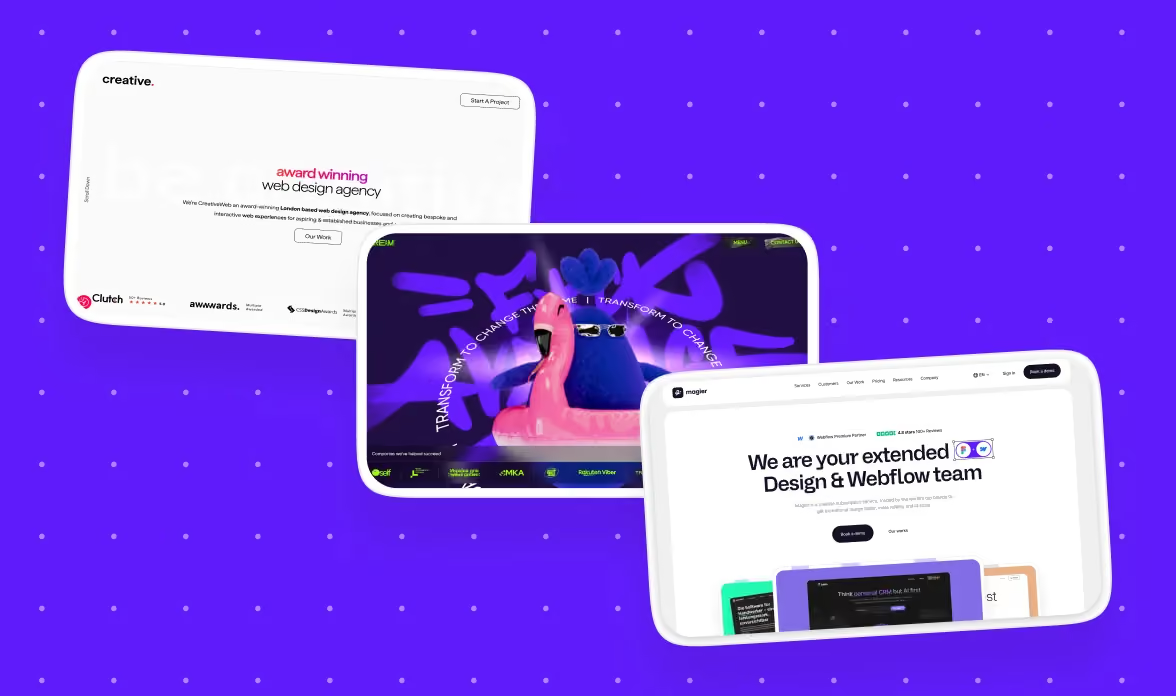
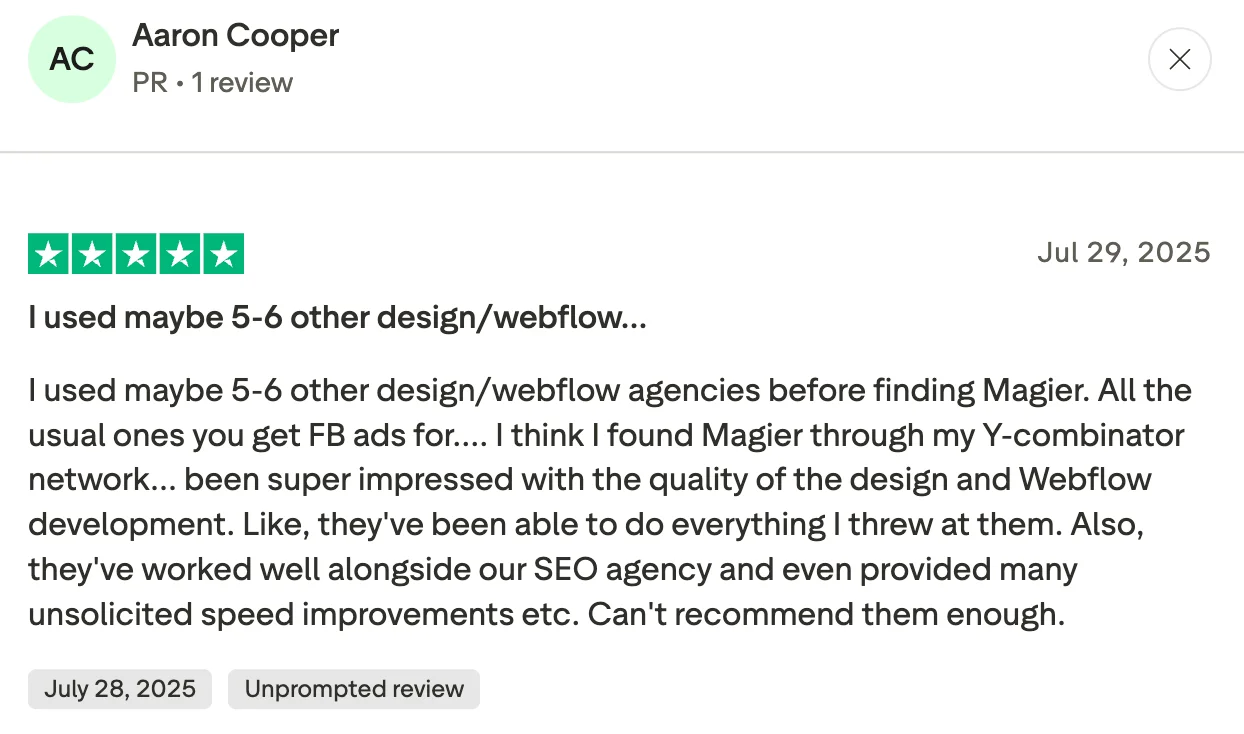
magier is a subscription-based design service that gives brands access to a dedicated team of graphic designers and Webflow developers for a fixed monthly fee. You submit design requests through a simple ticket system, get a dedicated project manager and design team, and receive completed work within 48 hours. You can also request revisions until the designs meet your needs.
For companies that don't need a constant subscription, magier also takes on one-time projects with the same team quality and turnaround speed.
What makes magier different from traditional agencies is the pricing model. Instead of paying per project with unpredictable costs and timelines, you pay one flat monthly rate and can cancel anytime. This removes the two biggest friction points in creative work for small businesses: not knowing what something will cost, and waiting weeks for deliverables.
The team specializes in both SaaS web design and Webflow development, which means they handle the design and the build under one subscription. You might not get this mix of services in any other agencies in this list and it removes the coordination overhead that comes from managing separate design and development partners.
magier led a complete website rebrand for fintech company Particula, redesigning three core conversion paths and building a visual system from the ground up. As Particula's co-founder Nadine Wilke put it, "What was missing before was someone guiding me. With magier, I didn't have to steer everything myself, and that made a huge difference."
Key services: Graphic design (ads, social media, presentations, brand collateral), Webflow design and development, landing page and pricing page design, brand identity design, motion design, pitch deck and presentation design.
Pros:
- Flexible engagement with both subscription and one-time project options
- Wide range of design services under one roof, so you don't need separate vendors for ads, landing pages, brand identity, and Webflow
- Fast turnaround (48 hours average per task) with multiple revisions included
- You own everything they create, including all design files and Webflow builds
- Design and development handled by the same team, which eliminates the "design doesn't match the build" problem
Cons:
- Does not offer specialized UI/UX product design services like in-app interfaces, user research, or usability testing. If you need deep product design work, you'll need a dedicated product design agency alongside magier.
2. Adchitects (best for polished product and e-commerce sites)
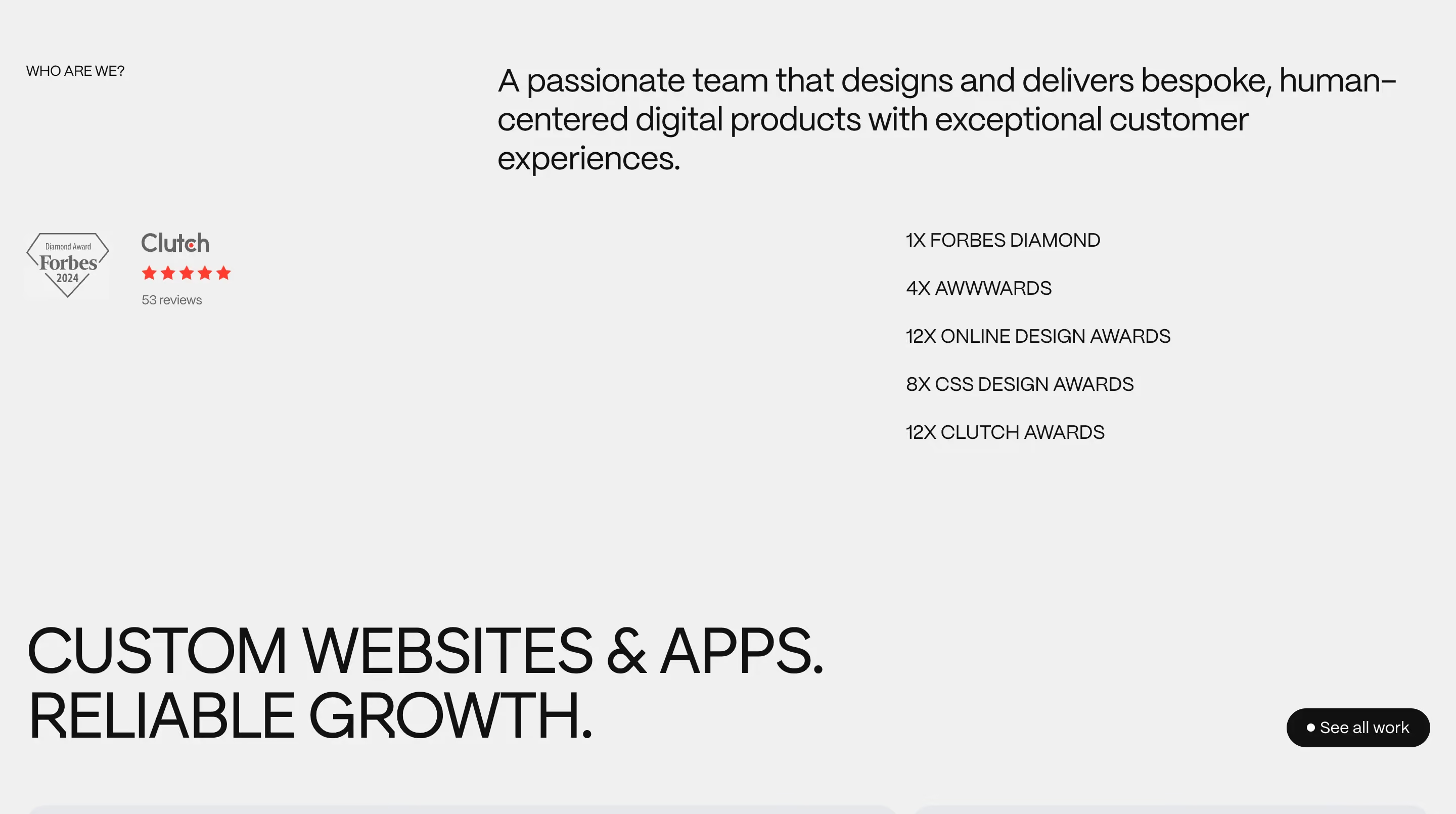
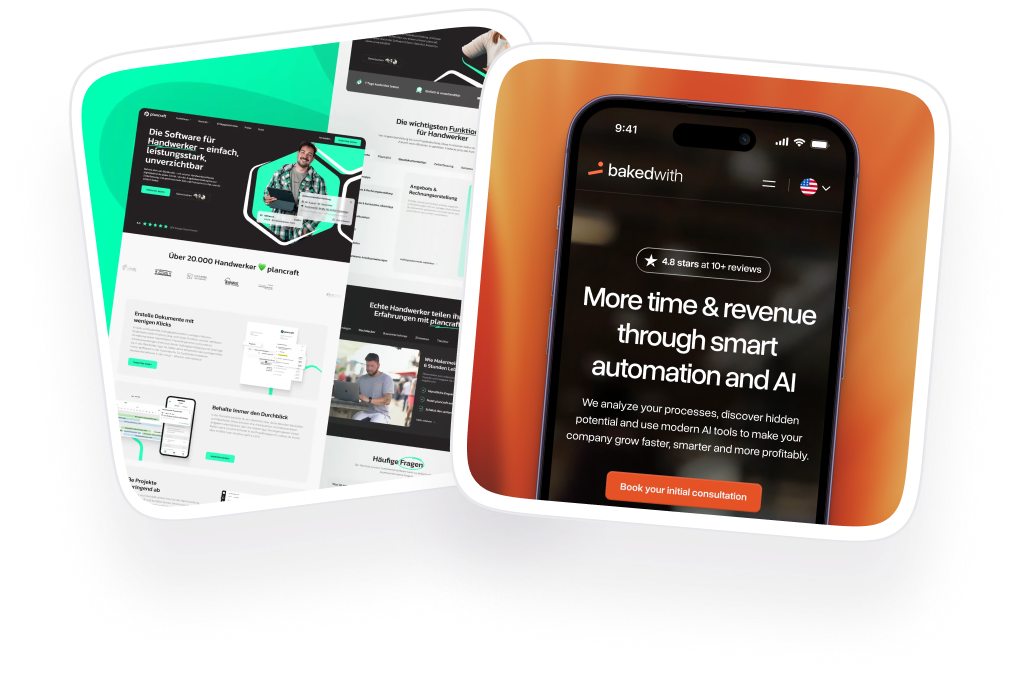
Adchitects is a Poland-based design agency with a strong visual and UI focus. They specialize in website design, custom CMS builds, and e-commerce development, with a portfolio that skews toward polished, modern product sites.
What stands out about Adchitects is the consistency of their design quality across projects. Their Clutch profile shows a 4.9 rating from 54 reviews, which is unusually high for an agency of their size. They work primarily with SaaS and e-commerce companies that need a site that looks premium and performs well.
Pros:
- Strong UI and visual design quality
- Experience with SaaS and e-commerce verticals
- High volume of verified positive reviews on Clutch
Cons:
- Project-based pricing means costs can be less predictable for small businesses on tight budgets
- Less suited for ongoing, high-volume design needs
3. WPRiders (best for custom WordPress and WooCommerce)
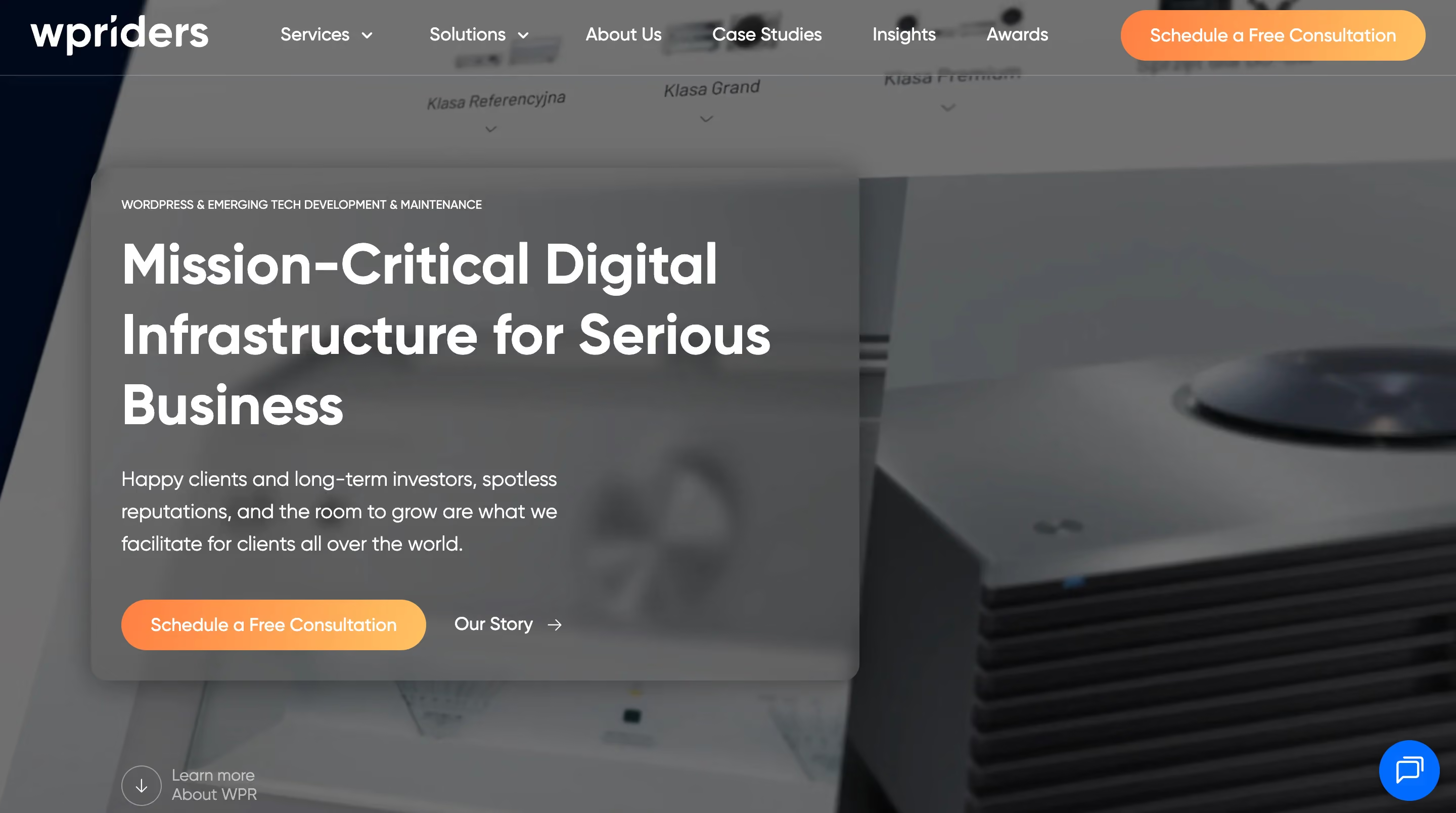
WPRiders is a Romania-based agency that specializes in custom WordPress builds, integrations, WooCommerce stores, and long-term technical maintenance. If your business runs on WordPress and you need more than a basic theme installation, WPRiders is built for that kind of work.
Their published minimum project size starts at $1,000, with reviewed projects ranging from roughly $1,800 to $85,000 depending on complexity. That range makes them accessible for smaller businesses while still being capable of handling larger, more complex builds.
Pros:
- Deep WordPress and WooCommerce expertise
- Accessible entry-level pricing for small businesses
- Long-term maintenance and support available
- Strong fit for sites that need custom integrations or complex functionality
Cons:
- WordPress-specific, so not the right fit if you prefer Webflow, Shopify, or other platforms
- Project timelines can vary depending on complexity
4. Rudo (best for B2B Webflow websites)
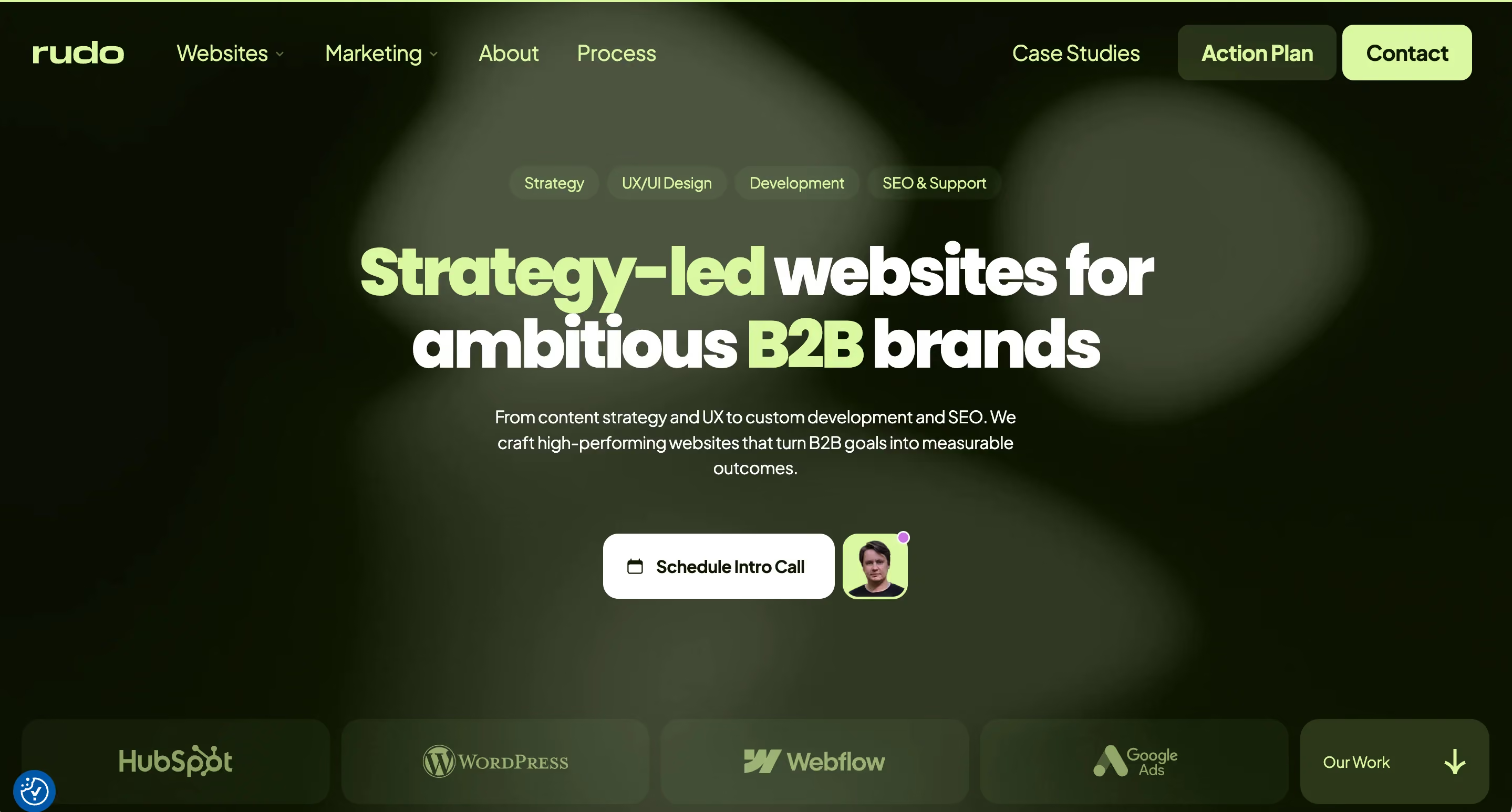
Rudo is a UK-based agency that focuses on design-led Webflow sites for B2B companies. Their sweet spot is growth-stage businesses that want a marketing website their team can manage and update without developer help after launch.
Rudo's minimum project size is around $10,000, which puts them in the mid-range for agency work. They're best suited for B2B companies that have outgrown their initial site and need something more strategic and conversion-focused.
Pros:
- Specialized in B2B, which means they understand lead-gen funnels and conversion paths
- Webflow focus means your team can update content post-launch without a developer
- Design-led approach that balances aesthetics with business goals
Cons:
- Higher minimum budget than some alternatives on this list
- Better suited for growth-stage companies than very early-stage startups with minimal budgets
5. CreativeWeb (best for premium bespoke websites with SEO)
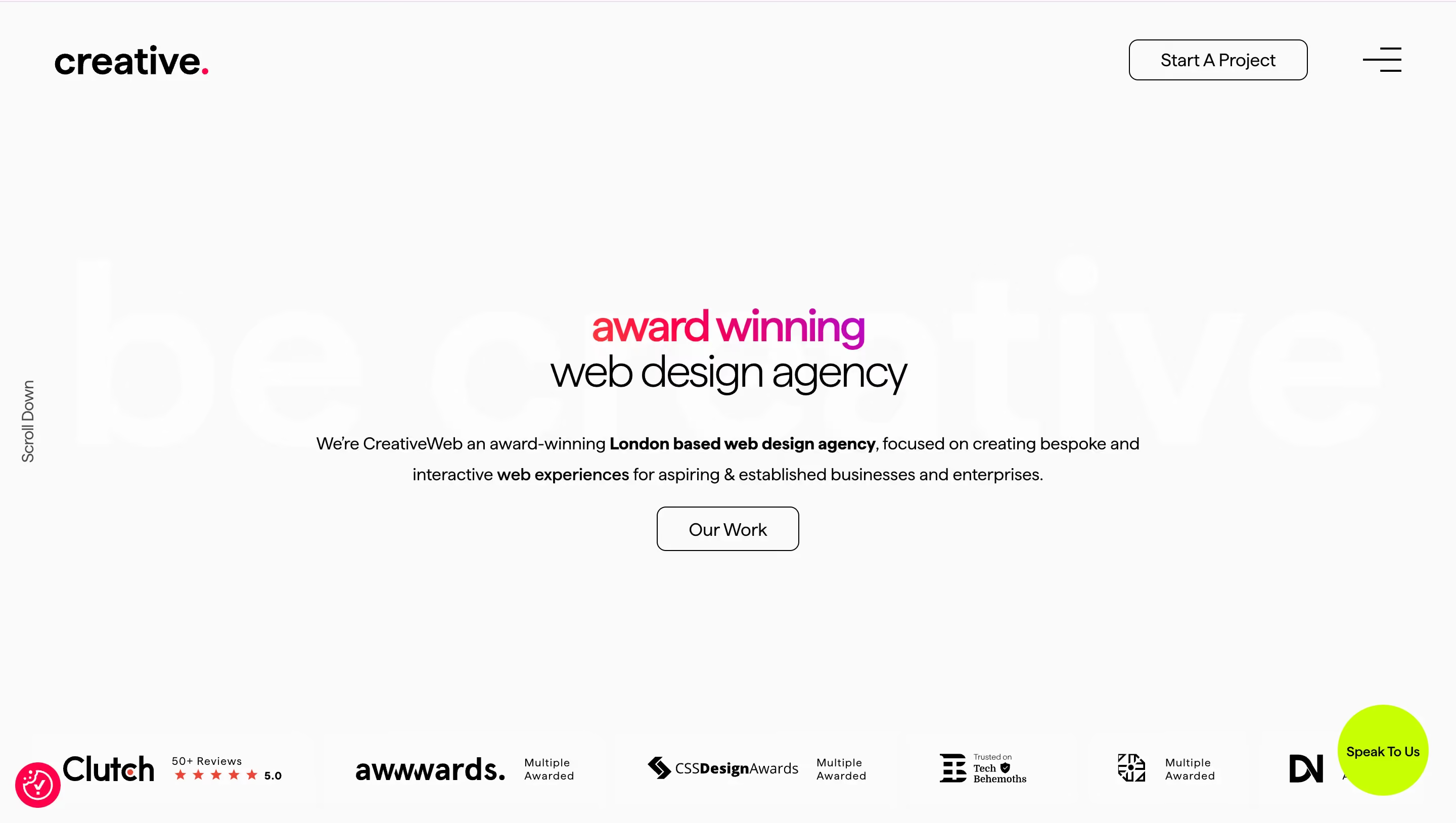
CreativeWeb is a UK-based agency that offers strategy, design, build, and SEO in a single engagement. They're a higher-end choice, with a typical project range of £10,000 to £120,000 (based on forum reviews), but the value proposition is that you get a comprehensive service without needing to hire separate partners for design and search optimization.
For established small businesses where both brand presentation and search performance are priorities, CreativeWeb brings everything together under one roof.
Pros:
- Full-service offering that includes SEO strategy alongside design and development
- Strong fit for businesses where search visibility is a key growth driver
- Experience with larger, more complex website projects
Cons:
- Premium pricing that's above most small business budgets
- Longer project timelines due to the strategic depth of their process
6. Phenomenon Studio (best for strategy-to-launch custom builds)
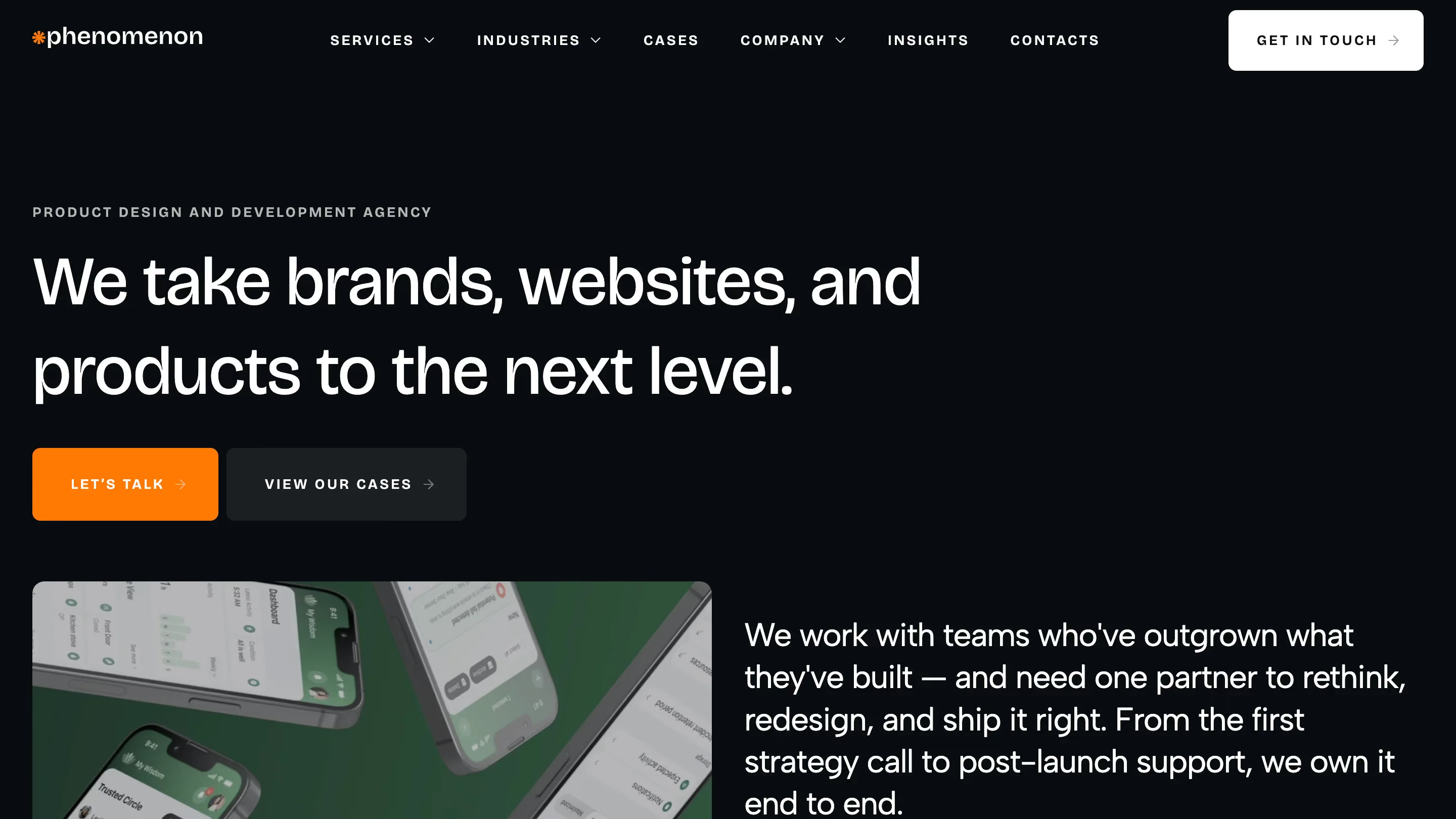
Phenomenon Studio is a boutique product design and development agency based in Estonia, with entities in the USA and Switzerland. Their team of 70+ senior specialists works end-to-end, from strategy and discovery through design, development, and post-launch support.
They hold a 5.0 rating on Clutch and have completed 120+ launches, with their clients having raised over $500 million collectively. Phenomenon is also a Webflow Experts partner and holds a Nielsen Norman Group UX certification, which adds credibility to their design process.
Pros:
- Senior-level team works directly with clients, with no layers of account management in between
- End-to-end service from strategy through post-launch support
- Webflow Experts partner with UX certification
- Strong track record across SaaS, fintech, healthcare, and EdTech
Cons:
- Premium positioning means pricing may be higher than some alternatives
- Best suited for businesses that need a strategic engagement, not just a quick site build
7. Qream (best for brand-driven web design with fast delivery)
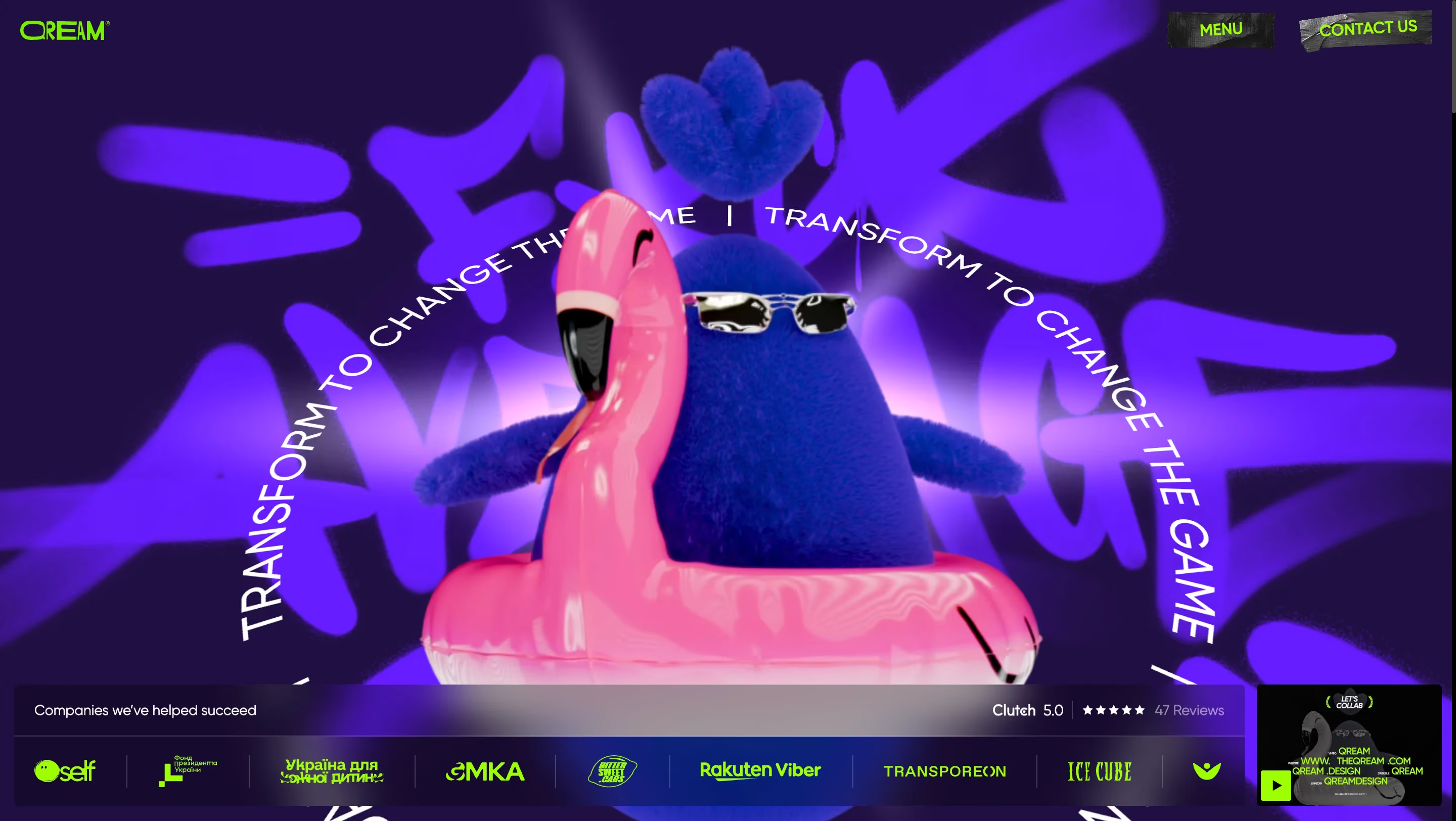
Qream is a Norway-based creative agency specializing in website design, UI/UX, and responsive design. Their Clutch reviews are overwhelmingly positive, with clients consistently praising their creative quality, fast delivery, and ability to produce visually appealing designs that also work well on mobile.
What makes Qream a good fit for small businesses is their combination of brand thinking and speed. They don't just build websites, they develop the visual identity and design system alongside the site, so everything feels cohesive from day one. For businesses in or targeting the Nordic market, Qream's Scandinavian design sensibility is a natural advantage.
Pros:
- Strong brand design capabilities built into the web design process
- Fast delivery timelines with responsive project management
- Scandinavian design approach that emphasizes clarity and usability
Cons:
- Smaller agency, so availability for very large or multi-month projects may vary
- Best suited for businesses that value design quality over rock-bottom pricing
8. KOTA (best for animation-heavy Webflow sites)
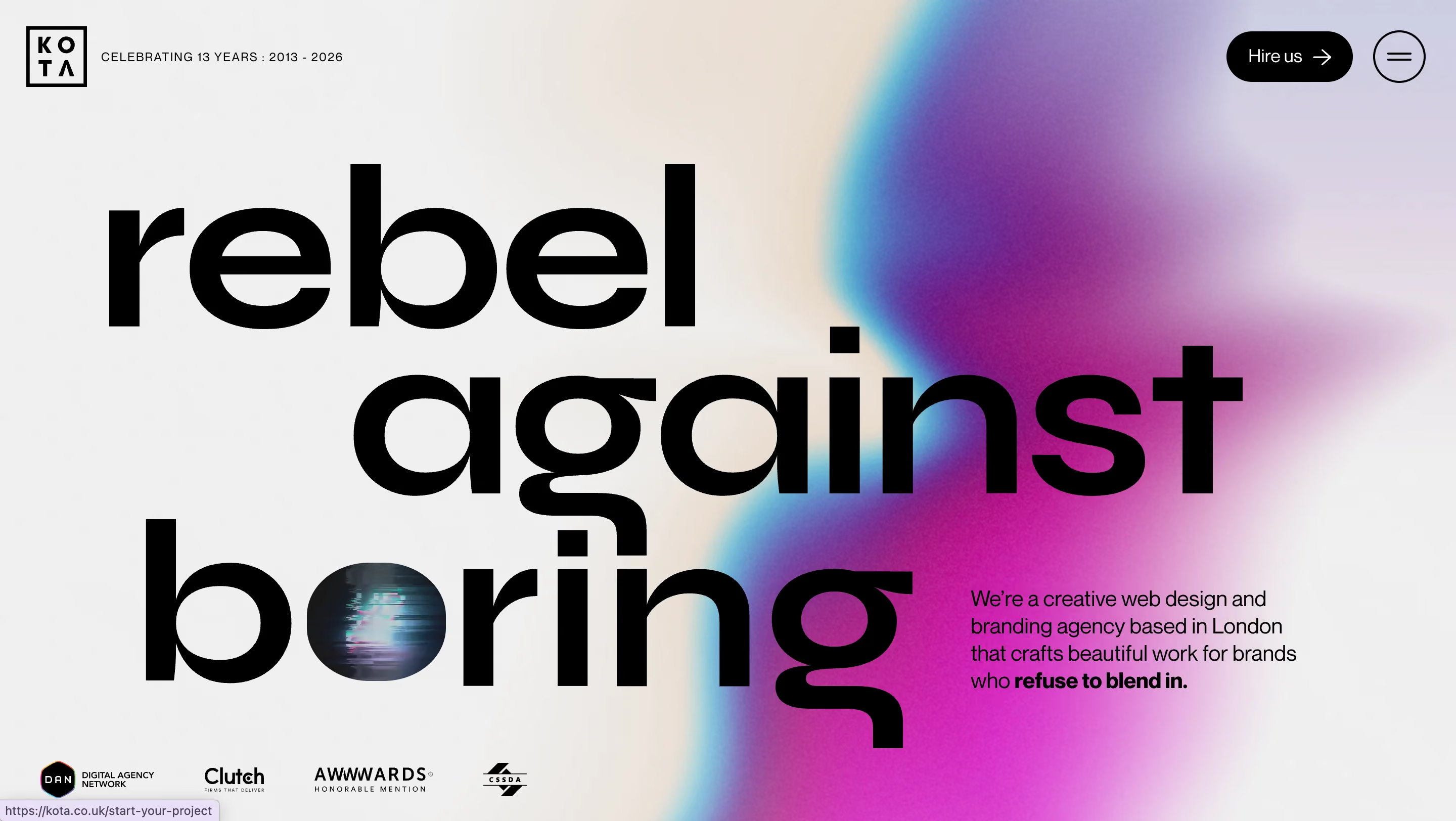
KOTA is a London-based agency known for bold, animation-driven Webflow websites. They specialize in helping brands stand out through motion design, interactive elements, and distinctive visual identity.
If your business is in a crowded market and you need a website that visually differentiates you from competitors, KOTA's approach is worth considering. Their portfolio leans toward creative, design-forward work rather than standard corporate sites.
Pros:
- Strong motion design and animation capabilities
- Webflow expertise means your site is manageable post-launch
- Creative, design-forward approach that helps brands stand out
Cons:
- Animation-heavy sites need careful performance optimization to avoid slow load times
- Less focused on conversion optimization compared to more strategy-driven agencies
9. EL Passion (best for product design and web app development)
EL Passion is a Warsaw-based agency with over 13 years of experience and 400+ completed projects across 30+ markets. They specialize in product design and development for both web and mobile applications, with clients including EY, Polaroid, and Varner.
For small businesses that need more than a marketing website, such as a web application, customer portal, or internal tool alongside their public site, EL Passion brings both design and development expertise to the table.
Pros:
- 13+ years of experience across a wide range of industries
- Capable of handling both marketing websites and product/app development
- Strong technical team alongside the design practice
Cons:
- Product-focused approach means they may be more than you need if all you want is a simple marketing site
- Pricing reflects the full-service, development-inclusive scope
10. Afternow (best for B2B branding and web design)
Afternow, previously known as BB Agency is a Sarajevo-based design and branding agency that focuses on B2B companies. They offer web design, branding, UI/UX, and digital strategy, with a strong emphasis on aligning visual design with business goals.
For B2B small businesses that need their website to support a sales process, not just look good, BB Agency's strategic approach is a good fit. They think through the buyer journey and design for conversion, not just aesthetics.
Pros:
- B2B specialization means they understand business buyer psychology
- Combines branding and web design into a unified process
- Competitive pricing relative to UK and Western European agencies
Cons:
- Smaller agency, so capacity for very large or very urgent projects may be limited
- Less known outside the B2B design space

What is a DIY website builder? When do you need one?
If you've searched for website design services, you've probably also seen recommendations for platforms like Wix, Squarespace, Shopify, and Webflow. These are website builders, and they serve a different purpose than the agencies and services listed above.
Website builders make sense when you have a tight budget (under $500), a relatively simple site with fewer than 10 pages, and enough time to learn the platform yourself. They typically cost between $15 and $50 per month, and platforms like Wix and Squarespace offer drag-and-drop editors that don't require coding knowledge.
Here's a quick rundown of the most popular options:
So when should you use a builder instead of a service?
A builder works best when you need a basic site quickly, your design requirements are simple, and you're comfortable doing the work yourself. But builders give you a template, not a strategy. You won't get a discovery process, competitive research, custom UI/UX tailored to your conversion goals, or ongoing design support. If your website is a core part of how your business generates leads or revenue, investing in a professional service almost always delivers better results.
Before you choose a platform or a service, also think about what happens if you want to switch later. Some website builders like Wix and Squarespace are closed platforms, which means your site's design and content can't be easily exported to another system. If you decide to move, you're essentially starting over. Open platforms like WordPress and Webflow give you more control over your code and content, which makes migration possible (though never painless).
This is especially important because the platform choice you make now could cost you thousands of dollars in rebuilding costs two or three years from now if your needs outgrow what the platform can do.

How much does website design cost for a small business?
Whether you're searching for affordable web design for small business or comparing small business web design packages, this is one of the most common questions in this space, and for good reason. Pricing in web design is all over the place, and most guides give vague ranges that don't help you make a real decision. Let's break it down clearly.
DIY builders ($0 to $50 per month)
At this tier, you're using a platform like Wix, Squarespace, or Shopify to build the site yourself. Monthly costs range from free (with platform branding and limitations) to about $50 for premium plans with custom domains and e-commerce features.
But the sticker price doesn't tell the whole story. You'll likely spend money on premium templates ($50 to $200), third-party plugins or apps ($10 to $50 per month each), stock photography, and possibly a freelancer for logo design or copywriting. The real cost of a DIY site is usually $500 to $2,000 when you factor in everything, plus your own time.
Freelance designers ($500 to $5,000 per project)
Hiring a freelance web designer typically costs between $500 for a basic template customization and $5,000 for a custom-designed site with 5 to 10 pages. This makes freelancers one of the most accessible options if you're looking for inexpensive website design for your small business without sacrificing custom work. Freelancers can offer great value, especially for simple projects with clear scope.
The risk with freelancers is what the industry calls the "handoff cliff." Your freelancer finishes the project, moves on to another client, and your site sits frozen. If something breaks, if you need updates, or if you want to add new pages six months later, you're often starting from scratch with someone new. Before hiring a freelancer, ask specifically about post-launch support and what happens if you need changes after the project ends.
Design subscriptions ($1,000 to $5,000 per month)
This is a newer model that's growing in popularity, and it works differently from both freelancers and traditional agencies. With a design subscription, you pay a fixed monthly fee and get access to a dedicated design team for ongoing work. You submit requests, receive completed designs within a set turnaround time, and can request revisions until you're happy.
magier's subscription, for example, starts at €2,750 per month and includes graphic design, Webflow development, unlimited revisions, and a 48-hour turnaround per task. The advantage of this model is cost predictability and speed. The disadvantage is that it's only cost-effective if you have enough ongoing design work to justify a monthly commitment.
Full-service agencies ($5,000 to $50,000+ per project)
At the agency tier, you're getting a full discovery process, custom design concepts, professional development, SEO foundations, and (ideally) post-launch support. According to Google's AI Overview, typical agency builds range from a few thousand dollars on the low end to $50,000 or more for complex sites, and they take 6 to 8 weeks on average.
The advantage of agencies is depth. You get a team of specialists working on your project, which usually produces a higher-quality result than a solo freelancer. The disadvantage is cost and timelines. Agency projects often run over budget and over schedule, especially if the scope isn't clearly defined upfront.
Post-launch costs
One thing most guides don't mention is the cost of maintaining your website after it launches. Expect to budget $50 to $200 per month for hosting, security updates, plugin maintenance, and minor content changes if you're on WordPress. Webflow hosting runs $14 to $39 per month with security and updates handled by the platform. If you need ongoing design changes, bug fixes, or new pages, a maintenance retainer with your agency or a design subscription will cost more, but it prevents the slow decay that turns a great new site into an outdated one within a year. The businesses that get the most value from their websites treat them as living assets, not finished projects.
Cost comparison summary
How to choose the right website design service
With so many options available, the choosing process itself can feel overwhelming. Here's a practical framework to narrow it down.
Start with your budget and timeline
Your budget is the single strongest filter. If you have less than $1,000, a DIY builder is your best option. Between $1,000 and $5,000, you're in freelancer or low-end agency territory. Between $2,000 and $5,000 per month, a design subscription like magier can deliver ongoing value. Above $5,000 for a one-time project, you can work with most agencies on this list.
Your timeline matters too. If you need a site in two weeks, a builder or a subscription service with fast turnaround is realistic. If you need a custom agency build, plan for 6 to 12 weeks minimum.
Define what you actually need
Not every business needs a 20-page custom website. Be honest about what your site needs to accomplish:
- A simple brochure site (5 to 7 pages, no e-commerce) is the most common small business need. A freelancer, builder, or subscription service can handle this well.
- An e-commerce store needs a platform like Shopify or WooCommerce and ideally a designer who understands product pages, checkout optimization, and inventory management.
- A lead-generation site for B2B or service businesses needs conversion-focused design, clear CTAs, and landing pages optimized for your specific audience. This is where agencies and subscription services add the most value.
- A web application or complex platform needs both design and development expertise. Agencies like EL Passion or Phenomenon Studio are built for this kind of work.
Questions to ask before you hire
Before signing with any service, ask these questions. The answers will tell you a lot about whether they're the right fit:
- Who owns the design files and code after the project? You should own everything. If the agency retains ownership, you're locked in.
- What's included in the quoted price, and what costs extra? Ask about revisions, stock photography, copywriting, SEO setup, and hosting.
- What CMS or platform will the site run on? Make sure it's a platform your team can manage, or that ongoing support is available.
- What does the revision process look like? How many rounds are included? What happens if you're not happy with the initial concepts?
- Can you show me recent work for businesses similar to mine? A portfolio of enterprise clients doesn't tell you whether an agency can serve a small business well.
- What happens after launch? Ask about maintenance, updates, bug fixes, and ongoing support. This is where many relationships break down.
- What's the typical timeline from kickoff to launch? Get specific dates, not vague estimates.
- How do you handle communication during the project? Ask about check-in frequency, feedback tools, and who your main point of contact will be.
Red flags to watch for
If you encounter any of these during your evaluation, proceed with caution:
- No portfolio or only outdated work. If an agency can't show you what they've built recently, that's a problem.
- Vague or hidden pricing. If they won't give you a ballpark range before a discovery call, they may not be a good fit for a small business budget.
- No contract or scope document. Every engagement should have a written agreement that defines deliverables, timelines, and payment terms.
- Guaranteed search rankings. No legitimate agency can guarantee you'll rank #1 on Google. If someone promises this, they either don't understand SEO or they're being dishonest.
- All stock photography in their portfolio. If every project looks generic, the design work probably is too.
- No post-launch support plan. If the agency's involvement ends at launch, you'll be on your own when something needs updating.
- Pressure to sign quickly. A good agency won't rush you into a decision. If they're creating urgency, ask yourself why.
Why your website design needs to focus on conversions, not just looks
Here's something most "best web design" articles don't talk about. A beautiful website that doesn't convert visitors into customers is a very expensive decoration. And let's be honest, most small business websites fall into this trap.
Conversion-focused design means every element on your site has a purpose. The layout guides visitors toward a specific action, whether that's filling out a contact form, booking a demo, or making a purchase. It's the difference between a site that gets compliments and a site that gets results.
A few numbers that explain why this matters:
- 40% of users abandon a website that takes more than three seconds to load. Your site's speed is a design decision, not just a technical one, because heavy animations, unoptimized images, and bloated code all slow things down.
- 58.67% of small business traffic comes from mobile devices, and mobile-optimized sites see a 5% higher conversion rate on average. If your site looks great on desktop but breaks on mobile, you're losing more than half your visitors.
- 74% of people are likely to return to a site that works well on mobile. That repeat traffic compounds over time.
So how do you tell if your designer thinks about conversions? Ask them about Core Web Vitals and Google PageSpeed Insights. Ask them how they structure a landing page for lead generation. Ask them where they'd place a CTA and why. If they can only talk about colors and typography but not about user behavior and conversion paths, they're designing for looks, not for results.
This is where working with a service that understands both design and business goals becomes important. Agencies like Rudo and BB Agency approach design from a B2B conversion perspective. Subscription services like magier bring conversion thinking into every landing page and website they build. The best investment is a site that looks great and generates revenue.
"When a client tells me their site 'looks fine but doesn't bring in leads,' the problem is almost never the visual design. It's the structure. The page doesn't guide visitors toward a decision. That's a strategy problem, not a design problem."

What to prepare before you hire a website designer
Walking into a web design project without preparation is like hiring a contractor to renovate your kitchen without deciding what you want. It wastes time, increases costs, and leads to results that don't match your expectations.
Here's what to have ready before you start talking to designers or agencies:
Your goals for the website
Be specific. "I want a better website" is not a goal. "I want a site that generates 20 qualified leads per month" or "I want an online store that sells our products to customers in Germany and the UK" gives your designer something to build toward.
Examples of websites you like (and why)
Collect 3 to 5 URLs of sites you admire and write one sentence about what you like about each. Is it the layout? The color scheme? How easy it is to navigate? This gives your designer a visual starting point that's much more useful than abstract descriptions.
Your brand assets
This includes your logo (in vector format if possible), brand colors, fonts, and any brand guidelines you have. If you don't have these yet, mention that upfront so the agency can include brand development in the scope.
Your content
Website projects stall most often because the content isn't ready. If you have existing copy, product descriptions, team bios, or case studies, gather them before kickoff. If you need help writing content, ask whether the agency includes copywriting or if you need to hire a writer separately.
Your technical requirements
Do you need e-commerce? A blog? Contact forms? Integration with a CRM like HubSpot or Salesforce? Multilingual support? List everything your site needs to do so there are no surprises mid-project.
Your budget range
You don't need to share your exact number, but giving your designer a range helps them scope the project realistically. A $3,000 budget gets a very different site than a $30,000 budget, and a good agency will be honest about what's possible at your price point.
Can AI tools replace a web designer in 2026?
This question shows up frequently in search results, and the honest answer is "partially, for some use cases."
AI-powered tools like Durable, UENI, Wix ADI, and Framer AI can generate a functional website in minutes. You provide some basic information about your business, and the tool produces a template-based site with placeholder content and a color scheme. For a solopreneur who needs a basic online presence and has no budget for professional design, these tools are a practical and helpful starting point.
But AI-generated sites have real limitations. They can't conduct a discovery process to understand your specific audience and goals. They can't create a custom visual identity that differentiates you from competitors. They can't optimize a page for conversions based on user behavior data. And they can't make strategic decisions about information architecture, which means how your content is organized and how visitors move through your site.
Hiring a motion designer to generate a basic AI website is like hiring a chef to reheat your leftovers. The tool works, but you're missing the expertise that actually creates value. AI is a good starting point for very simple needs, but it's not a replacement for professional design when your website is a core business tool. The same applies to motion assets: tools like invideo Agent’s free motion control AI can map movement from a clean reference video onto a character, but it still needs clear creative direction to fit the brand and website experience.
The most practical use of AI in web design right now is as an accelerator, not a replacement. Designers use AI to generate initial layout ideas, write first-draft copy, optimize images, and speed up repetitive tasks. Even when you're working with a professional service, AI can reduce the time and cost of the overall project.
Final thoughts
Your website is one of the highest-impact investments your small business can make. It works around the clock, represents your brand to every visitor, and directly influences whether people trust you enough to become customers.
But getting it right takes thought, and it takes finding the right partner. Whether you go with a DIY builder for a quick start, a freelancer for a scoped project, a subscription service like magier for ongoing design and Webflow development, or a full-service agency for a custom build, the key is matching the service to your actual needs and budget.
The best next step? Pick the section of this guide that's most relevant to your situation, whether that's the cost breakdown, the comparison table, or the questions to ask, and use it as your starting point. Good design is worth the investment, but only when it's the right investment for where your business is right now.
FAQ
Prepare your website goals, 3 to 5 examples of sites you like, your brand assets (logo, colors, fonts), your content (or a plan for creating it), a list of technical requirements, and a budget range. The more prepared you are, the faster and smoother the project will go.
Hire a freelancer if you have a simple, well-defined project with a clear scope and a budget under $5,000. Hire an agency if you need strategic depth, multiple specialists, post-launch support, or a complex site with custom functionality. Consider a design subscription if you need ongoing work with fast turnaround and predictable costs.
A DIY builder site can be ready in days. A freelancer project typically takes 2 to 6 weeks. An agency project usually takes 6 to 12 weeks. Subscription services like magier can deliver individual pages or design tasks within 48 hours, but a full website project still takes a few weeks of coordinated work.
A website builder like Wix or Squarespace gives you tools to create your own site using templates. An agency designs and builds a custom site for you based on your specific goals, audience, and brand. Builders are cheaper and faster but less customizable. Agencies are more expensive but deliver tailored results with strategic depth.
Your website is often the first interaction a potential customer has with your brand. Research shows that 75% of users judge a company's credibility based on website design, and 68% of online experiences begin with a search engine. A well-designed website builds trust, generates leads, and supports revenue growth in ways that other marketing channels can't replicate on their own.
Start with your budget and timeline, then define what your site needs to accomplish. Look for services with relevant portfolio work, transparent pricing, verified client reviews on platforms like Clutch or Trustpilot, and clear post-launch support plans. Use the questions and red flags sections in this guide to evaluate your options.
ChatGPT and similar AI tools can generate website code, suggest layouts, and write copy, but they can't replace a professional designer for anything beyond basic sites. AI lacks the ability to conduct user research, make strategic design decisions, or optimize for conversions based on your specific business context.
It depends on your needs. Wix is the easiest to use for beginners, Squarespace offers the best-looking templates, Shopify is the strongest for e-commerce, and Webflow gives you the most design flexibility. For most small businesses that want a simple site quickly, Squarespace or Wix is the best starting point.
Costs range from $500 to $5,000 for a freelancer, $1,000 to $5,000 per month for a design subscription, and $5,000 to $50,000+ for a full-service agency. The right budget depends on your site's complexity, your business goals, and whether you need ongoing support after launch.
.avif)

.webp)