What Is Brand Architecture? A Complete Guide for SaaS Brands
Brand architecture for SaaS is a set of rules that decides which SaaS products, features, and modules get their own name and which ones live under your company brand.
Without these guidelines, your prospect might land on your pricing page, get overwhelmed by seeing multiple product names, and eventually leave without knowing which one solves their problem.
A clear structure also keeps your brand consistent across every product, and consistency has a measurable upside. According to Lucidpress's 2019 State of Brand Consistency press release, surveyed organizations estimated that consistent brand presentation could lift revenue by up to 33%, although that is a survey estimate and not a measured result. Most teams respond by picking one of four brand models, yet a quick customer check can tell you in minutes whether your current structure already confuses buyers.
In the last couple of years, our team has built brand identities and design systems for 150+ brands, and we've had a front-row seat to several mergers and diversification projects. From that experience, we have written this guide:
- What brand architecture is, and how it differs from brand strategy
- The four models, with SaaS examples
- Six examples to study
- A quick check for customer confusion
- A decision table for features, products, and new brands
- How the right structure changes by funding stage
- How it shows up in your website, pricing, and design system
- Options for acquired products, and mistakes to avoid
There aren’t many resources on this topic on the internet, yet SaaS founders and marketers need it more than anything. Give this a read!
{{freebie}}
What is brand architecture?
Brand architecture is the structure that defines how a company's brands, sub-brands, products, and services relate to one another. It sets the hierarchy, the naming rules, and the visual and messaging rules across a portfolio, so customers and teams can see how each offering fits. You may also see it called brand hierarchy, branding architecture, or portfolio architecture, and the terms are close enough to use interchangeably.
Three related terms get mixed up with it, so here is how they differ:
Architecture decides the relationships, and identity decides how each of those brands looks. If you choose a model where products share one master brand, your visual identity usually shares one logo family and design language as well.
You will also meet three terms that describe what architecture can protect or damage:
- Brand equity: The value a brand earns through recognition, trust, and associations.
- Brand dilution: What happens when a brand stretches across so many unrelated categories that its meaning blurs.
- Brand sprawl: The uncontrolled buildup of product names and logos that nobody planned together.

Brand architecture vs product architecture
Search results sometimes mix up brand architecture with technical SaaS architecture, so the table below separates the two. Product architecture describes how the software itself is built, while brand architecture describes how customers see those pieces.
Five modules can share one codebase and still look like five products or one product, depending on the brand decisions you make.
Some technical articles also use "multi-brand SaaS architecture" for one codebase that serves several branded customers. That is a different topic, and this guide only covers the branding meaning.

Why SaaS companies need brand architecture
Picture your navigation menu with six product names, three module names, and a feature that sounds like a product. A visitor has to decode your org chart before they can find the tool that solves their problem. That's where brand architecture comes in, because it gives every name a place and every product a clear relationship to the others, which becomes essential for multi-product SaaS companies.
SaaS companies carry two surfaces, the marketing site and the product itself, and both have to tell the same story. A tidy website that points to dashboards with different logos, menus, and colors leaves customers wondering whether they bought from one company or three. This often happens after an acquisition, when the new product keeps its old look inside the app.
Structure also affects money. Products that share a master brand can borrow awareness and trust from it, while products with separate brands pay to build both again. The same sharing works in reverse, since a security incident or a poor release in one product can hurt the others under the same name, and the signals section later covers how to track the effect.
The four brand architecture models
Most guides describe four models, and almost every SaaS company ends up using one or a blend of them. The language comes from the brand relationship spectrum that David Aaker and Erich Joachimsthaler published in the California Management Review in 2000, which names four strategies: house of brands, endorsed brands, sub-brands, and branded house. Many modern guides replace sub-brands with a hybrid category, and this guide follows that version because it fits how SaaS companies grow.
Branded house
In a branded house, one master brand covers every product, and products borrow the parent's name, reputation, and visual identity. Apple is the example most guides use, since the iPhone, iPad, and Mac all reinforce the Apple name, although some analyses describe Apple as a blend of models. FedEx is another common example, with its express, freight, and other divisions sharing the master brand. In SaaS, Gong follows a similar logic by pairing its name with each product's job, as the examples below show.
Best for: Products that share an audience and solve related problems.
Main risk: A problem with one product can affect the rest.
Example: Hubspot

House of brands
In a house of brands, the parent owns several independent brands with their own names, identities, audiences, and marketing. Procter & Gamble is the classic case, with brands like Tide and Pampers that many shoppers don't link to the parent, and Unilever keeps Dove, Knorr, Hellmann's, and Magnum distinct in the same way. Fortune reported in 2014 that P&G planned to shed up to 100 brands and focus on 70 to 80 that produced about 90% of its sales and 95% of its profit, which shows how costly a large portfolio is to run. You can read the original Fortune report for the details.
Best for: Large companies with unrelated markets and audiences.
Main risk: Each brand needs its own awareness and marketing budget. In SaaS this model is rare, and companies often reach it after acquisitions.
Example: Bending Spoons

Endorsed brands
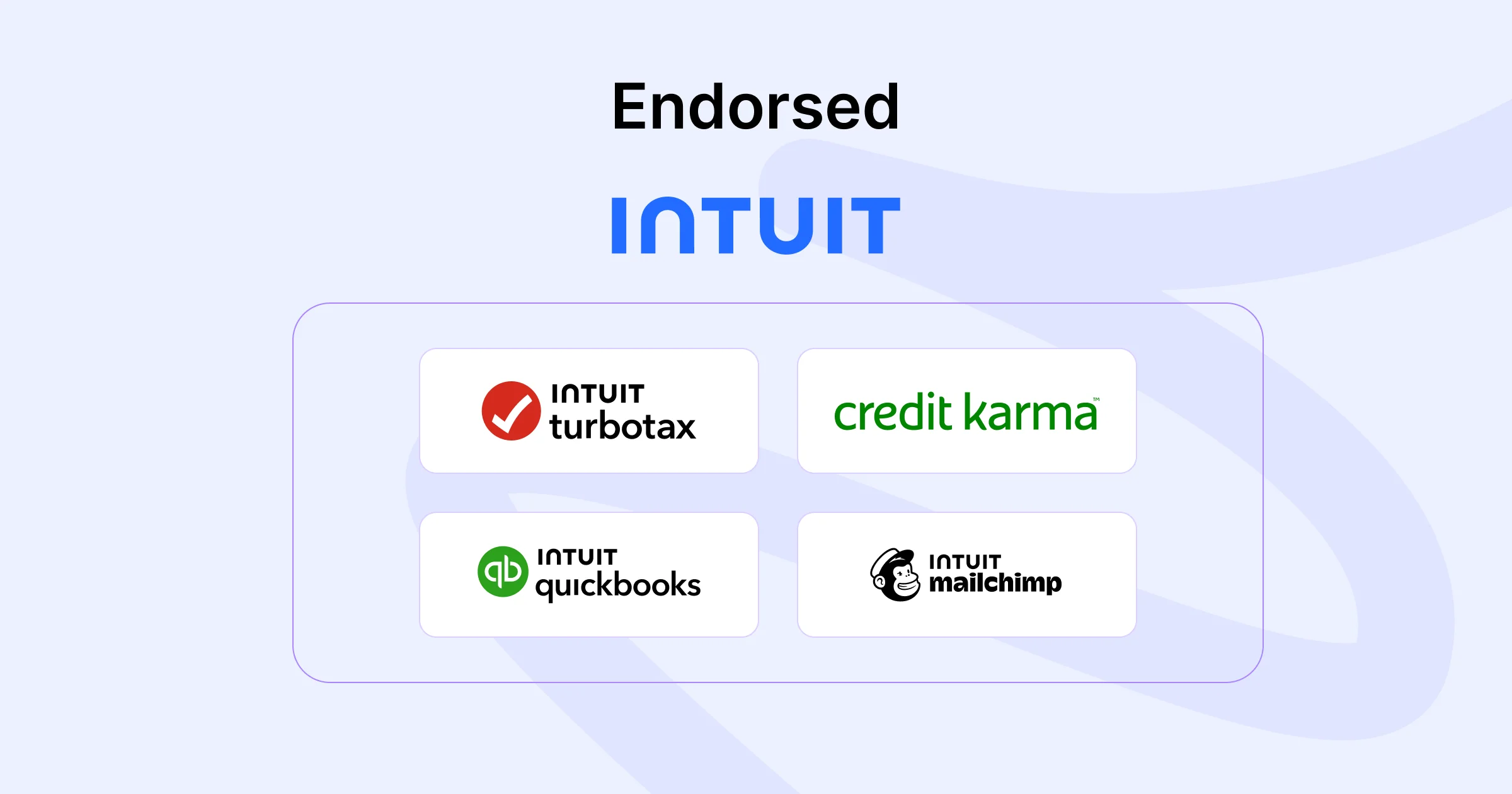
Endorsed brands keep their own names and identities while the parent visibly backs them, so the parent acts as a trust signal. Courtyard by Marriott is the example Aaker and Joachimsthaler place in their endorsed category. In software, it shows up when a company keeps an acquired product's name and adds "by Parent" during the transition.
Best for: Acquired products with strong recognition, or products for a new customer group.
Main risk: The parent's reputation transfers to the product, and the product's reputation transfers back.
Example: Intuit
Hybrid architecture
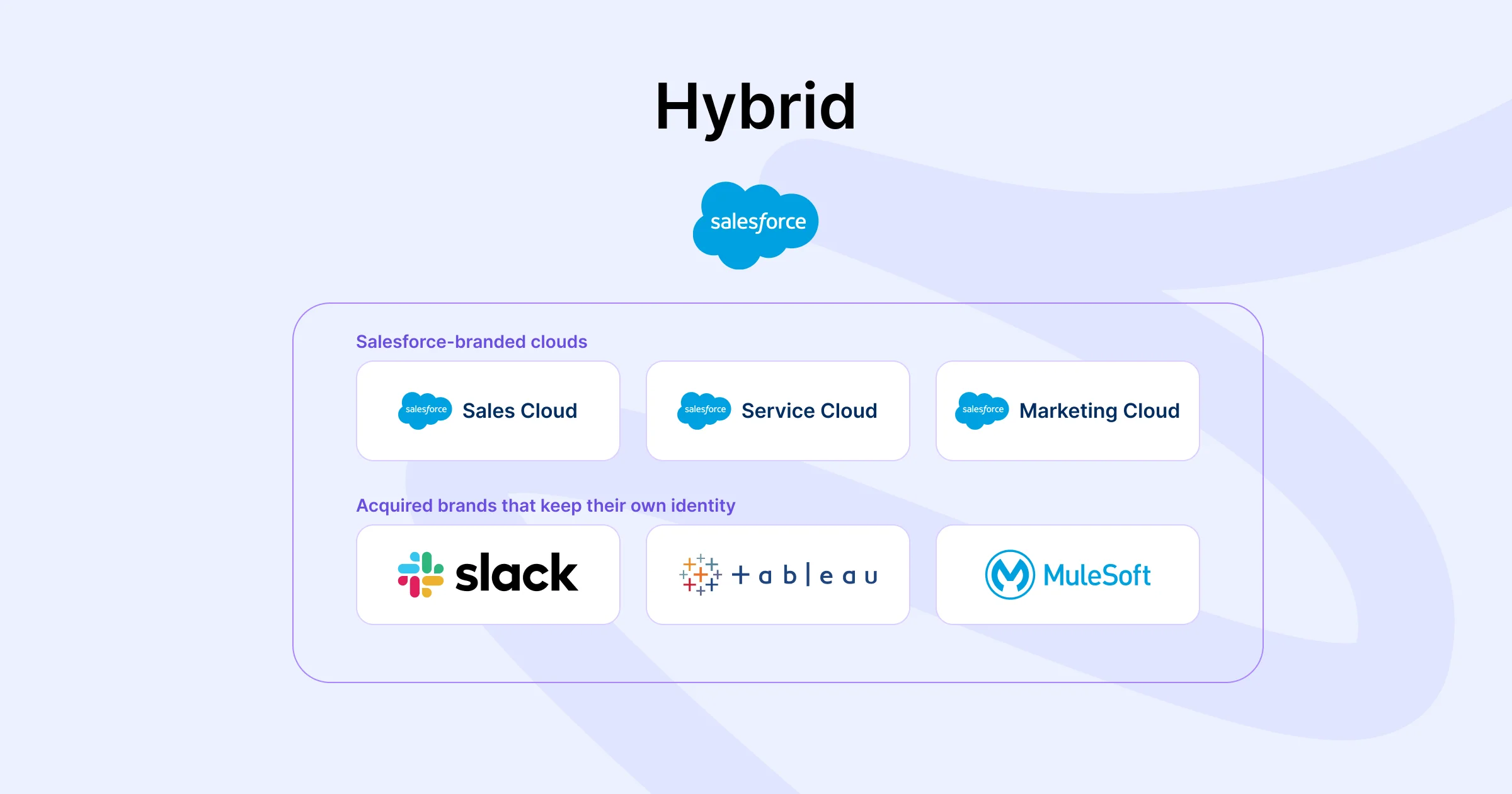
A hybrid architecture mixes the other models, applying different rules to different parts of the portfolio. Amazon and Alphabet are common examples, because some of their businesses share the parent name while others keep their own. Most growing SaaS companies end up here, and the Dropbox example below shows why.
Best for: Portfolios with acquisitions and several customer groups.
Main risk: Confusion when the rules for each product aren't written down.
Example: Salesforce
The first table below shows how each model is built, from the naming style to the website structure. Read it as a quick answer to what each choice looks like in practice.
Structure is only half the decision, because each model also carries a different cost and risk. The branded house and the house of brands sit at opposite ends, with the endorsed and hybrid models in between. The second table shows where each model fits best and what it asks of your team.
Most SaaS companies end up in the middle of these options and blend them over time. That is why the examples below describe each company's choices and not a single label.
Brand architecture examples to study
These six examples show different decisions, from naming products to renaming the whole company. Gong, Legora, and Dropbox lean toward a branded house, Intuit toward endorsed brands, Salesforce toward a hybrid, and Bending Spoons toward a house of brands. Sources disagree about how to label many companies, and even Apple is described as a branded house in some guides and as a blend in others. Software names such as Atlassian and HubSpot also land in different models depending on the source, so treat the labels below as a way to describe each company's choices and not as strict categories.
Gong: one master brand, products named by job
Gong sells a revenue platform and names its add-on products with its own name plus the job each one does. Its product pages list Gong Engage for sales engagement, Gong Forecast for forecasting and pipeline analytics, and Gong Enable for coaching. A buyer who knows the Gong name can guess what each product does without a sales call.
Closest model: Branded house.
What to learn: A simple naming rule is easier to remember than clever product names, and it makes the next product easy to introduce. Gong said in a 2026 announcement that 50% of its customers run multiple products on the platform, though that is a company claim and not independent data.
Legora: one brand, plain feature names, and a rename
Legal AI platform Leya rebranded as Legora in February 2025, alongside new product features, as the company's press release describes. Its CEO said the company's expansion called for a brand that matched its ambition and its clients' sophistication. Underneath the new name, the platform uses plain feature names such as Assistant, Tabular Review, the Word Add-in, and Workflows and not separate product brands.
Closest model: Branded house, in its simplest form.
What to learn: Fix the master brand first, then keep the names underneath simple. Renaming later means updating domains, pages, and customer habits, so Legora also secured the legora.com domain as part of the change.
Dropbox: moving acquisitions under the master brand in stages
Dropbox acquired HelloSign in 2019 and renamed it Dropbox Sign in 2022, and HelloFax and HelloWorks became Dropbox Fax and Dropbox Forms. Dropbox described the change as part of its vision to build one place for all of a customer's content, and you can read the rebrand FAQ for the details. Dropbox's October 2022 launch materials still listed DocSend under its own name, but its help center now refers to the product as Dropbox DocSend, so the move under the master brand happened in stages.
Closest model: Branded house, reached through acquisitions.
What to learn: An acquisition does not have to move under the master brand all at once. Keeping a recognized name for a while and renaming later gives customers time to adjust, as long as you write down the end state.
Intuit: cornerstone brands with the parent name above them
Intuit calls TurboTax, Credit Karma, QuickBooks, and Mailchimp its cornerstone brands and shows them together in a shared logo lock-up. Its CEO told Fortune in 2023 that Intuit is investing in connecting the brands because it is not a house of brands, and TurboTax has become Intuit TurboTax. The brands keep their own names, while the parent name sits above them.
Closest model: Endorsed brands, moving toward a branded house.
What to learn: Endorsement is a stage you can move along, not a permanent label. Intuit's CEO said the company has data showing trust and consideration rise when customers understand the brands are connected, which is a company claim you should test with your own customers. You can read the Fortune interview for the full context.
Salesforce: named product families plus acquired brands
Salesforce pairs its own name with a function for its core products, such as Sales Cloud. Slack, Tableau, MuleSoft, Heroku, and Informatica appear in its product menu under their own names. The result is a portfolio with more than one naming rule, which you can see on its products page.
Closest model: Hybrid.
What to learn: A hybrid works when each product has a clear reason for its name, and it needs regular upkeep. One product-list guide reports that Salesforce added an Agentforce prefix to most product names in late 2025 and largely removed it in September 2026, so confirm the current names on Salesforce's own pages before you rely on that detail.
Bending Spoons: independent brands under a quiet parent
Bending Spoons describes itself as acquiring digital products to own and operate for the long term, and its portfolio includes Evernote, Meetup, Remini, Splice, StreamYard, and WeTransfer, each under its own name. The parent has stayed remarkably under the radar even as it owns recognizable brands, so many users know the product without knowing who owns it. You can browse its portfolio to see the products listed individually.
Closest model: House of brands.
What to learn: This model works when each product has its own audience and the parent's job is to operate them well, not to share a name. It is rare in SaaS, and the cost is that every brand has to build its own awareness.
Now that you have seen the options in use, the next step is choosing one for your own portfolio, and one quick check does most of the work. That check takes about ten minutes and needs nothing more than a few product names.
How to choose a SaaS brand architecture
A model is only useful if you can pick one with confidence, so start with seven questions about your products, buyers, and brand.
Start with seven questions
Answer each question for your own portfolio and read across the table. A mix of answers usually points to a hybrid, which is fine as long as you write the rules down.
Aaker and Joachimsthaler suggest treating the branded house as the default and moving away from it only when specific questions point elsewhere. That fits a SaaS company with two related products for the same buyer, where one master brand with descriptive product names is usually the simplest choice.
Run the three-name check
Remember the quick check promised earlier? Pick any three of your product names, show them to a prospect or a new hire, and ask how the products relate. If they can't explain it without help, your structure is doing too little work and your sales team is doing the rest.
Run it with five people outside your company and write down where they hesitate. Hesitation points to a name that needs a clearer rule, a clearer descriptor, or a separate brand. SurveyMonkey advises validating the choice with customer research rather than internal assumptions, and this check is the smallest version of that.
Not every feature needs its own name tag
A new capability that helps the same users with the same job is usually a feature, and it does not need its own brand. Giving every feature a separate brand is like putting a name tag on every spoon in the drawer, because nobody can remember them all.
You might think a separate brand makes a product look more established, but each new name needs its own awareness, positioning, and trust. One SaaS glossary suggests a sub-brand when a product serves a fundamentally different buyer, such as finance teams instead of marketing teams. Use the table below to sort a new launch.
Set a simple naming hierarchy
A naming hierarchy gives every name a level, so a new launch has an obvious place to go. A simple version has four levels, which are company, product, module, and feature. Imagine a fictional company called Nexus that sells a CRM, an email tool, and an analytics product to B2B marketing teams. The company is Nexus, a product is Nexus Analytics, a module is Reports, and a feature is Scheduled exports.
Only the company and product levels carry the master brand, while modules and features use plain descriptive names. That keeps the number of brand names small, and it makes it easy to tell customers where a new capability belongs.
Brand architecture by company stage
The right structure changes as the company grows from a single product to a platform, and a setup that fits a seed-stage team can confuse customers at Series C. Let's be honest, most seed-stage teams should not spend a quarter on this yet, because with one product the company name and the product name are usually the same thing. The goal at that stage is to avoid decisions that are expensive to undo, such as separate names for every feature.
The table is practical guidance and not research findings, so adjust it to your market. If you sell one product and have no second launch planned, a clear company name and descriptive feature names are enough. Revisit the question when you plan a second product, enter a new market, or consider an acquisition.
How brand architecture shows up on your website, pricing, and product
A diagram in a brand guide does not change what customers see until it appears in your website, pricing, and product. So where should you look first?
Website and URL structure
For most SaaS companies, the simplest starting point is one domain with a page for each product. Running a separate website for every product is like renting three offices for one team, because each one needs maintenance and none of them shows how the products fit together. A simple structure looks like this:
company.com/
company.com/products/
company.com/products/crm/
company.com/products/analytics/
company.com/pricing/
You might think separate sites help search, but Google's John Mueller has said Google Search is fine with either subdomains or subdirectories, and he recommends choosing a setup you can keep for longer. Many SEOs still prefer subdirectories, so treat the choice as an operations decision first and give each product page one clear job so similar pages don't compete for the same searches.
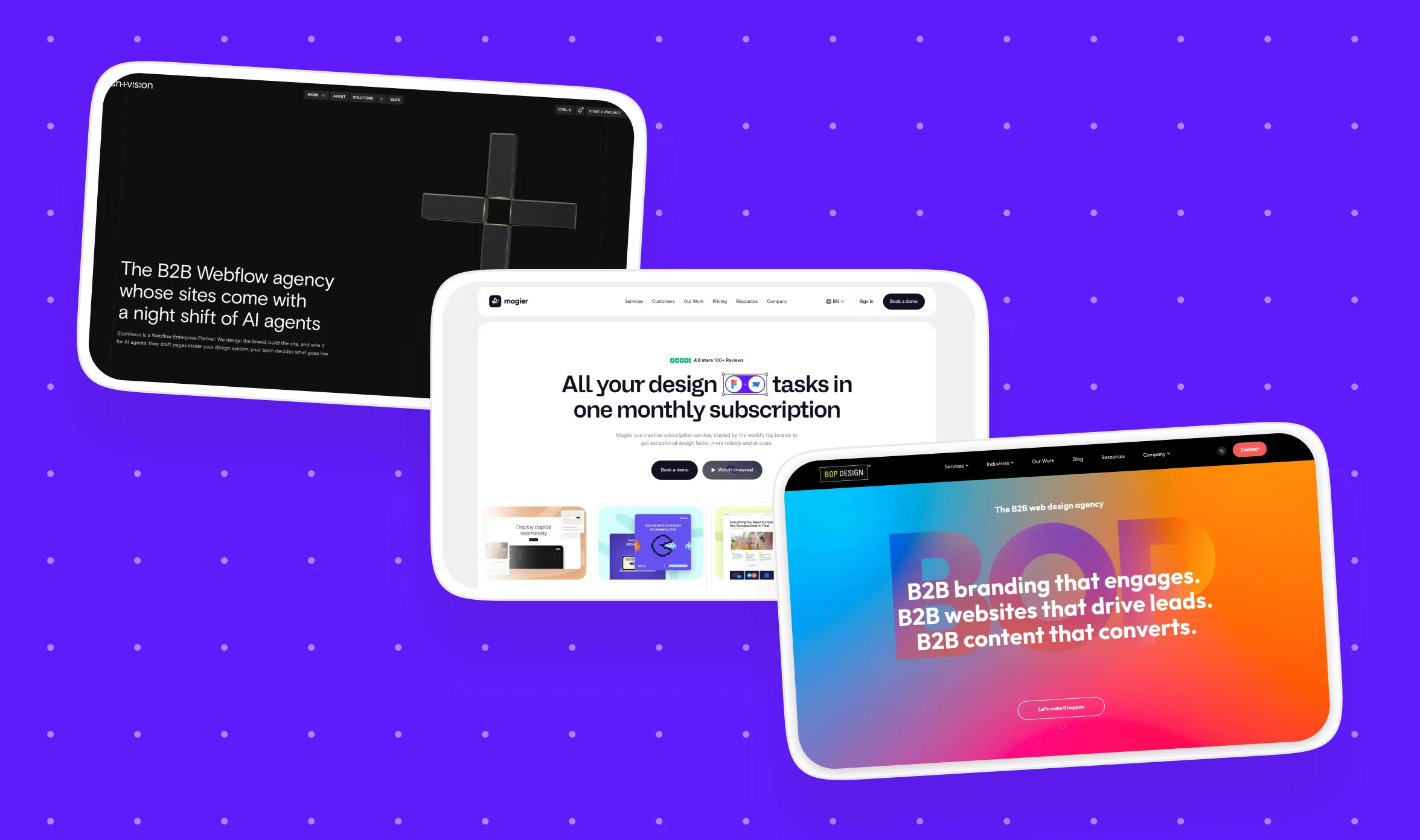
That's where a structured Webflow build helps, because CMS templates let you add a product page, keep the same navigation, and avoid rebuilding the site for every launch. You can see how magier approaches design and Webflow together if you want one team to handle both.
Navigation, pricing, and in-product discovery
Inkbot Design argues that SaaS brand architecture shows up mainly in pricing, product design, and navigation, and that customers often discover your next product inside the one they already use. If a second product is only visible to people who visit your homepage, your structure has no built-in way to introduce it.
So what should you check on your own product? Look at where a customer first sees the next product, how your plans group products, and whether the menu uses the same names as your website.
Design system and visual identity
A design system turns architecture rules into reusable parts, including logo lockups, color rules, type styles, and interface components. That's where a design system comes in, because it lets new launches look related without needing a fresh brand project each time. For product screens, design tokens, which are shared values for color, type, and spacing, keep the app and the website aligned.
Decide which elements every product shares, such as the logo family, typefaces, and base colors, and which can change, such as an accent color or an icon. The Weglot team did this for its first flagship event, Next Market Live. magier created a full visual identity that felt distinct yet stayed aligned with Weglot's core brand, built as a flexible system that scales across formats and future editions in other countries. You can read the Weglot case study, or check out magier's design services if you want help turning your rules into a system.
A design system is the cheapest way to enforce naming and visuals, because the rules live in the components and not in a PDF nobody opens."

{{cta}}
What to do with acquired products
Acquisitions create architecture decisions faster than any other event. Go back to Nexus, the fictional company from earlier, and imagine it acquires a support platform called HelloFlow. Nexus now has four options, and the Dropbox example above shows the same choice in practice.
Customers decide whether a name has value, so ask support and sales how often buyers mention the old name before you retire it. Marketing, product, sales, customer success, and leadership should agree on the choice, because each group feels the change differently. Leaving an old product logo in a slide deck two years after a rename is a sure sign that nobody owned the decision.
How to build a brand architecture strategy in six steps
If you are starting from scratch, this process keeps the work in a sensible order:
- Audit your portfolio: List every product, module, feature, acquisition, domain, and name, so you can see what customers already see.
- Understand your audiences: Note which buyers each product serves and where they overlap, because overlap decides how much you can share.
- Define positioning: Decide whether each product needs its own market position or can borrow the company's.
- Choose a model: Use the seven questions and the three-name check to pick a branded house, house of brands, endorsed, or hybrid structure.
- Set naming and visual rules: Write down how logos, colors, type, and names work across products, so new launches follow the same rule.
- Document the rules and assign an owner: Put everything in brand guidelines, draw a simple brand architecture diagram, and name one person responsible, since unowned rules drift.
How to use visual identity to shape your brand architecture
Visual identity is where architecture becomes visible, because customers judge the relationship between products by what they see before they read a name. If two products look unrelated, buyers assume they come from different companies. If every product looks identical, buyers can't tell where one ends and the next begins. The table below shows what usually stays shared under each model and what to write down.
Whatever the model, define a shared core and a small flexible edge. The core is the logo family, base colors, typefaces, and layout rules that every product uses, while the edge is the short list of things a product team may change, such as an accent color or an icon. This keeps new launches fast, because the team picks from approved options instead of starting a new brand project.
If you are working through these decisions, magier helps growing SaaS teams turn architecture rules into a working identity and design system, then builds the website on Webflow so both stay in step. The design service runs on a fixed monthly fee with unlimited revisions, so you can adjust the system as your portfolio grows. Check out magier's design services to see what the team covers.
{{cta}}
Common brand architecture mistakes and how to fix them
Let's face it, most of these mistakes happen because each product team names things on its own. Use the table to spot the symptom and the fix.
How to tell whether your brand architecture is working
Brand architecture has no single KPI, so you need signals that show whether customers understand, find, and adopt your products. Set a baseline before you change anything, because a unified structure won't automatically improve every metric.
Choose a structure your customers can follow
Brand architecture comes down to one goal, which is making it easy for customers to understand what you sell and how the pieces fit together. The three-name check from earlier is the fastest way to see whether your current structure meets that goal.
Restructuring a portfolio takes cross-team work, because product, marketing, sales, and customer success all have a stake in the names. You might worry that a change will cost more than it returns, so start small by writing the naming rule and applying it to your next launch.
If you want help turning your structure into a website and design system, book a free demo with magier and we will walk you through how the design and Webflow subscription works. This week, show three of your product names to five people outside your company and write down where they hesitate.
FAQ
Brand architecture is the structure that defines how a company's brands, products, and sub-brands relate to one another. It covers the hierarchy, the naming, and the visual and messaging rules, so customers can see how everything fits. In SaaS, it covers the master brand, products, modules, and acquired tools.
The four types are branded house, house of brands, endorsed brands, and hybrid. A branded house shares one master brand, a house of brands runs independent brands, endorsed brands keep their own names with parent backing, and a hybrid mixes these rules. Aaker and Joachimsthaler's original spectrum names sub-brands as the fourth strategy instead of hybrid, and many modern guides replace it.
Apple is the example most guides use for a branded house, because products such as the iPhone, iPad, and Mac all reinforce the Apple name. Some analyses describe Apple as a blend of models, so it is best read as a leaning and not a strict category.
Brand architecture theory describes how companies structure their brands, and the best-known version is the brand relationship spectrum from David Aaker and Erich Joachimsthaler, published in the California Management Review in 2000. It runs from a branded house to a house of brands, with sub-brands and endorsed brands in between. The authors suggest treating the branded house as the default and moving away from it only when specific questions point elsewhere.
No model is best for every company. Some SaaS-focused sources recommend starting as a branded house for related products aimed at the same buyer, and different buyers, price tiers, or acquisitions can justify an endorsed or hybrid structure.
Create a sub-brand when a product serves a fundamentally different buyer or market, such as finance teams instead of marketing teams. If it serves the same buyer with a related job, name it under the master brand.
You can absorb it under the parent name, endorse it with "by Parent," keep it independent, or fold its features into an existing product. The choice depends on customer recognition and overlap, and Dropbox's rename of HelloSign to Dropbox Sign is one example.
Brand strategy defines why a brand exists, whom it serves, and how it competes. Brand architecture defines how several brands, products, and features are organized and related.