9 Best Designity Alternatives in 2026 (and Which One Fits Your Team)
If you've hit Designity's retainer floor and started wondering whether you're paying for a Creative Director layer you don't actually need, you're not the only one.
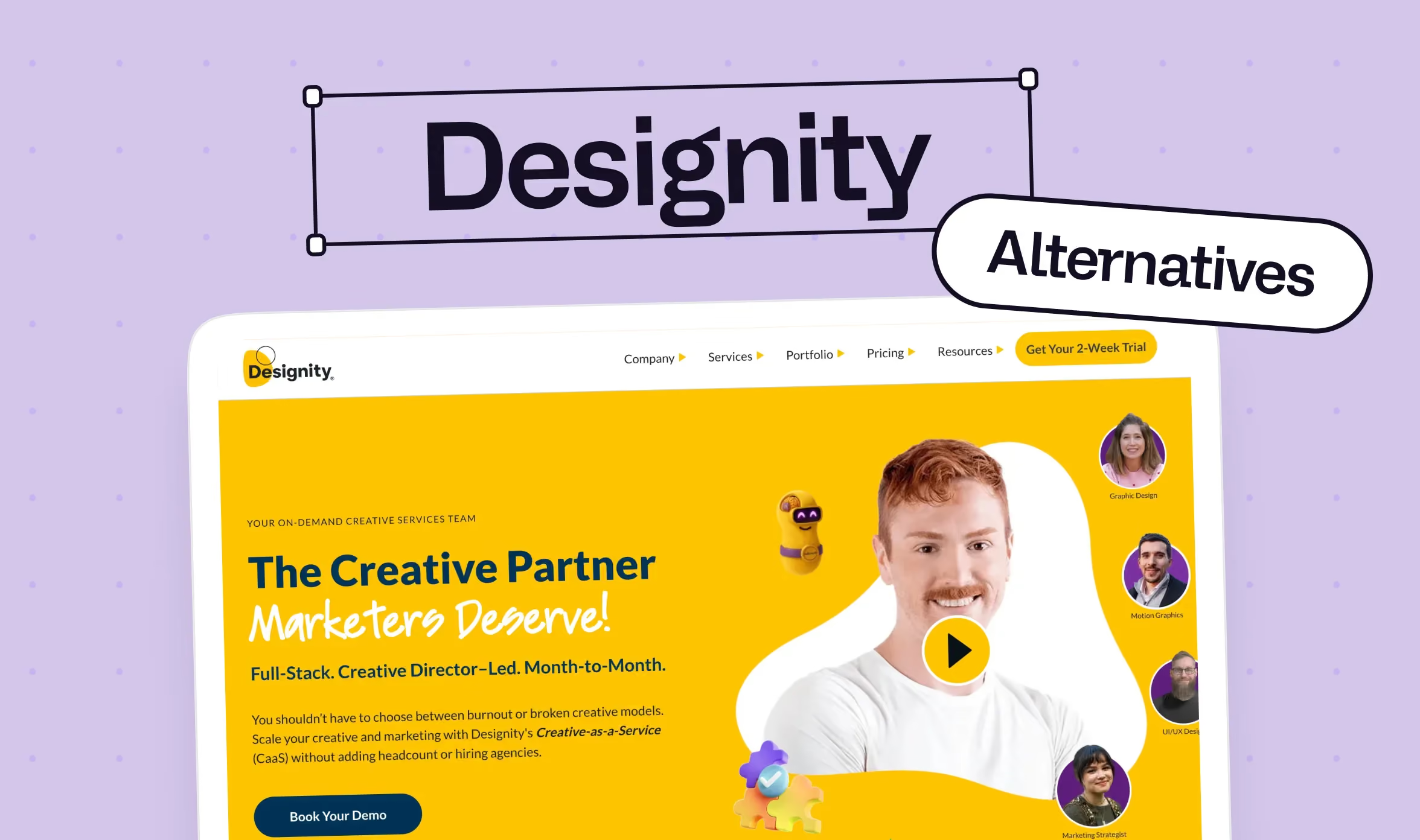
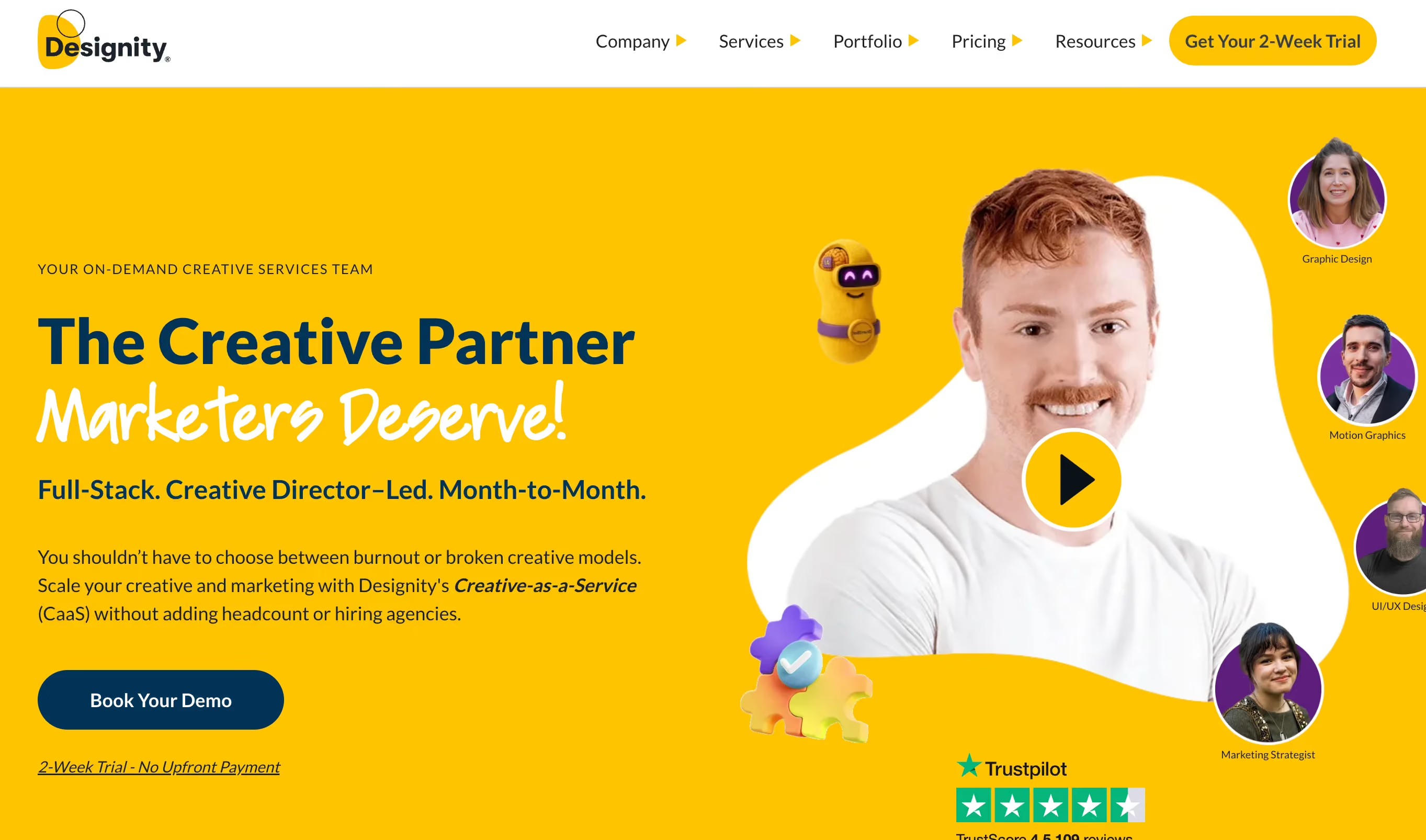
Designity is a creative-as-a-service subscription built around a Creative Director coordinating a matched roster of designers. It's a strong fit for a mid-market marketing team that wants that coordination layer, and a weaker fit for a smaller team that already owns creative direction internally, or one that needs design and Webflow development in the same subscription.
That coordination comes at a real price. Public pricing on Designity's own site runs roughly $3,799 to $6,000 or more per month depending on scope, a figure independently verified against Designity's site in mid-2026. If you've hit that retainer floor and started wondering whether you're paying for a layer you don't actually need, you're not the only one.
In this blog, we came up with the best Designity alternatives you could find out there and classified them based on your team requirements.
Here's what's covered:
- What factors we considered when coming with the list
- Each alternative broken down by services, pricing, and fit
- Why teams start looking for a Designity alternative in the first place
- What you'd actually be giving up if you left Designity
- A five-question framework for choosing between your final options
Quick comparison table
Every price above is checked against each vendor's own pricing page as of this writing. Vendors update pricing often, so confirm the current number directly before signing anything.
{{freebie}}
How we picked what to include
Before ranking anything, we set a few ground rules for what counted as a real alternative, since a lot of "alternatives" lists online end up comparing services that don't actually solve the same problem.
- It had to be a comparable service, not just a nearby category: Some competitor lists for this exact topic include PPC agencies, PR firms, and SaaS platforms alongside actual design subscriptions, which isn't a fair comparison for someone trying to replace Designity specifically. Every option on this list is a design-as-a-service subscription or a close variant of one.
- Pricing had to be checked against the vendor's own site, not pulled from a third party: Where a vendor publishes a rate, we used that number and noted when we checked it. Where pricing sits behind a consultation or a sales call, we said so directly instead of guessing at a figure.
- We looked at the hours model, not just the monthly price: A $1,500 plan with hours that expire at the end of the month isn't the same deal as a $1,500 plan with hours that roll over, so we noted whether capacity carries forward or resets.
- Team structure mattered as much as scope: A dedicated designer working on your brand every day is a different experience than a rotating pool, even if both plans list the same services. We noted which model each service uses, since that affects consistency more than the service list does.
- We included our own limitations, not just the competition's: Since magier is one of the options on this list, we held it to the same bar: real pricing model, real scope, and an honest look at who it isn't built for.
The best Designity alternatives in 2026
Flocksy

Flocksy pairs a dedicated designer, video editor, motion editor, and illustrator with a client, working through a shared queue rather than a rotating pool. It positions itself as the closest step-down from Designity without a drop in craft, and unused hours bank for 30 days instead of expiring.
Key services: graphic design, video editing, motion graphics, illustration, and copy support.
Best for: teams of 3 to 50 people that want senior, multi-disciplinary craft without paying for a Creative Director layer.
Price: $1,199/mo billed annually, $1,699/mo month-to-month.
Pros:
- Hours roll over for 30 days instead of resetting or expiring
- Covers design, video, motion, and copy in one plan, closer to Designity's scope than most budget options
- Time is tracked to the minute with a visible reports page, so there's no black-box billing
Cons:
- No dedicated Creative Director layer, which some teams genuinely need
- Doesn't include Webflow or web development
- Shared queue model means less senior-only bandwidth than a fully custom roster
Superside
Superside runs creative pods for enterprise marketing teams handling multi-market campaigns and committee-based approvals. It's built for scale and process, not for a lean team that just needs a few designs a month.
Key services: design, video, motion, web, and AI-assisted production at scale.
Best for: global enterprise brands with multi-market rollouts and formal procurement processes.
Price: $15,000/mo for the Flex tier, $30,000/mo for the Dedicated AI-Native Team tier, plus a $1,000/mo software fee.
Pros:
- Built to handle parallel workstreams across multiple markets at once
- Vets from the top 1% of global creative talent
- Backed by real funding and scale, having raised a $20M Series B in 2022
Cons:
- Price point puts it out of reach for small or mid-sized teams
- Retainer hours are consumed within the term, not banked
- Requires a formal sales process rather than transparent self-serve pricing

magier

magier is a subscription-based design-as-a-service that gives marketing teams access to expert graphic designers and Webflow developers for a fixed monthly fee, with a 48-hour turnaround per task and the flexibility to cancel monthly. Most design subscriptions cover graphic design and stop there, so if a team needs a landing page built in Webflow, a set of ad creatives for a B2B campaign, and a presentation deck in the same month, that usually means managing two or three separate vendors. magier handles all of that under one subscription, with the option to switch to one-time project pricing when a team doesn't need an ongoing plan.
The service was built specifically for Series A+ startups and scaleups with marketing teams of three to four people producing a high volume of content, ads, and landing pages without the bandwidth or budget for a full in-house design team. magier's clients have collectively raised over $7B in funding, and the roster includes companies like Weglot, sellerX, plancraft, aikido, upvest, and Choco.
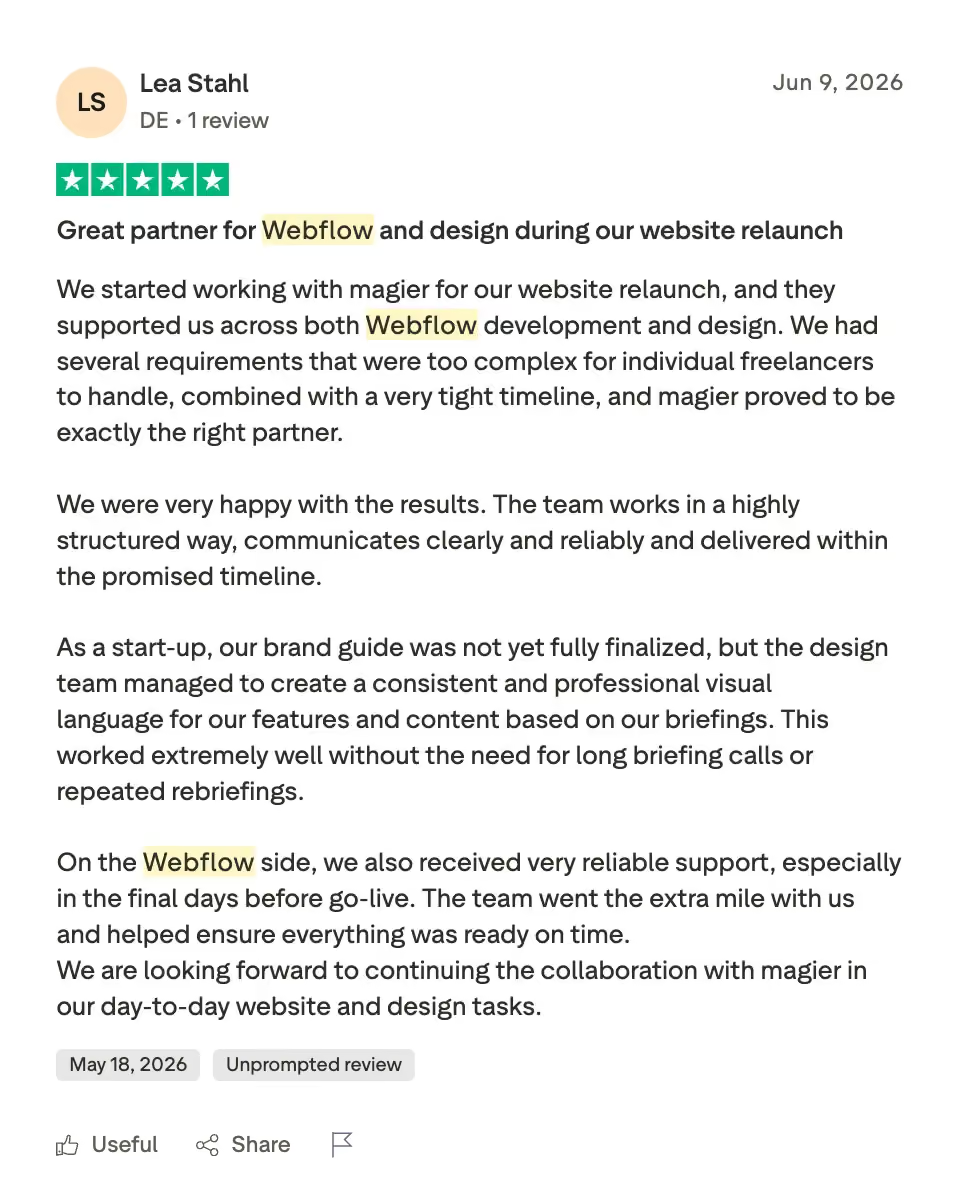
Two things set magier apart from Designity, the other queue-based subscription many teams compare it to. The first is quality assurance built into the workflow. Every design goes through QA before it reaches the client, which means fewer revision cycles and less back-and-forth than a queue system where one designer works through requests in sequence. magier instead assigns a team of specialists, so the right designer handles each type of task rather than one generalist covering everything from logo design to motion graphics.
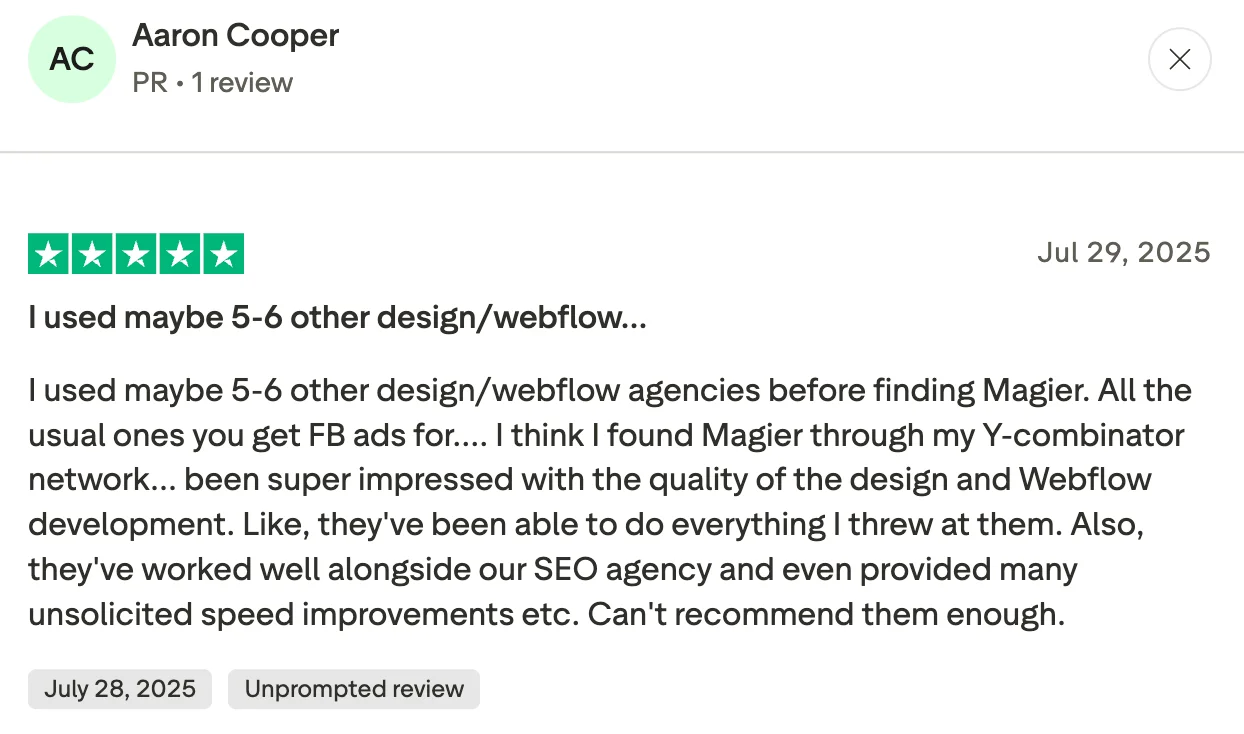
The second is Webflow development. An increasing number of SaaS companies run their marketing site on Webflow, and magier can handle the design and the development in the same subscription, which saves the coordination time of managing a separate designer and developer. Pricing is a fixed monthly subscription with no hourly tracking and no daily caps, so there's no surprise on the invoice the way there can be with hour-based plans. magier holds a 4.9 out of 5 rating on Trustpilot across 100+ reviews, has delivered over 1,000 SaaS ad creatives for B2B companies, and serves 150+ brands.
Key services: graphic design, ad creatives, and brand design; presentations and social media graphics; Webflow design and development; motion graphics and landing page design.
Best for: marketing teams at Series A+ startups and scaleups that need a scalable design partner, especially teams that also need Webflow development alongside graphic design and value built-in quality assurance over raw output volume.
Price: quote-based fixed monthly subscription, cancel anytime, no hourly tracking or daily caps. One-time project pricing also available.
Pros:
- Combines graphic design and Webflow development in a single subscription instead of two vendors
- Built-in QA process before delivery reduces revision cycles compared to a single-designer queue
- 4.9/5 Trustpilot rating across 100+ reviews, with $7B+ raised collectively by its client base
Cons:
- Built for ongoing partnerships with growth-stage companies, not ideal for a one-off request
- A solo founder looking for the cheapest possible option for basic social graphics may find a more budget-focused service a better fit
- Pricing isn't published publicly and requires a quote
{{cta}}
Penji
Penji is a budget-first graphic design subscription with a rotating designer pool and same-day delivery available on higher tiers. It's built for teams that mostly need static graphics rather than a full creative department.
Key services: graphic design, illustration, and basic UI/UX on higher tiers.
Best for: budget-conscious teams and founders who mostly need static social and marketing graphics.
Price: starts around $499/mo, with Team and Agency tiers up to roughly $1,995/mo.
Pros:
- Lowest published entry price on this list with real brand names in its client roster, including Nike
- Recruits from the top 2% of designers, a specific and published vetting standard
- Trusted by 4,000+ businesses, a meaningful volume of social proof
Cons:
- Designers rotate on lower tiers, which can affect style consistency over time
- Revisions can restart the turnaround clock on some tiers
- Scope stops well short of Webflow or full web development
Kimp
Kimp bundles graphics and video into one unlimited plan at a price closer to a graphics-only competitor. It runs on a team-and-pool model rather than a single dedicated designer.
Key services: graphic design and video editing in one plan.
Best for: small teams that want one plan covering social graphics, short-form video, and light motion work.
Price: roughly $698-$995/mo depending on tier.
Pros:
- Combines graphics and video in one subscription at a price most graphics-only plans charge alone
- Simple, predictable monthly pricing without hourly tracking
- Good fit for teams that need occasional video without a dedicated video editor
Cons:
- Pool-based team model means tone consistency takes more direction over a longer engagement
- No Webflow or web development scope
- Less senior-craft positioning than Designity, Superside, or magier
Designjoy
Designjoy is a solo productized design service run by one operator, offering one senior designer's consistent taste rather than a roster or team.
Key services: product and web design, with Webflow development available.
Best for: founders who want direct access to one senior designer without managing a team or roster.
Price: $4,995/mo, a single published tier.
Pros:
- One consistent point of contact and aesthetic across every request
- Includes Webflow development, a rare combination at this price point
- Simple, transparent single-tier pricing with no scope tiers to compare
Cons:
- No bench to swap to if the one operator's style or availability doesn't fit
- Only one active request at a time, which limits throughput for high-volume teams
- Price sits closer to Designjoy's own niche than to budget alternatives, despite being a solo operation
Design Pickle

Design Pickle is one of the longest-running names in the unlimited design category, with strong brand recognition and a well-developed workflow tool. Current pricing sits behind a consultation rather than a published rate card.
Key services: graphic design, illustration, and motion graphics.
Best for: teams that want the best-known brand in the category and don't mind a sales call to get pricing.
Price: quote-based; historically ranged from roughly $1,600 to $7,950/mo depending on daily hours, per third-party research, though current published pricing requires a consultation.
Pros:
- Longest track record and strongest brand recognition in the unlimited design category
- Mature, well-built workflow and request tooling
- Broad creative coverage across graphic design, illustration, and motion
Cons:
- Pricing now sits behind a consultation instead of being published upfront
- Base plans typically allow only one active request at a time
- Hours are use-it-or-lose-it, with no rollover
Draftss
Draftss is the closest direct comparison to magier on this list for a team that specifically needs design and Webflow development bundled together, though it comes at a different price point and team structure.
Key services: graphic design and Webflow or WordPress development.
Best for: budget-conscious teams that need basic web development support alongside design, without magier's built-in QA layer or specialist team structure.
Price: starts at $1,790/mo for the Full Team plan, which includes development, with smaller design-only tiers starting around $490/mo.
Pros:
- Bundles design and web development at a lower starting price than most comparable options
- Trusted by 1,200+ startups, brands, and agencies
- Offers a 7-day free trial to test the service before committing
Cons:
- Task-based model without the same specialist-per-task structure or QA layer magier uses
- Less established brand recognition than Design Pickle, Penji, or Superside
- Development scope is generally lighter than a dedicated Webflow-focused service
ManyPixels
ManyPixels is a graphics-first subscription with a queue-and-pool designer model, positioned as a lean, predictable option for startups and small marketing teams.
Key services: graphic design and light illustration, with a designated-designer option on higher tiers.
Best for: founders and small teams that want a predictable queue for social and marketing collateral.
Price: $549-$2,599/mo depending on tier.
Pros:
- Served 3,000+ clients and completed 125,000+ designs, a strong volume track record
- Tiered pricing lets a team start small and upgrade to a designated designer later
- Quarterly and annual billing discounts of 10% and 20% respectively
Cons:
- No rollover on unused capacity at lower tiers
- Scope beyond static design and light illustration is thin
- Same-day delivery and a designated designer require upgrading to a higher tier
Why teams look for a Designity alternative in the first place
The Creative Director layer that makes Designity attractive to some buyers is duplicated cost for others. If a founder or head of marketing already owns creative direction, paying for a coordinator on top of the designer roster adds a cost without adding much value.
Hours are also project-scoped rather than banked, meaning unused capacity inside a retainer term doesn't carry into the next one. A slow week is a lost week, and a team that isn't consistently at full capacity ends up paying for hours it never uses.
Finally, the monthly floor itself assumes a marketing-department level of spend. A 3 to 25 person team can pay the floor price every month and never come close to using the full scope it covers.
"Most of the teams that come to us from a bigger retainer already know exactly what they want, they just don't want to pay for someone to manage the conversation about it. That's usually the whole story behind the switch."

What you'd be giving up if you leave Designity
None of this makes Designity a bad service, and it's worth being upfront about what a switch actually costs. Designity recruits from the top 3% of US-based creatives, which is a real vetting standard most flat-rate competitors don't publish an equivalent for. The Creative Director model also means one person is accountable for coordinating your entire roster, rather than you managing several specialists directly.

Designity also offers a 2-week trial with no upfront payment, which lowers the risk of testing the service before committing to a full retainer. If your team genuinely needs that level of coordination and can use the full scope every month, Designity remains a reasonable choice, and this guide isn't built to talk you out of a fit that already works.
How to choose the right Designity alternative
- What is your real monthly floor? If your team can't consistently use $3,000 or more in creative output every month, this is a scope question before it's a shortlist question.
- Do you actually need a Creative Director layer? If a founder or head of marketing already owns creative direction, that coordination layer is often duplicated cost rather than added value.
- Do you want hours that bank, or a fixed subscription with no hourly tracking at all? Flocksy banks unused hours for 30 days, while services like magier skip hourly tracking entirely in favor of a flat monthly scope.
- Do you need a single dedicated team, or is a rotating pool acceptable? Dedicated-team models keep the same people on your brand every day, while pool models rotate and require more re-briefing.
- Does design and web development need to live in the same subscription? If your marketing site runs on Webflow, magier and Draftss are the two options on this list built to handle both without adding a second vendor.
Before you decide
Choosing a Designity alternative comes down to matching your actual monthly floor, your need for a Creative Director layer, and whether design and web development need to live in the same subscription, not just picking whichever name ranks first. Switching creative vendors still takes real transition time, even once you've picked the right fit.
If your team needs design and Webflow development in one place, check out magier's combined design and Webflow subscription. Run the five-question framework above against your top 2 or 3 picks from this list before committing to anything.
{{cta}}
FAQ
For a mid-market marketing team that wants a Creative Director layer coordinating design, copy, web, and motion inside one retainer, yes. For a founder or a smaller team that already owns creative direction, the retainer floor is usually more than the team can consume in a month.
Penji publishes the lowest entry price on this list at roughly $499/mo, though its scope is limited to static graphics. Flocksy is the lowest-priced option that still includes video, motion, and illustration in the same plan.
No. Designity's retainer hours are consumed within the retainer term rather than banking into the next month, and unused hours in a project scope don't carry forward.
magier and Draftss are the two options on this list that bundle graphic design with Webflow development in the same subscription. magier adds a built-in QA process and a specialist-per-task team structure, while Draftss starts at a lower price point with a lighter development scope.
magier is built specifically for Series A+ startups and scaleups with lean marketing teams, while ManyPixels and Penji suit even earlier-stage teams that mostly need static social and marketing graphics on a tighter budget.
.avif)

%202%20(1).webp)